What happened
- On October 23, 2026, Nature Physics published work by 16 authors from the University of Science and Technology of China (USTC) in Hefei.
- They encoded a logical qubit in several internal spin states of a single trapped ion and applied autonomous error correction, which beat the break-even point for qubit lifetime.
- The method transfers the entropy created by errors into the ion’s motional modes, which is then dissipated by sympathetic cooling with an ancilla ion. It needs no measurement or feedback.
- They saw the lifetime extension under ordinary lab conditions and also with injected low-frequency magnetic noise.
Why it matters
- Beating break-even means the protected qubit lasts longer than an unprotected one. It is the minimum proof that correction adds rather than subtracts.
- Conventional correction needs repeated measurements, real-time feedback or post-selection, and several physical qubits. Doing it inside a single ion cuts the hardware required.
- The authors propose it for robust quantum memories with lower overhead.
The number
1 ion. A single ion holds the logical qubit, with a second ancilla ion that cools it.
Context
Trapped ions have many internal energy levels. The work uses that multilevel structure as the space to encode information, instead of spreading it across several physical qubits.
What’s next
- The abstract reports the qubit’s lifetime extension; it reports no logical operations on it.
- No deadlines announced.
Bottom line
Quantinuum reached 5 errors per million operations on a logical qubit with up to 37 physical qubits. And a theoretical result set a quantum speed limit for reaching equilibrium.
Sources
- Nature Physics — Beating the break-even point with autonomous quantum error correction (DOI 10.1038/s41567-026-03486-y; October 23, 2026)
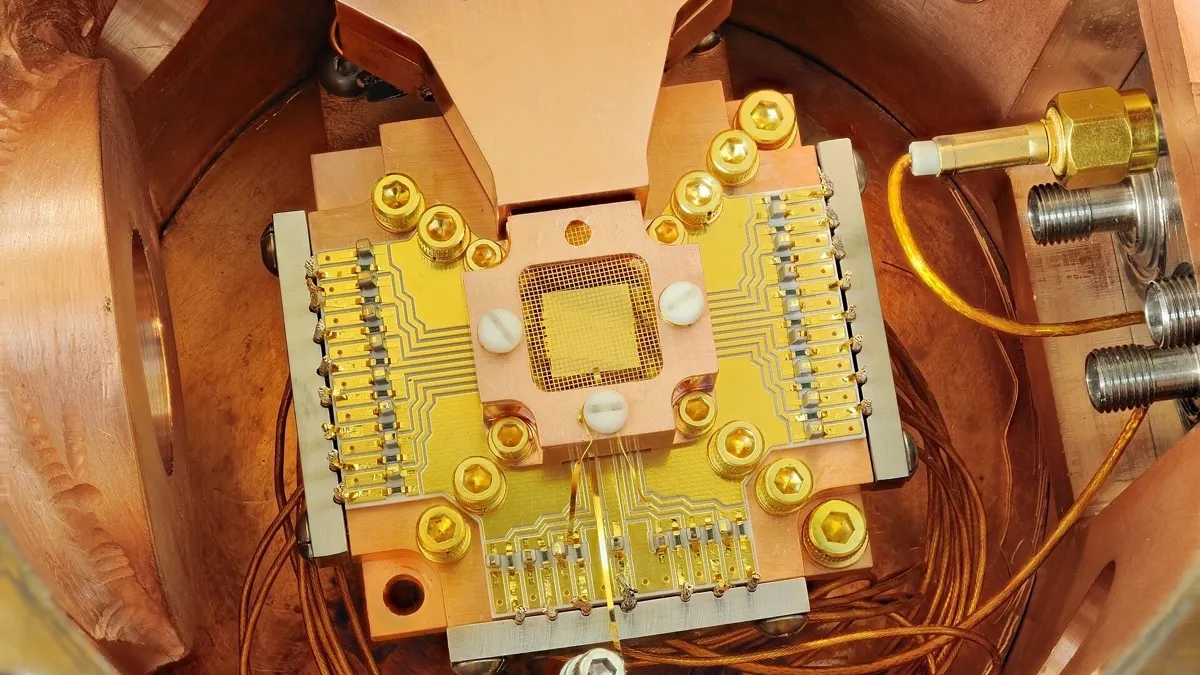
- Cover image: National Institute of Standards and Technology, Public domain, via Wikimedia Commons
Edited by Rodrigo Cornejo. How we select and verify: who writes these notes.