What happened
- On October 23, 2026, Nature Communications published work by 15 authors from Forschungszentrum Jülich, RWTH Aachen University and the University of Cologne.
- They demonstrated single-qubit gates on a superconducting transmon with total leakage error consistently below 2.0 × 10⁻⁵ and fidelities above 99.98% with 6.8-nanosecond pulses.
- They did it by removing direct transitions beyond nearest-neighbour levels, using a double recursive application of the DRAG pulse technique.
- They also introduce a sequence that amplifies leakage so it can be measured down to 10⁻⁶.
Why it matters
- Leakage happens when the qubit escapes its two useful states. According to the authors, fast control requires strong pulses that cause it, especially in weakly anharmonic qubits such as the transmon.
- Cutting leakage with short pulses tackles two limits at once: the time each operation takes and its error.
- The authors argue the method can be adapted to other platforms, which makes it useful beyond their lab.
The number
6.8 nanoseconds. Pulse length at which the X and X/2 gates exceeded 99.98% fidelity.
Context
The team tested gates across a range of pulse lengths and several benchmarking methods to separate the error channels. The amplified leakage sequence directly measures an error that other techniques leave buried in noise.
What’s next
- The work covers single-qubit gates; it reports no two-qubit results.
- No deadlines announced.
Bottom line
Qblox connected its quantum controller to an NVIDIA DGX Spark with 7.2 microseconds of latency, and Quantinuum reached 5 errors per million on a logical qubit: two more pieces of the same problem, less error and faster control.
Sources
- Nature Communications — Ultrafast single-qubit gates through multi-photon transition removal (DOI 10.1038/s41467-026-78373-4; October 23, 2026)
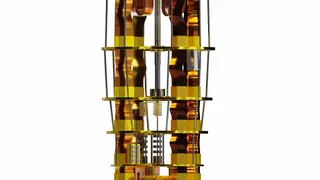
- Cover image: Pimvantend, CC BY-SA 4.0, via Wikimedia Commons
Edited by Rodrigo Cornejo. How we select and verify: who writes these notes.