What happened
- On October 21, 2026, Nature published “Additive manufacturing of ultralong and architected single crystals.”
- The authors used alternating and pulsed heat inputs to steer the growth of a single crystal during 3D printing, something the intense thermal cycles of that technique prevented.
- They made Ti-6Al-4V a meter tall and a centimeter in diameter and, according to the paper, the first single-crystal lattices with zigzag ligaments.
- The method also worked for printing single crystals of refractory metals: tungsten, molybdenum, niobium and MoNb alloys.
Why it matters
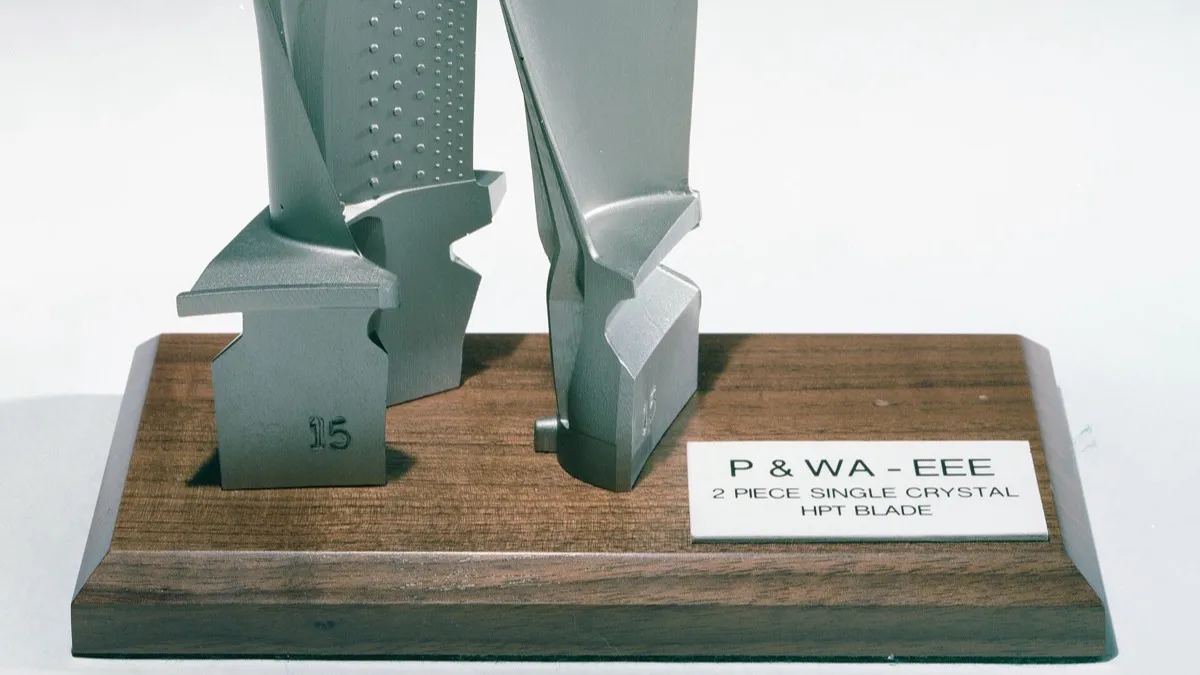
- A single crystal has no grain boundaries, which are where a metal starts to deform at high temperature. That is why turbine blades are made this way, but until now in sizes and shapes limited by casting.
- If the method scales, design stops depending on the mold: a complex, resistant part is printed instead of cast. For Chilean workshops and mining companies that import high-temperature spares, the effect would be a shorter supply chain.
- The condition: it is a laboratory result in one alloy; the paper reports no costs or print speed.
The number
10 times. Increase in creep resistance of single-crystal Ti-6Al-4V over what grain-size scaling predicts.
Context
Single-crystal materials are indispensable in high-performance applications, but conventional manufacturing requires near-steady thermal conditions. Additive manufacturing melts and cools over and over, and that oscillation was incompatible with growing a large crystal. The paper argues that fine control of heat resolves that contradiction.
What’s next
- No dates for an industrial version or for in-service part testing.
- Other labs still need to replicate the result with other geometries.
Bottom line
Manufacturing advances through parts that could not be made before: Alphabet released its robotics base under an Apache license for mid-sized workshops, and Saft opened in Bordeaux its first solid-state battery line for aviation.
Sources
- Nature — Additive manufacturing of ultralong and architected single crystals (published October 21, 2026)
- Cover image: Photographer: JACK DARGINSKY, Public domain, via Wikimedia Commons
Edited by Rodrigo Cornejo. How we select and verify: who writes these notes.