What happened
A research team documented autonomous synchrotron X-ray experiments in which people and AI agents worked on nanoparticle superlattices. The study is available at arXiv from November 6, 2026. It is a niche preprint and is not presented as an article that has already undergone peer review.
Its central contribution is the record. The authors preserved conversations between people and agents and between the agents themselves to reconstruct who proposed a decision, how the objective changed, and how errors were corrected during the work.
Why it matters
Connecting a model to a physical instrument forces you to evaluate something that doesn’t appear in a question-and-answer test: how work is distributed when measurements change the plan. The study uses programming agent infrastructure supported by previously validated scientific procedures.
The audit allows us to differentiate an initial order, an interpretation and a shared correction. That distinction avoids attributing the entire experiment to a single entity. It also shows a limit: counting messages does not automatically measure scientific quality. A long conversation may contain useful work, redundancy, or problems that needed to be resolved. The reported proportions should be read as a description of these runs.
The number
Three experiments. Between 61% and 67% of the messages were classified as interpretation or judgment. Between 59% and 68% of error corrections involved multiple participants, according to the authors’ audit.
Context
The experiments studied supernetworks of nanoparticles under human-defined goals that they could evolve. The first rehearsal had more setup work; In the following ones, the proportion of contributions classified as methodological or scientific increased.
These categories allow us to describe how the activity within the team changed. They are not a universal scale for comparing laboratories, instruments or models operating under other constraints.
On related topics, Mamífero has also published evaluation of agents with synthetic data, behavior of a model in security tasks, molecular prediction with little data and secrets exposed in Claude Code settings.
What’s next
The next question is whether the audit method works on more instruments and with different objectives. Preserving complete traces helps to study decisions, but also requires defining consistent criteria to classify messages and recognize human intervention.
For operational adoption, complementary measures would be needed: quality of measurements, discarded experiments, need for supervision and performance in the event of instrument failures. The article proposes a basis for studying these problems, without demonstrating general autonomy. The usefulness of logging is to make visible contributions and dependencies that a summarized demo might hide.
Bottom line
The result describes auditable collaboration on real instruments. The figures show that many corrections were shared. The contribution is to be able to follow that chain of decisions; not a claim that agents can single-handedly direct any scientific experiment.
Sources
- arXiv, prepub 2611.12933; summary, history and full text consulted, November 6, 2026. Initial shipment date confirmed in arXiv. The RSS spread it on November 11; It is included due to its niche nature. It is not presented as peer review.
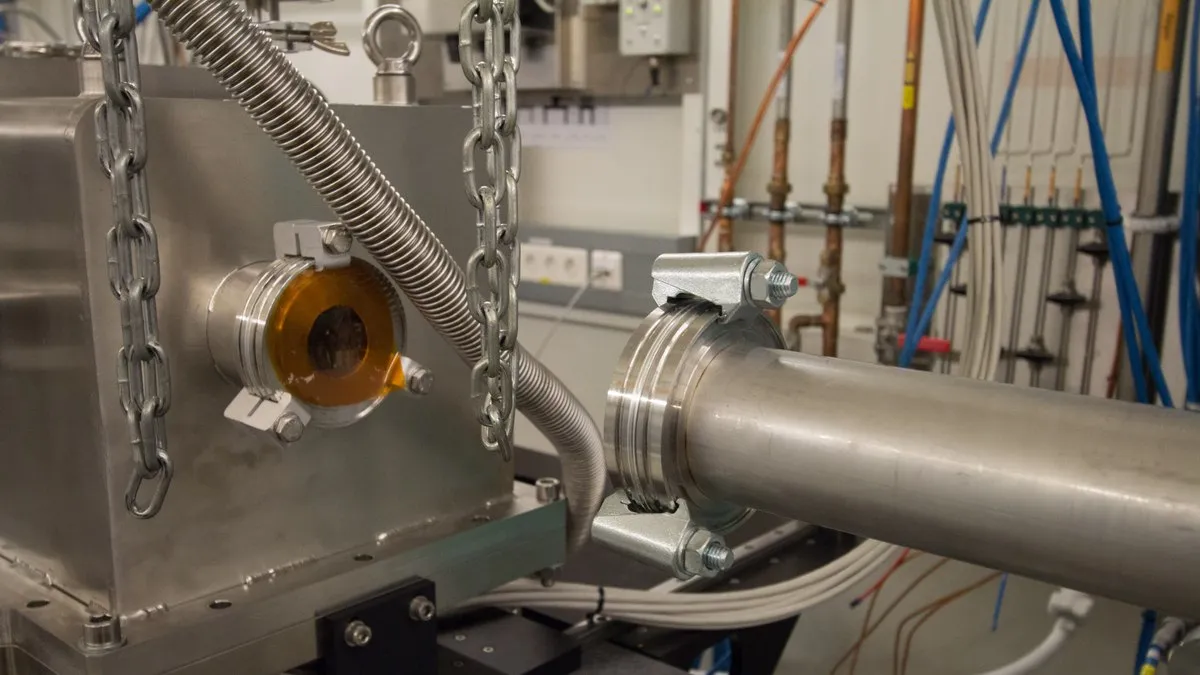
- Cover image: Olaf Kosinsky, CC BY-SA 3.0 de, via Wikimedia Commons. Cropped and resized to 1200 × 675 pixels. Reference photograph; it does not document the announced event.
Edited by Rodrigo Cornejo. How we select and verify: who writes these notes.