What happened
- On October 23, 2026, Nature Sustainability published work by six authors from the College of Chemistry at Zhengzhou University, China.
- They designed an anolyte, the negative-side electrolyte, based on oligo(disulfide)s: the bonds between sulfur atoms store the charge. It is made by polymerising the potassium form of thioctic acid.
- With a sulfonated cobalt phthalocyanine catalyst it reached 128 ampere-hours per litre and 95.5% material utilisation.
- It kept 98.1% of its capacity after 2,200 cycles at about 70% energy efficiency, and the team validated closed-loop recycling in a 63 Wh stack.
Why it matters
- Aqueous flow batteries can store grid energy for hours. According to the authors, they lacked anolytes that were cheap, stable, recyclable and high-capacity all at once.
- For grids with a lot of solar and wind, storage lasting several hours lets that energy be used outside its window. This work targets one concrete part of that system.
- 63 Wh is lab scale, and grid batteries are measured in megawatt-hours. The industrial leap remains to be shown.
The number
98.1%. Capacity retained after 2,200 cycles at 100 mA per square centimetre.
Context
The abstract describes the starting thioctic acid as “endogenous”, a molecule the body itself makes, and the authors link that to environmental compatibility. Ring-opening polymerisation, they explain, offers a scalable route to high concentrations of active material.
What’s next
- No scale-up timeline announced.
- The authors report no cost per kWh.
Bottom line
Genesis opened a 100 MW, 200 MWh battery at Huntly, and Viridi installed 3.75 MWh inside a 105-home building: the gap between 63 Wh and the grid is measured in those orders.
Sources
- Nature Sustainability — A circular oligo(disulfide) anolyte enables practical aqueous redox flow batteries (DOI 10.1038/s41893-026-01970-0; October 23, 2026)
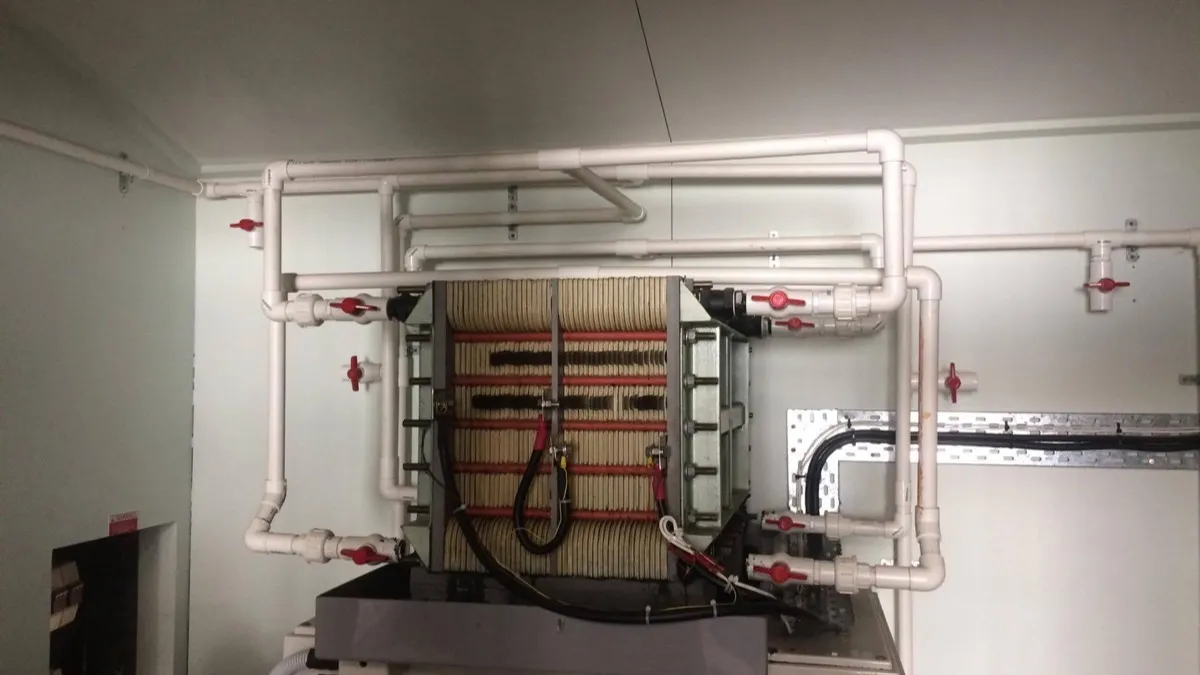
- Cover image: Radiotrefoil, CC BY-SA 4.0, via Wikimedia Commons
Edited by Rodrigo Cornejo. How we select and verify: who writes these notes.