What happened
- On October 22, 2026, a Columbia University team reported in Science that electron waves were trapped inside a metal, Pd₅AlI₂.
- The material can be peeled into two-dimensional layers and keeps its metallic character. Xavier Roy’s lab synthesized it.
- Spectroscopy images from Abhay Pasupathy’s lab revealed electron waves bound around defects in the crystal lattice. It is the first observation of a bound state in the continuum (BIC) in a metal, according to the university.
- Raquel Queiroz developed the models that explain the observations.
Why it matters
- In a metal electrons move freely, and a bound state in a sea of waves seemed impossible. That it happens through destructive interference, with no physical barriers, changes what can be expected from other metals.
- Until now this effect had only been achieved with light, after a decade of etching fine patterns into materials to trap photons. Bringing it to electrons suggests electronic devices that hold quantum states in the conductor itself.
- The consequence the release does not develop: defects, which electronics treats as flaws, become the place where the state is stored.
The number
Infinitely many escape paths. The electron wave stays trapped anyway, Queiroz says; the effect had not been seen with electrons.
Context
A year ago the same group published in Nature Physics that electrons in Pd₅AlI₂ move more slowly than expected. Their explanation was “frustration”: the arrangement of atoms and orbitals offers hopping paths that cancel each other. Pasupathy’s team then found patterns it did not expect.
What’s next
- The authors point to new ways of manipulating quantum states in metals.
- No applications or timelines announced.
Bottom line
Materials quantum physics advances through measurements that contradict intuition: a quantum speed limit for reaching equilibrium turned up yesterday in another system. And five tests of the Born rule turned out to assume probability.
Sources
- Phys.org — Quantum interference traps electron waves in metal for first time (reproduces the Columbia University release of October 22, 2026)
- Science — Electronic bound states in the continuum in a two-dimensional metal (DOI 10.1126/science.adt9825; date confirmed in Crossref: October 22, 2026)
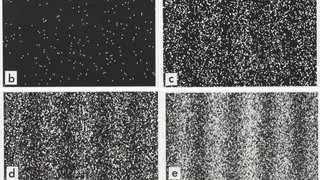
- Cover image: Dr. Tonomura, CC BY-SA 3.0, via Wikimedia Commons
Edited by Rodrigo Cornejo. How we select and verify: who writes these notes.