What happened
- On October 21, 2026, Nature published “Programmable design of functional proteins from natural language,” introducing Pinal.
- Pinal is a 16-billion-parameter foundation model that proposes candidate proteins from a natural-language description of the desired function.
- It was trained on 1.7 billion synthetically annotated protein–text pairs.
- The authors applied it to four tasks: a fluorescent protein, a PET hydrolase, an alcohol dehydrogenase and a metabolic H-protein. In all four they observed the intended function, with catalytic activity in both enzymes.
Why it matters
- Until now designing a protein required starting from a natural one or translating the goal into shape and sequence constraints. Here the entry point is a sentence.
- The practical figure is the designed H-protein: without iterative experimental optimization, it raised product output 1.7-fold over the native E. coli protein in a CO₂ fixation pathway.
- For a Chilean mining or environmental biotech lab, the PET hydrolase points to a concrete use: enzymes to degrade plastics. The paper shows it worked, not how much plastic it breaks down.
The number
1.7-fold. Increase in a CO₂ fixation pathway’s product with the H-protein designed by Pinal over the native E. coli one.
Context
The abstract notes that current design models have limits: they require natural starting proteins or reformulating the goal as geometric constraints. In computational evaluations, Pinal’s candidates combined predicted foldability, alignment with the functional description and sequence diversity.
What’s next
- The authors present the result as a basis for prioritizing designs that can be tested in the lab.
- No dates for an open version of the model or for industrial applications.
Bottom line
AI-driven protein design and discovery already has recent precedents: 950 Claude agents described an unreported enzyme system and AlphaFold added 2,800 viruses to its catalog. Pinal adds the reverse step, from text to protein.
Sources
- Nature — Programmable design of functional proteins from natural language (published October 21, 2026)
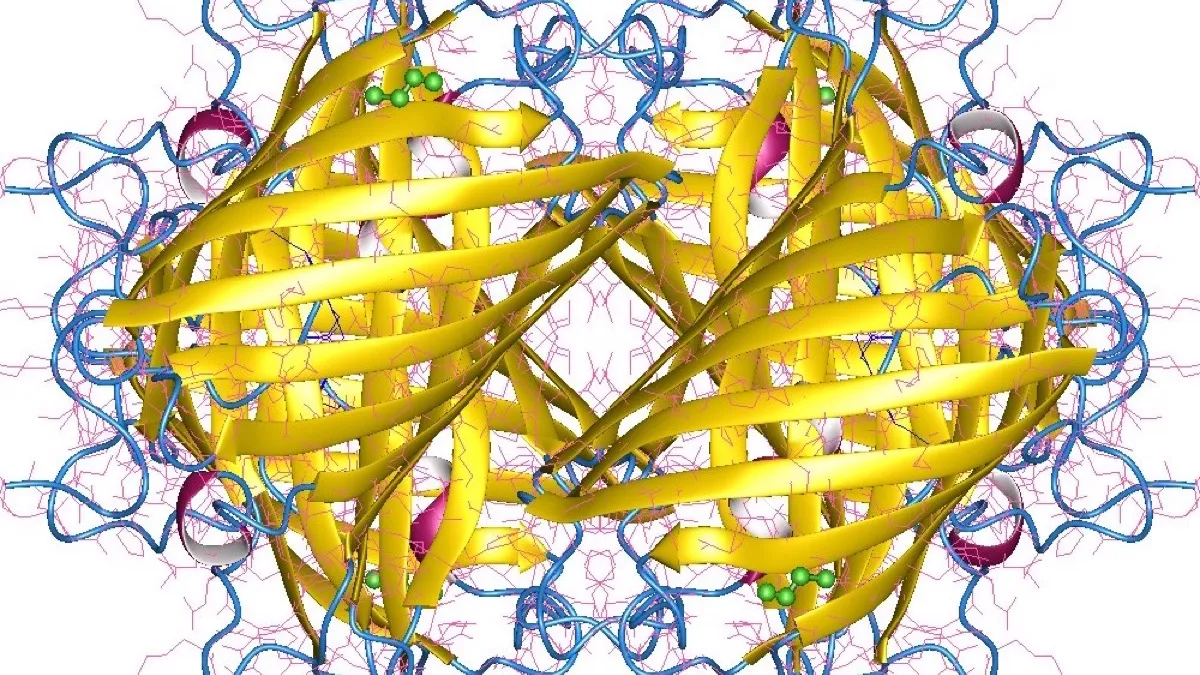
- Cover image: Deposition authors: Remington, S.J., Wachter, R.M., Yarbrough, D.K., Branchaud, B., Anderson, D.C., Kallio, K., Lukyanov, K.A.; visualization author: User:Astrojan, CC BY 3.0, via Wikimedia Commons
Edited by Rodrigo Cornejo. How we select and verify: who writes these notes.