What happened
- On October 22, 2026, Nature Communications published work from ICFO (Barcelona) on short-wave infrared photodiodes made with lead sulfide (PbS) colloidal quantum dots.
- The authors developed a lead-thiolate chemistry that passivates both polar and non-polar surfaces of the large quantum dots needed for that band (1 to 2 µm).
- The devices showed a dark current of about 34 nA/cm² at −1 V and a specific detectivity D* of about 8×10¹² Jones.
- According to the paper, that value matches commercial InGaAs photodiodes and the devices keep their performance across temperature.
Why it matters
- Short-wave infrared sensors serve machine vision, autonomous driving and imaging at night or in bad weather. Today the benchmark performance belongs to epitaxially grown III-V semiconductors, and quantum dots are proposed as a low-cost alternative.
- If quantum dots match the performance, cost drops because they are deposited from an ink onto silicon readout electronics. That is a promise the authors themselves make, and it is still laboratory-stage.
- For Chilean mining and agriculture, short-wave infrared distinguishes minerals and moisture. A cheap sensor would open uses in equipment where it is not justified today.
The number
8×10¹² Jones. Measured specific detectivity, on par with commercial InGaAs photodiodes.
Context
The gap between quantum dots and epitaxial semiconductors came from dark current, which generates noise. The authors attribute the limit to incomplete passivation of non-polar surfaces. Their work received funds from the European Research Council and Spain’s Severo Ochoa program.
What’s next
- Still pending: industrial-scale fabrication confirming the laboratory figures.
- No dates for commercial products.
Bottom line
Sensors advance through optics and quantum physics at once: NASA is preparing a quantum gravity sensor in orbit with Monarch photonics, and Xanadu secured up to US$10 million from DARPA for its photonic computer.
Sources
- Nature Communications — Non-polar surface passivation of PbS Quantum Dots using metal thiolates enables photodiodes rivaling InGaAs performance (published October 22, 2026)
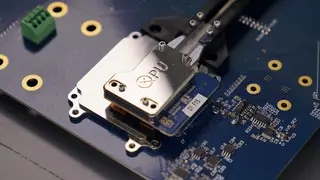
- Cover image: Travis.jennings, CC BY 3.0, via Wikimedia Commons
Edited by Rodrigo Cornejo. How we select and verify: who writes these notes.