What happened
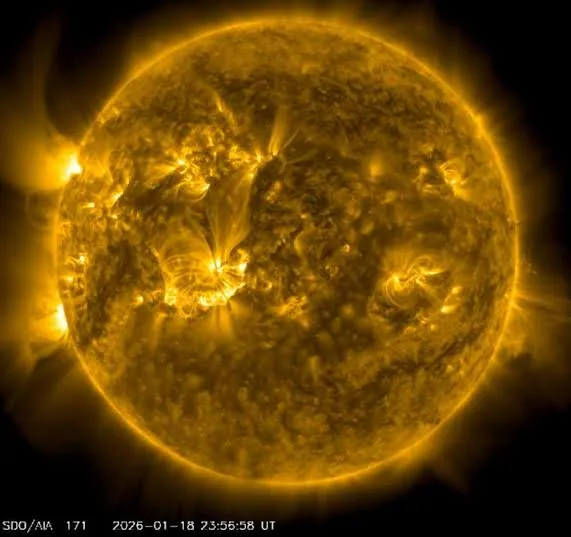
- A study published in Space Weather, the AGU and Wiley journal, reconstructed the solar radiation storm of November 11, 2025. Phys.org’s coverage is dated October 20, 2026.
- The event, cataloged GLE 77, was the largest rise in ground-level radiation in almost 20 years. A rare X5-class solar flare triggered it.
- Radiation exceeded the advisory thresholds of the International Civil Aviation Organization: the “moderate” level at business-jet altitudes and the “severe” level at supersonic-flight altitudes.
- A London-to-New York flight that departed during the storm received 46% more radiation than normal background.
- The University of Surrey led, with the UK Met Office, the Royal Netherlands Meteorological Institute (KNMI) and Lancaster University. Balloons were launched from the Shetland Islands and the Netherlands.
Why it matters
- Radiation is not spread evenly: it varied by place and altitude. The authors ask for coordinated atmospheric monitoring for aviation.
- For airlines crossing high latitudes, such as transpolar routes, the thresholds are no longer theoretical: they were exceeded in a real event.
- The consequence the summary does not stress: the 46% corresponds to one specific flight, not an average of routes. That makes it case data, not a rate for any storm.
The number
46%. Additional radiation exposure received by a London-to-New York flight that left during the storm.
Context
The same space weather threatens satellites and computing in orbit: Mamífero already reported how Google carries a TPU into space. A gravity instrument like Monarch’s for NASA also depends on operating under those conditions.
What’s next
- The authors ask for better coordination of monitoring, with no published timeline.
- Pending: whether aviation bodies adopt the thresholds with real-time balloon data.
- No announced dates.
Bottom line
A solar event from eleven months ago is only now finishing being measured, with balloons, neutron monitors and real flights. Space-weather science advances behind the phenomena it studies.
Sources
- Phys.org — Rare solar radiation storm gives scientists clearest picture yet of flight risks (October 20, 2026)
- Space Weather — study on GLE 77 (DOI 10.1029/2026sw005279)
Edited by Rodrigo Cornejo. How we select and verify: who writes these notes.