What happened
- On October 14, 2026, Nature published “Advancing subseasonal forecasting with machine learning,” by Guan and colleagues; the journal highlighted it in a note on October 21.
- The work presents probabilistic bias correction, a machine learning framework that learns to correct past probabilistic forecasts.
- Applied to the leading models of the European Centre for Medium-Range Weather Forecasts (ECMWF), it doubles the subseasonal skill of its AI forecasting system and improves the debiased dynamical model on 91% of pressure, 92% of temperature and 98% of precipitation targets.
- In ECMWF’s 2025 real-time forecasting competition, its global forecasts outperformed those of six operational centers and 34 teams on all variables and lead times.
Why it matters
- Between 2 and 6 weeks models lose skill because of compounding errors and the chaotic nature of the atmosphere. It is the range where decisions are made on when to plant, how much water to store or how much energy to reserve.
- The improvement does not come from a new model but from correcting existing ones. That lowers the cost of adoption: a weather service can apply it on top of the system it already has.
- For agriculture and hydropower in central and southern Chile, which plan months ahead and depend on the rainy season, a more reliable subseasonal forecast is a direct input. The paper does not evaluate South America separately.
The number
98%. Share of precipitation targets where the method improves ECMWF’s debiased dynamical model.
Context
Forecasts already have high accuracy up to two weeks, thanks to physical and AI models. The paper designed the method to run in production and tested it in ECMWF’s 2025 competition. The authors argue it can improve agricultural planning, energy management and disaster preparedness in vulnerable communities.
What’s next
- The authors raise operational deployment; the abstract sets no dates or services that will adopt it.
- Its performance in South America remains to be seen.
Bottom line
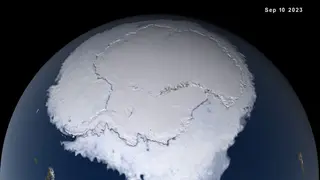
Climate is measured with more data and more compute, and that has a cost: Massachusetts asks data centers for their own clean energy. Meanwhile, Antarctic sea ice reached 17.59 million km² in 2026, the third-lowest figure.
Sources
- Nature — Advancing subseasonal forecasting with machine learning (published October 14, 2026)
- Nature — An AI tool improves weather forecasts up to a month ahead (journal summary, October 21, 2026)
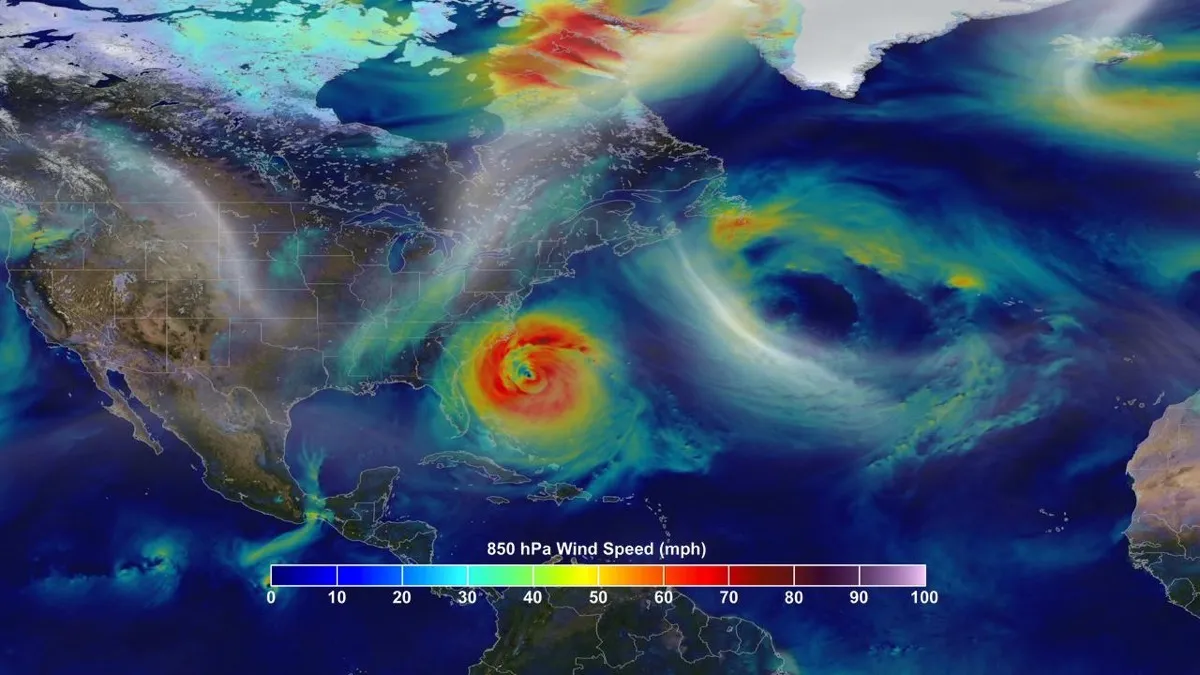
- Cover image: NASA Goddard Space Flight Center from Greenbelt, MD, USA, Public domain, via Wikimedia Commons
Edited by Rodrigo Cornejo. How we select and verify: who writes these notes.