What happened
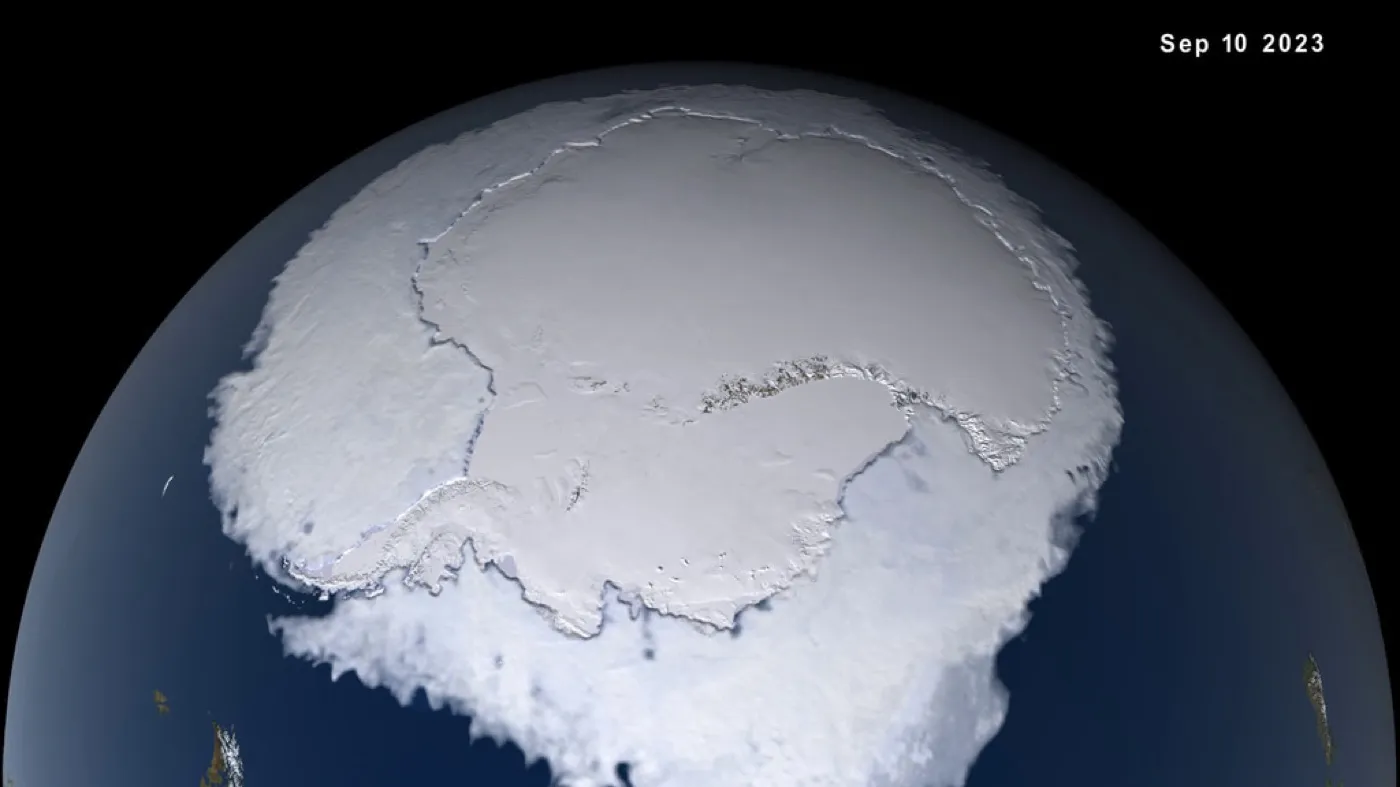
- NASA’s Earth Observatory, with data from the National Snow and Ice Data Center (NSIDC), reported that Antarctic sea ice reached its annual maximum on September 14, 2026, at about 17.59 million km².
- It ranks third from the bottom among winter maxima in the satellite record, which began in late 1978 with the Nimbus-7 satellite.
- Between 1979 and 2014 extent grew about 1% per decade and set maxima in 2012, 2013 and 2014. The upward trend ended in 2015 and since 2016 there have been substantial losses.
- In 2023, Antarctica recorded a summer minimum and a winter maximum smaller than any since satellite observation began.
Why it matters
- Sea ice had been used as a counterexample to global warming because it was growing. That it has changed trend in a few years shows how hard it is to read a polar system from a decade of data.
- Chile is an Antarctic country and its gateway is Punta Arenas. Less sea ice changes base logistics, krill fishing and ship traffic at the continent’s edge.
- NASA notes it is still unknown whether this is a long-term change or a statistical fluctuation; a single season does not settle it.
The number
17.59 million km²: extent of the 2026 maximum, the third low reading in the satellite record.
Context
Sea ice does not raise sea level when it melts, but it regulates how much solar radiation the surface reflects and how the ocean circulates. That is why it is read alongside continental ice: the Thwaites anchoring zone NASA adjusted is another piece of the same picture. According to NSIDC, daily extent fell to lows for early October, below those of 2023, a fact covered by secondary outlets and not by the NASA page consulted.
What’s next
- The austral summer minimum, measured in February or March 2027.
- More NSIDC analysis of the October daily lows.
- No announced timeline for a consensus on the cause of the trend change.
Bottom line
Antarctica went from record ice to low readings in a decade. That science still does not know whether it is trend or noise is the uncomfortable part of a story with consequences for three continents. While the ice falls, the emissions debate moves to infrastructure: Massachusetts asks data centers for their own clean energy.
Sources
- NASA Earth Observatory — Antarctic sea ice reaches its 2026 maximum (reproduced by ScienceDaily) — October 15, 2026. Reproduces NASA’s text
- NSIDC — National Snow and Ice Data Center
- Image: NASA’s Scientific Visualization Studio - USRA/Trent L. Schindler, KBR Wyle Servi, Public domain, via Wikimedia Commons
Edited by Rodrigo Cornejo. How we select and verify: who writes these notes.