What happened
- On October 7, 2026, Google DeepMind opened SynthID Detector to anyone, worldwide and in English. Until now it was an early version for journalists and media professionals.
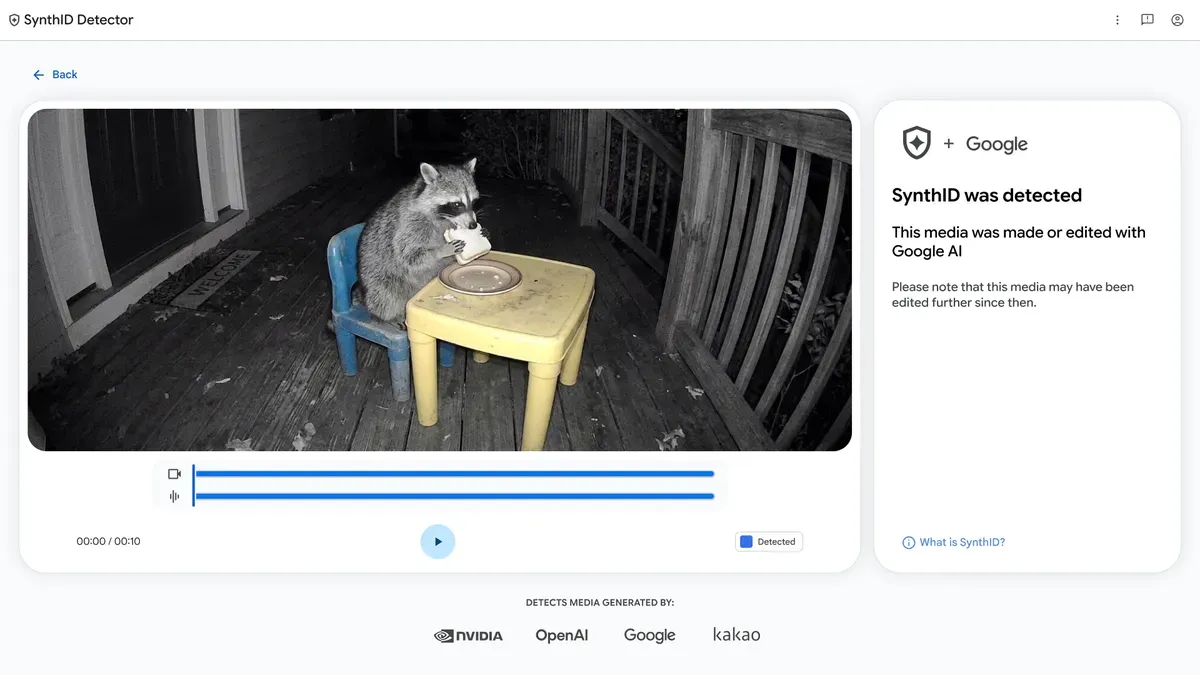
- It lives at synthid.com: you upload an image, a video or an audio file and the tool looks for the invisible watermark. Besides Google’s own, it reads those from OpenAI, NVIDIA and Kakao. Apple is listed as a partner joining “soon,” with no date.
- Google says it has watermarked more than 180 billion images and videos since 2023, plus audio equivalent to roughly 240,000 years. Built-in verification in Search, the Gemini app and Chrome handles over a million requests a day.
- The screenshot for this note shows the use case: a 10-second video of a raccoon eating at a child-sized table comes back with “SynthID was detected”: made or edited with Google AI, and possibly edited further since.
- Google’s post doesn’t mention C2PA, error rates, pricing or API access.
Why it matters
- It’s an open detector that reads marks from more than one lab. Until now each company verified only its own: whoever received a suspicious image had to guess which tool made it and hunt for the matching checker. With four providers at the same door, the question becomes “did anyone on this list make it?”
- A negative result proves nothing. The tool only sees marks from participating systems, so it says nothing about content made with other tools, material from before marking began, or a mark degraded by editing. Nor does it confirm that what the piece shows is true: a positive means AI was involved, not that the story is false or true.
- For a small business reviewing material from suppliers, influencers or clients, it works as an extra filter, not a verdict. Same rule as with Anthropic’s checker: requiring the original file with its metadata intact is the only thing you can verify.
- Robustness is contested. A paper presented at USENIX Security 2026 (MarkNull) reported removing SynthID-Image watermarks in the implementation it tested. That doesn’t show every deployment is vulnerable, but there are no independent audits of error rates across providers either.
The number
Context
OpenAI: from metadata to a shared watermark
OpenAI had been attaching C2PA content credentials to DALL·E 3 images and later to ImageGen and Sora since 2024. That signal travels in the metadata and is lost with a screenshot. In May 2026 it took the second step: it declared itself C2PA-conformant and adopted Google’s SynthID on images from ChatGPT, the API and Codex, and announced its own verifier in preview that looks for both signals. The October 7 opening is the other side of the same deal: Google’s detector now reads OpenAI’s marks.
Anthropic: a different path, and no open detector for now
Anthropic isn’t among the partners of Google’s detector. It marks its content with two mechanisms of its own, according to its help center: an imperceptible watermark in text, built in at the model level, and signed C2PA credentials on files such as PNG and JPEG. It applies to models launched since August 2, 2026, across all its products and also on the AWS, Google Cloud and Microsoft Foundry clouds, and the company signed the code of practice under Article 50(2) of the European Union’s AI Act.
The difference is in detection. Files are checked with a free verifier at claude.com/check-content. The text mark, by contrast, can only be detected in a private preview for regulators, law enforcement, media, fact-checkers, researchers and organizations with compliance obligations. There’s no public text detector from Anthropic or from Google: SynthID Text is handled separately, and its detection is probabilistic and drops with rewrites or translation.
Comparison to date
| OpenAI | Anthropic | ||
|---|---|---|---|
| Images, video and audio | SynthID, with open detector | SynthID plus C2PA on ChatGPT, API and Codex images | C2PA on files such as PNG and JPEG |
| Text | SynthID Text, detector not public | No text mark confirmed in the sources reviewed | Model-level watermark |
| Public detector | synthid.com, since October 7 | Verifier in preview (May) | claude.com/check-content, file credentials only |
| Reads others’ marks? | Yes: OpenAI, NVIDIA and Kakao | Reads SynthID and C2PA | No |
| Stated driver | In-house marking since 2023 | Deal with Google and C2PA | EU AI Act |
Reading: Google and OpenAI converged on a common format. Anthropic took a parallel lane, with C2PA for files and its own mark for text that today only authorized organizations can verify. Until there’s interoperability, anyone who wants to check a piece will have to consult more than one tool.
What the United States expects
No one in the federal government has commented on the announcement, at least as far as could be verified for this note. The US framework rests on three pieces.
- No federal watermark mandate. The 2023 executive order that called for provenance standards was revoked. NIST’s technical guidance (AI 100-4, 2024) is voluntary. Congress has bills, such as the COPIED Act (S.1396 in its 2025 version), but none has passed. The 2025 AI Action Plan mentions a NIST program to evaluate deepfake detectors and turn it into a voluntary standard for courts and agencies, not an obligation for companies.
- California is the real mandate today. The AI Transparency Act (SB 942, amended by AB 853) has applied since August 2, 2026 to providers with more than a million monthly users: they must offer a free tool that says whether an image, video or audio file was created or altered by their system, and embed a latent mark. The penalty is $5,000 per violation, and each day counts as a separate one. From January 1, 2027, large platforms will have to detect and show provenance without stripping it, and from 2028 camera and phone makers will have to mark by default.
- Fake intimate content: federal law in force. The TAKE IT DOWN Act has required platforms since May 19, 2026 to remove nonconsensual intimate images, including AI-generated ones, within 48 hours of a valid request. The FTC began enforcing it that day. It regulates removal, not marking.
What Google does with this is a reading, not a company statement: an open, multi-provider detector fits California’s requirement to offer a free verification tool, but Google doesn’t say it’s doing it because of that law. What is true is that in the US the pressure comes from one state and from European regulation, not from Washington.
What’s next
- Apple joins as a detectable provider, no date.
- Anthropic said it will widen access to its text detection and publish technical guidance, with no deadlines.
- January 1, 2027: large platforms operating in California must detect and display provenance data (SB 942 / AB 853).
- December 2, 2026: transition cutoff under EU Article 50 for systems already on the market, according to one of the sources reviewed.
- A pending California amendment (SB 1000) would remove the one-million-user threshold.
Bottom line
The watermark stopped being a feature of each lab and started to become a shared system, but one that only answers “someone on the list made it.” It catches signed content well and says nothing about content that isn’t, and text still has no public detector.
Sources
- Google DeepMind — We’re making it easier to identify AI-generated content globally (Oct 7, 2026)
- The Neuron — Google SynthID Detector: AI watermarks, limits and trust
- eWeek — Google opens SynthID Detector
- OpenAI — Advancing content provenance
- Anthropic Help Center — How Claude marks AI-generated content
- California AI Transparency Act (SB 942), summary of requirements
- FTC — Begins enforcing the TAKE IT DOWN Act (May 2026)
- NIST — Guardians of Forensic Evidence
Written by Mamífero. Edited by Rodrigo Cornejo. How we select and verify: who writes these notes.