What happened
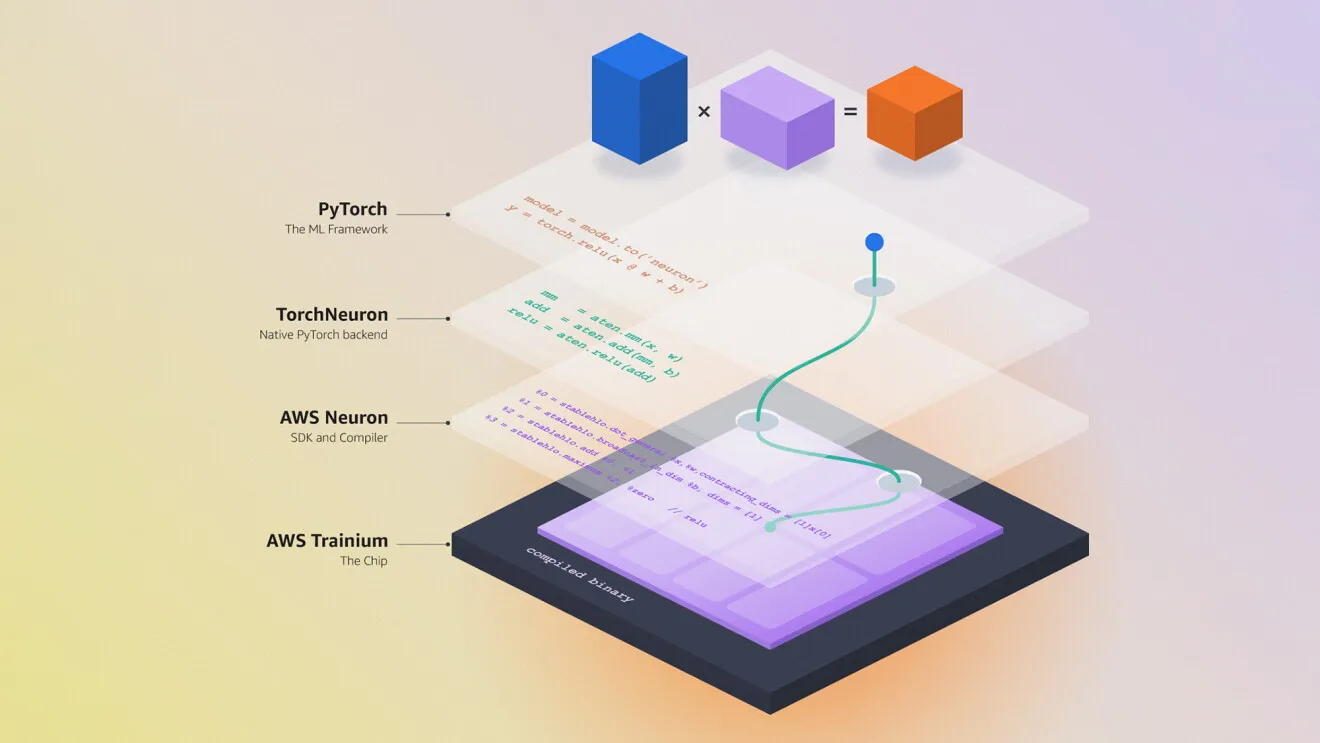
- AWS announced TorchNeuron, a native PyTorch backend for its Trainium2 and Trainium3 chips. It enters public beta on October 20, 2026 under the Apache 2.0 license, according to the PyTorch blog.
- It installs with
pip install torch-neuronx. To move a model you just name the device,.to('neuron'). In compiled mode the backend must be named once. - It supports eager execution,
torch.compileand the usual distributed APIs, such as FSDP2 and tensor parallelism. Hugging Face lists it as a device in Transformers v5 and Diffusers. - Deepgram, cited by AWS, reports that Trainium processes about 60% more seconds of input audio per dollar than its GPU baseline, in the benchmarks it evaluated.
Why it matters
- Until now, using Trainium required adapting code with AWS-specific tools. That engineering cost was the practical reason to stay on Nvidia GPUs. TorchNeuron reduces it, without eliminating it.
- For a data team in Chile that rents compute, the change is one of bargaining power: moving a workload between providers stops being a months-long project.
- The consequence the announcement omits: the 60% is a figure from a single company in one case, with support from AWS’s innovation center over several months. It is not the result an SME will get with a week of work.
The number
~22,000 skipped tests. These are PyTorch tests that AWS skipped because some operators lack a native Neuron lowering, according to its own report.
Context
Support arrives through PrivateUse1, PyTorch’s official mechanism for third-party hardware. AWS acknowledges limits in this first version: no dynamic shapes or sparse tensors, and FP8 remains in private beta. It tested 100,000 Hugging Face models in a reduced configuration and publishes the result in a chart, with no figure in the text.
What’s next
- FP8 and TorchAO will reach general availability in the next release, with no date.
- AWS says it will close most operator gaps “in future releases”, with no calendar.
- It remains to be seen how many third-party libraries declare real compatibility, beyond AWS’s own tests.
Bottom line
The dispute over compute is now fought in the software around it. Akamai signed a CPU contract with Anthropic and the Department of Justice requested information on the Nvidia–Groq deal. TorchNeuron aims to let the code AI teams already use run without rewrites on a chip that is not Nvidia’s.
Sources
Edited by Rodrigo Cornejo. How we select and verify: who writes these notes.