What happened
- On October 23, 2026, Phys.org distributed a release from Japan’s National Institute of Advanced Industrial Science and Technology (AIST) about a new principle of photon detection, published in Physical Review Applied.
- The researchers directly observed the magnetic flux quanta that a photon’s absorption creates in a superconductor. The number of quanta identifies how many photons arrived.
- The method aims to combine two capabilities that are hard to join: resolving the number of photons and operating at high speed.
- The scientific paper, «Direct observation of photon-induced vortices in superconducting films», is listed on Crossref dated September 2, 2026.
Why it matters
- Photonic quantum computers and quantum communications need to know how many photons there are, not just whether there is any.
- Transition-edge sensors (TES) resolve photon number but measure heat and need cooling time, which limits their speed.
- Nanowire detectors (SNSPD) are very fast but do not distinguish energy and need many combined to count photons.
The number
A pair. When a superconductor absorbs a photon, a pair of magnetic flux quanta is created, according to the release.
Context
According to the explanation, when a photon is absorbed by a superconductor, the gradient of the superconducting phase becomes unstable and the quanta are created. As they cross the material they cause a phase slip and a voltage signal quantized by the Josephson effect. Observing that signal identifies the number of incident photons. The text gives no measured efficiency or speed figures, so it remains to be seen what performance it reaches against TES and SNSPD.
What’s next
- The authors point to uses in evaluating single-photon sources, bosonic quantum computing and quantum communication.
- Speed and efficiency at industrial scale still have to be shown.
Bottom line
Fine control of quantum systems advances on several fronts: a trapped ion corrects its own errors and passes break-even without measuring and Jülich ran qubit gates in 6.8 nanoseconds. For photonic machines, Vietnam will have its first quantum computer with a Quandela machine. And on fundamental limits, a quantum speed limit for reaching equilibrium was demonstrated.
Sources
- Phys.org — A new principle of photon detection counts photons using magnetic flux quanta (October 23, 2026; reproduces the AIST release)
- Paper: Jodoi et al., «Direct observation of photon-induced vortices in superconducting films», Physical Review Applied, DOI 10.1103/n295-rfl8 (published September 2, 2026 per Crossref; the paper text was not read)
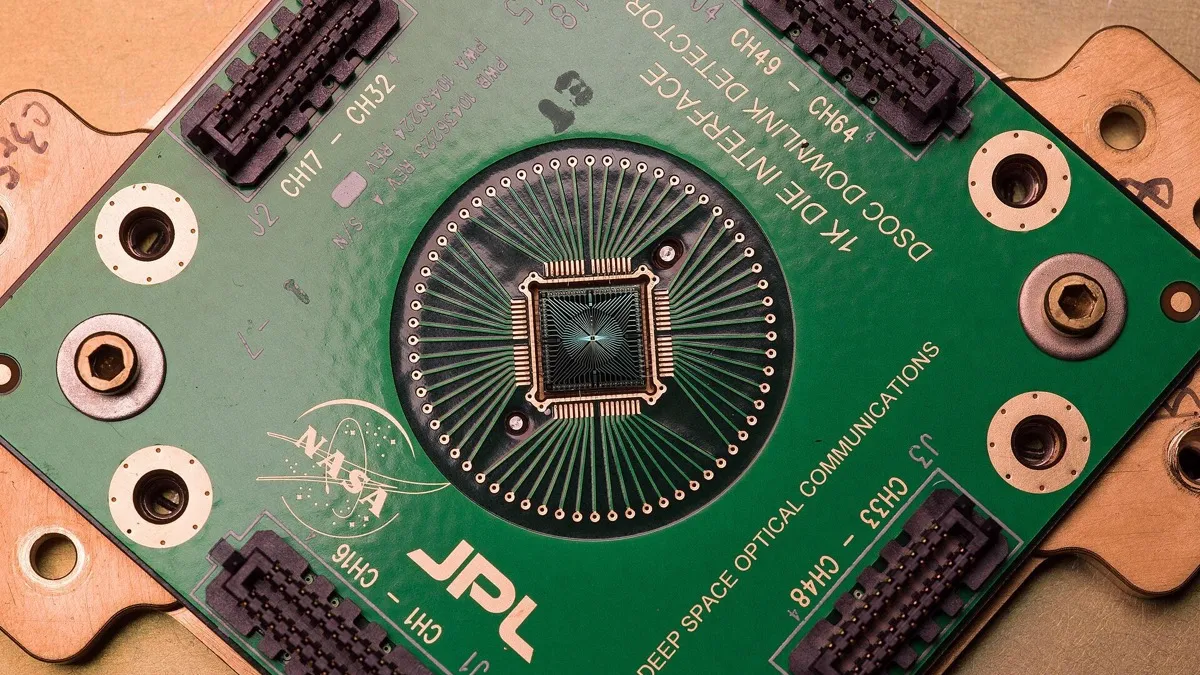
- Cover image: NASA/JPL-Caltech, Public domain, via Wikimedia Commons
Edited by Rodrigo Cornejo. How we select and verify: who writes these notes.