What happened
- On 27 and 28 October 2026 Akai showed, in short videos posted on Instagram, the MPC Sample Key, a 37-key keyboard it has not yet formally announced and that will have open-source firmware.
- The videos show modifications made by developers through “vibe coding”, meaning programming by giving natural-language instructions to an AI model. According to The Verge, those mods add synthesisers to the unit, including Native Instruments’ Massive, as well as virtual analogue and FM synthesis.
- One clip shows the unit running a completely custom operating system that bundles several synths.
- The same videos say these “community” features will also come to the standard MPC Sample, which is shown running synths built with Claude, Anthropic’s model.
Why it matters
- Akai, an inMusic brand, is moving from protecting its software to opening it. Jack O’Donnell, inMusic’s chief executive, told The Verge that the company will seed early units to developers, open some of its software and release a software development kit (SDK).
- AI-assisted programming lowers the barrier to building instruments. Musicians who do not write code could load their own synths onto a low-cost unit.
- For producers in Latin America, where high-end gear is expensive, an affordable and modifiable sampler widens the options.
The number
37 keys. The MPC Sample Key has no pads. Unlike the MPC Key 37, samples are triggered from the keys, and it adds pitch and modulation wheels.
Context
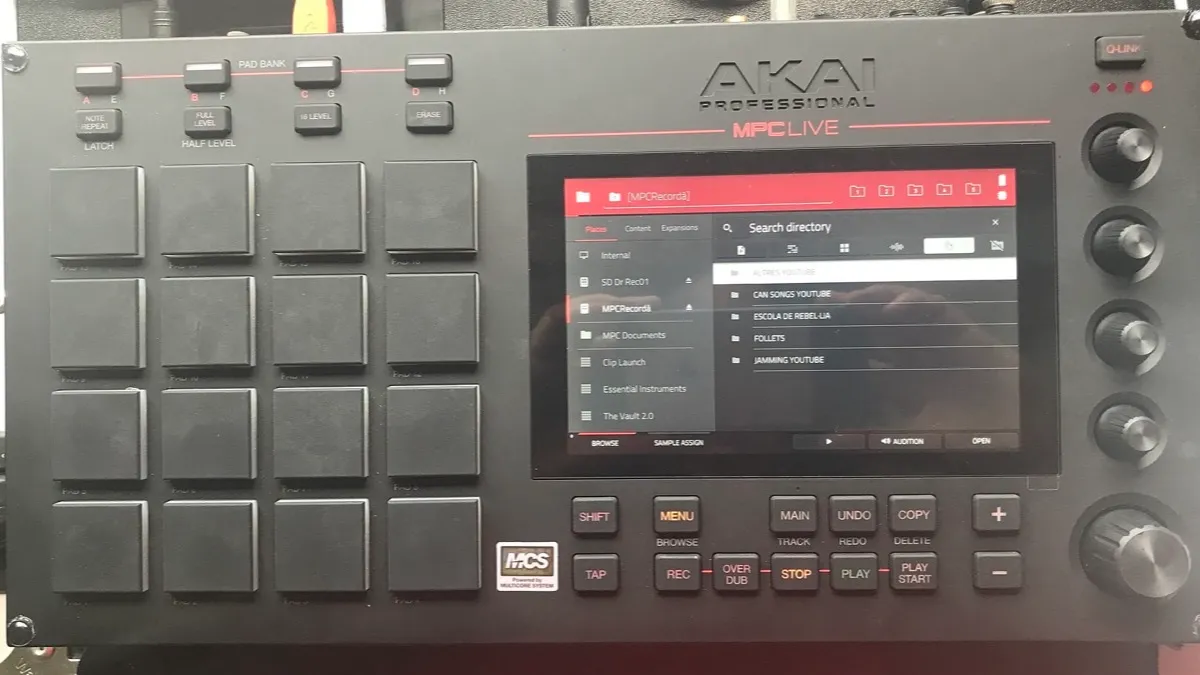
The MPC line has been a standard in hip hop and electronic music production for decades. The MPC Sample, the budget version, is the basis for the new keyboard model. The Verge expects the Sample Key to run some version of that same software, adjusted for the keyboard.
The use of AI models to write other people’s software is advancing in several directions. Mamífero reported how a reverse-engineering agent gathered thousands of GitHub stars by cloning paid programs, and how a coding model now runs on a laptop. On the creative side, Canva launched its own image model and Block introduced a voice model that runs locally.
What’s next
- Akai still has to formally announce the MPC Sample Key, with price and date.
- The licence for the firmware and the SDK is not yet known, nor which parts of the software will stay closed.
- If the features reach the current MPC Sample, existing owners will be able to install mods without buying a new unit.
Bottom line
Akai is betting that a community programming with AI help will give the unit more features than the company could build on its own. The risk is quality control: a synth generated in an afternoon can also fail on stage. How open the code is will decide how much of that can be checked.
Sources
- The Verge, “Akai is embracing vibe-coded mods with an open-source MPC”, 28 October 2026: theverge.com. Akai’s Instagram videos could not be reviewed directly; the description of the mods comes from The Verge.
- Cover image: Joan Recordà, CC BY-SA 4.0, via Wikimedia Commons
Edited by Rodrigo Cornejo. How we select and verify: who writes these notes.