What happened
- Anthropic published on its research site a report on “provable inference” for language models. The post is dated 2 November 2026 and TechCrunch reported it on 3 November.
- The work presents FlashProve, a system that lets whoever runs a model commit to it and then show, with a cryptographic proof, that each response was produced by that model.
- The technique belongs to the family of proofs known as zkSNARKs, which the authors say fit the problem because they hide information and are efficient to verify.
- Eight people from Anthropic, EPFL, StarkWare, MIT, RESI and Succinct signed the report. The code, the formal proofs written in Lean and the documentation were released under the Apache 2.0 licence.
- The authors stress that this is intermediate progress, not a finished research agenda. According to TechCrunch, there are no plans to deploy it at Anthropic or any other lab.
Why it matters
- Today someone querying a model cannot check that the response came from the model they chose. Judging by the quality of the text does not work, the authors warn.
- The report gives three cases. Independent evaluators need to know they are testing the same model that is served to the public. Users reaching a model through an intermediary service want to know it was not swapped for a cheaper one. And if an attacker tampers with the token stream while posing as a model, the user has no way to notice.
- The difficulty is that frontier model weights are private and checking a response would mean running the model again. A cryptographic proof separates the two: the lab publishes a fingerprint of the model that does not reveal the weights, and anyone can verify the proof.
The number
8. That is the number of authors on the report, spread across Anthropic and five academic institutions and cryptography companies.
Context
TechCrunch compares the system with the signatures that let an email recipient check the sender is who they claim to be. The difference is that FlashProve also guards against the lab itself: it would stop a company from quietly swapping a model for a cheaper one to save money, or for a more expensive one to inflate results. The authors add that such proofs could help verify compliance with commitments on the pace of AI development.
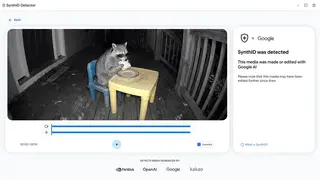
Mamífero follows efforts to prove where AI output comes from. We reported that Anthropic released a C2PA credentials verifier that confirms its brand and that Google began marking its content with SynthID and brought in OpenAI. On external evaluation, METR agreed with Anthropic that the risk is low and questioned how it was measured. In commerce, Visa, Mastercard and Ant began verifying AI agents jointly.
What’s next
- For the system to work, each lab would have to publish fingerprints of the models it releases. None has committed to doing so.
- The research remains open and the authors invite others to take the code and improve it.
- According to TechCrunch, verification is designed to be lightweight enough to run on a local device.
Bottom line
FlashProve does not change what models do; it changes what can be checked about them. If labs publish their fingerprints, an evaluator, a company or a user could demand a proof instead of trusting a label. For now it is open code waiting for someone to adopt it.
Sources
- Rinberg, R., Allain, A., Chiesa, A. et al., “Progress on provable inference for large language models”, Anthropic, 2 November 2026, anthropic.com/research/provable-inference
- FlashProve code on GitHub
- Brandom, R., “Anthropic is working on a system to prove AI models’ identity”, TechCrunch, 3 November 2026, techcrunch.com
- Cover image: D. Sharon Pruitt, CC BY 2.0, via Wikimedia Commons
Edited by Rodrigo Cornejo. How we select and verify: who writes these notes.