What happened
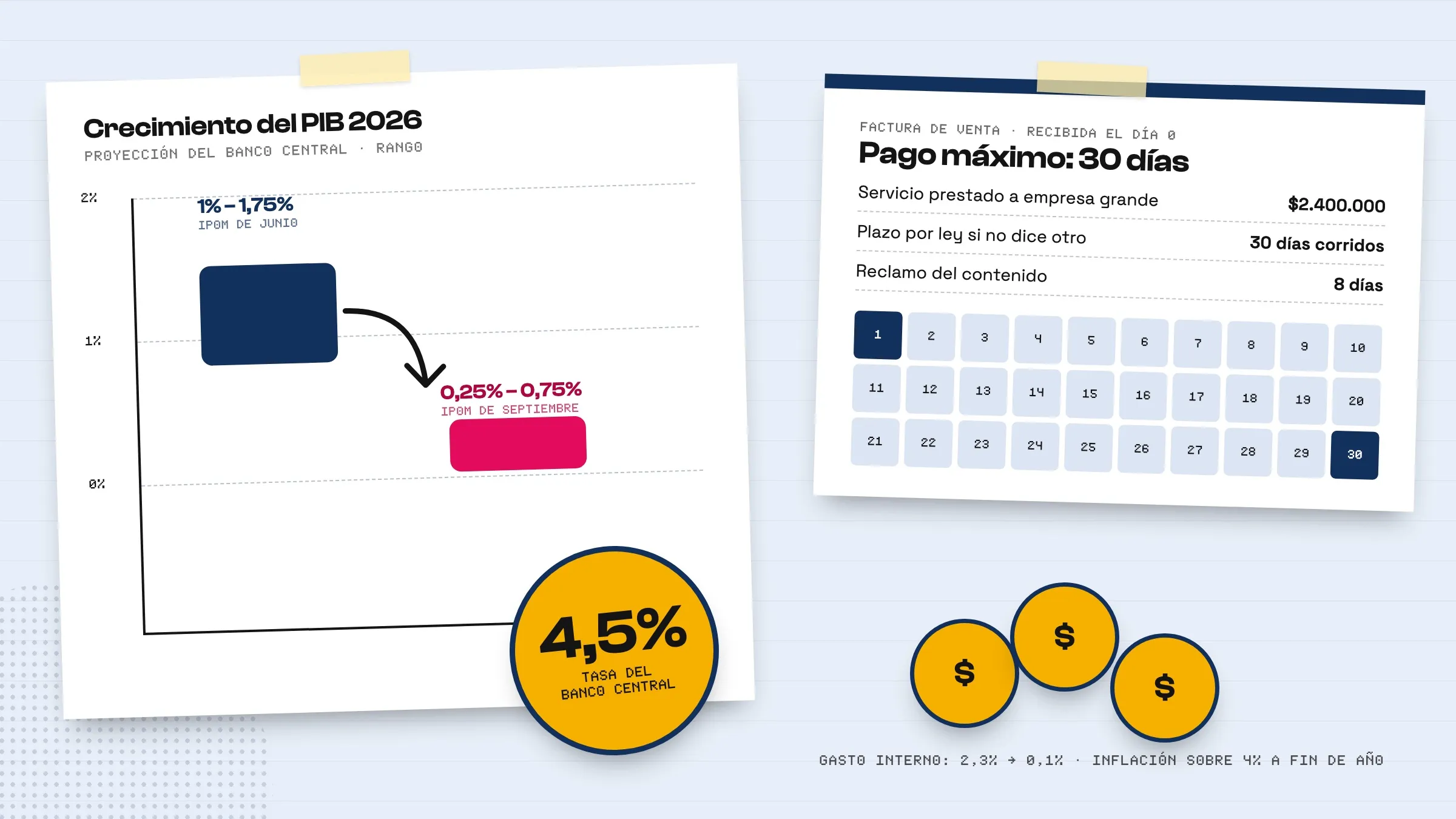
- On September 9, 2026, the Central Bank of Chile published its Monetary Policy Report. It cut its 2026 GDP growth projection to a range of 0.25% to 0.75%, from the 1% to 1.75% of June.
- The monetary policy rate stayed at 4.5%.
- Domestic spending went from growing 2.3% year on year in the first quarter to 0.1% in the second. The report projects private consumption will close 2026 at 1.7% (previously 2.2%) and investment with a 0.3% decline (previously a 2.2% rise).
- Headline inflation would end 2026 somewhat above 4% and converge to 3% in the second quarter of 2027.
- The report cites weaker demand, a labor market that deteriorated, lower confidence, higher fuel prices, adverse weather and less mining output. It expects more growth from 2027, in a 2% to 3% range, supported by the investment the already approved reconstruction law would stimulate.
Why it matters
- A small business’s sales projections usually start from the previous year. With domestic spending nearly flat, that starting point is more optimistic than the scenario the Central Bank sees for the rest of the year.
- With inflation above 4% and a rate that is not falling, costs rise faster than in a normal year and credit does not get cheaper. It is worth checking when prices and supplier lists were last adjusted.
- Five questions to review cash between now and year-end:
- Sales. Do fourth-quarter targets assume demand growth the report does not see?
- Collections. How many invoices go past 30 days unpaid?
- Inventory. How much capital is tied up in products that turn over more slowly than a year ago?
- Prices and costs. Have costs risen more than prices since the last review?
- Debt. When do loans mature and at what rate do they renew?
- The 30-day payment law (Law 21,131) establishes that every invoice must be paid within 30 calendar days of receipt. If it names no term, that one applies. A longer term requires a written agreement and cannot be agreed between a smaller company that sells and one above the highest annual revenue threshold that buys. Enforcing it is one of the few cash levers that does not depend on the economy.
The number
0.1%. Year-on-year growth of domestic spending in the second quarter, against 2.3% in the first.
Context
Unemployment reached 9.5% in the May–July quarter, according to the INE, the national statistics office. It is the same backdrop we discuss in ¿El agente o yo?, where we go through the INE employment figures alongside market data.
What’s next
- The next Monetary Policy Report is due in December.
- The Central Bank will assess the rate meeting by meeting, depending on events.
Bottom line
A projected GDP is not a lost order. It is a reason to review, before year-end, how much of the cash depends on demand picking up soon.
This note describes public information from the Central Bank and current legislation and is not financial or legal advice.
Sources
- Central Bank of Chile, September 2026 Monetary Policy Report
- Central Bank of Chile, summary of the September 2026 report
- CNN Chile, IPoM de septiembre
- INE, Quarterly Employment Bulletin no. 334
- Library of the National Congress, Law 21,131 establishing payment in thirty days
Written by Mamífero. Edited by Rodrigo Cornejo. See how we select and verify every note.