What happened
- On October 23, 2026, Nature Machine Intelligence published EdenGNN, an equivariant graph neural network by seven authors at Fudan University in Shanghai.
- The model predicts a material’s charge density and augmentation occupancies, enabling electronic structure calculations with projector augmented-wave (PAW) accuracy.
- It uses trainable radial basis functions and a delta-learning strategy to capture charge transfer. According to the abstract, that makes it more than an order of magnitude faster.
- Its universal version, EdenGNN-Uni, trained on the Materials Project database for non-magnetic structures across the periodic table, accurately predicted band structures for most unseen materials.
Why it matters
- Density functional theory (DFT) is the baseline calculation for studying batteries, catalysts and semiconductors, and its cost limits how many candidates can be screened. A reliable shortcut widens the search.
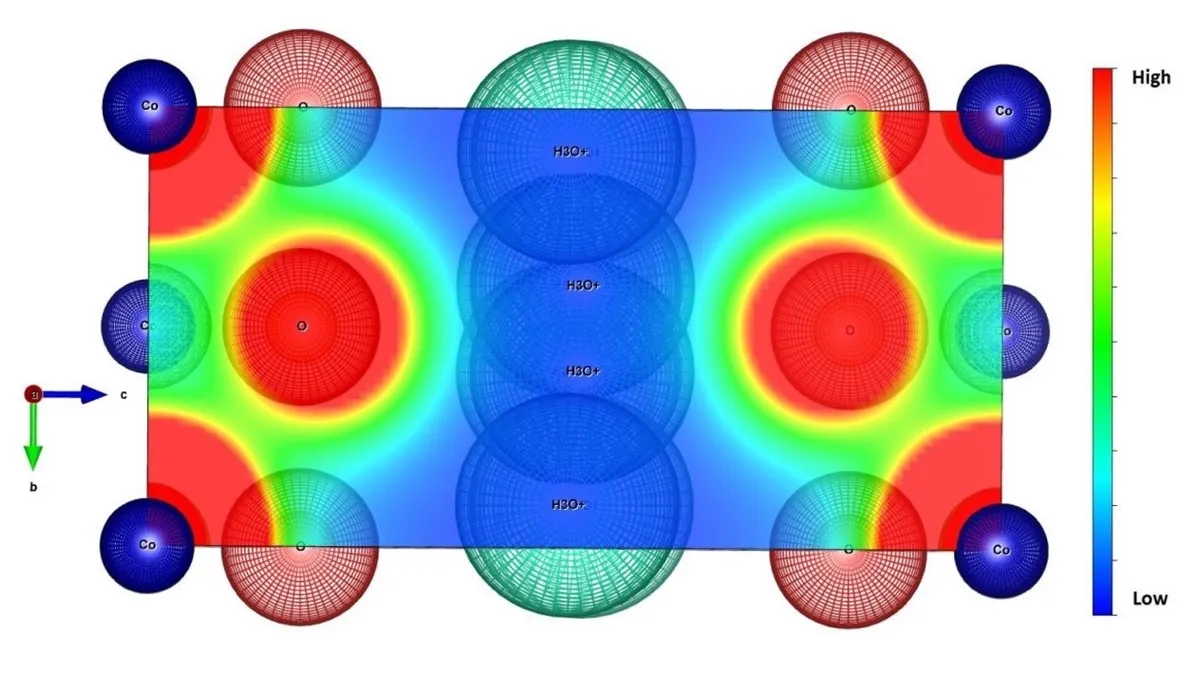
- Charge density is a physical quantity from which other properties follow. Predicting it leaves researchers with a result they can keep computing on, not just a final number.
- The abstract marks a limit: the universal model covers non-magnetic structures, so magnetic materials are out for now.
The number
More than 10 times. The speed-up the authors report, an order of magnitude.
Context
The authors compare EdenGNN with universal machine-learning Hamiltonian methods and report greater robustness. They note that earlier generalizable charge density models had computing costs that made them impractical.
What’s next
- The authors propose it as a scalable method for large electronic structure calculations and high-throughput materials screening.
- No deadlines announced.
Bottom line
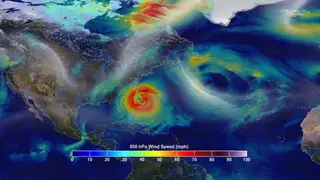
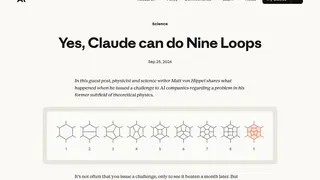
A machine-learning method doubled the skill of ECMWF’s AI weeks ahead, and Claude computed particle physics at 9 loops for under US$ 2,000: cheap scientific computing is advancing on several fronts at once.
Sources
- Nature Machine Intelligence — Efficient equivariant framework for universal charge density prediction (DOI 10.1038/s42256-026-01326-5; October 23, 2026)
- Cover image: Vadim A. Volochaev, ResearcherID: N-3239-2014 (Chemistry Department, Southern Federal University, Rostov-on-Don, Russia), CC BY-SA 4.0, via Wikimedia Commons
Edited by Rodrigo Cornejo. How we select and verify: who writes these notes.