What happened
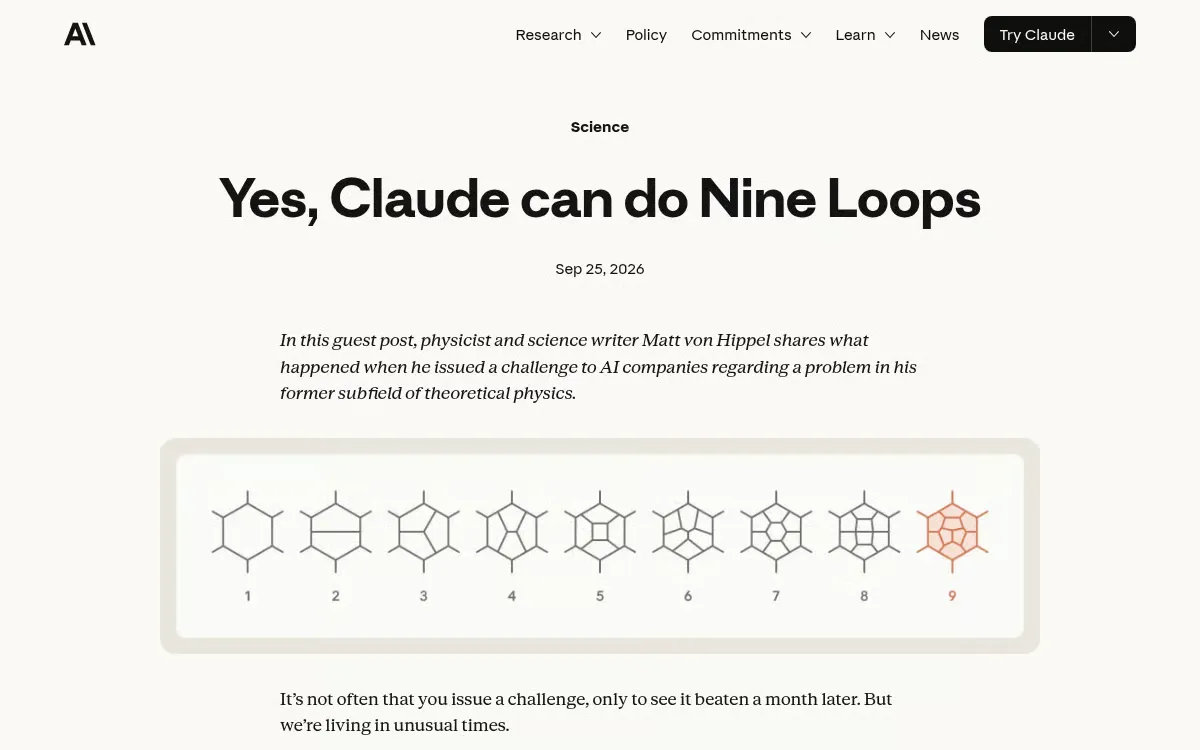
- Anthropic announced on September 25 that Claude computed the six-particle MHV amplitude at nine loops in planar N=4 super Yang-Mills theory. A loop is an order of correction in the calculation; each one adds precision and multiplies the difficulty.
- The work answered a challenge that physicist and science writer Matt von Hippel issued in August: achieving that calculation with resources within reach of an academic researcher. The previous record, at eight loops, belonged to Lance Dixon and his group at SLAC.
- According to the company, the Fable 5.1 model worked inside Claude Science using two independent methods. The total cost was somewhere between $1,000 and $2,000; the bootstrap route cost about $100, the equivalent of 96 processors for a week.
- Dixon, a professor at Stanford and SLAC, verified the result independently. Anthropic acknowledges that known methods were used and that Song He’s team at the Chinese Academy of Sciences reached comparable results with help from GPT-6.
Why it matters
- The figure that changes decisions is the price. A calculation that marked the limit of a specialized group now fits in the operating budget of a Chilean research project.
- Validation remained human and named. Without Dixon, the announcement would be a company’s claim about its own product. For universities in the region, that defines the bottleneck: there’s no shortage of calculations, there’s a shortage of experts who can review them.
- That two teams using rival models reached the same result almost at the same time indicates the merit lies in executing existing techniques. The novelty isn’t the method; it’s who runs it and how much it costs.
The number
$100. That’s what the bootstrap route of the calculation cost, according to Anthropic.
Context
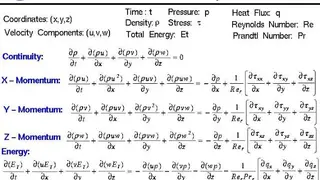
The debate over what AI contributes to science comes from a recent episode. Mathematicians who reviewed OpenAI’s Navier-Stokes proof said they learned nothing from it. This calculation has a similar profile: it produces a new figure with known recipes, without a new idea about the physics.
What’s next
- The full result is in the supplementary material of Anthropic’s publication. No submission for peer review was announced.
- The other half of the challenge, N=8 supergravity at seven loops, isn’t listed as solved in the announcement.
- No timelines announced.
Bottom line
OpenAI had already declared it had met its goal of an automated research intern. With this calculation, Anthropic shows the same thing with a useful difference: a third party with a name and title signed the verification.
Sources
Edited by Rodrigo Cornejo. How we select and verify: who writes these notes.