What happened
- A team led by the Department of Radiology at the Second Xiangya Hospital of Central South University, in Changsha, published in Nature Communications on October 28, 2026 the results of Impression-R1, a reasoning model specialized in drafting the diagnostic impression of radiology reports.
- The model was trained with a sequence the authors call imitation, reasoning and reinforcement: large-scale supervised learning, clinically conditioned reasoning and a reward designed around radiology criteria.
- It was evaluated on 11,884 cases from six institutions and three public datasets, across imaging modalities, body regions and diseases, including tests in English.
- In a randomized study of 360 interpretations, the model’s assistance improved report quality and cut the time needed to complete them by 27%.
Why it matters
- The impression is the final paragraph of the report, the one the treating doctor reads first to decide. The authors start from a concrete problem: radiology expertise is unevenly spread across hospitals.
- In a head-to-head comparison of 200 cases, Impression-R1 agreed more with the institutions’ reference impressions than all participating radiologists, on the objective measure. On the subjective evaluation it fell within the range of less-experienced radiologists.
- That contrast matters: matching a reference text is not the same as being judged equally useful by specialists.
- On the harmlessness measure, the difference between reports with and without assistance was not statistically significant. That suggests the time saved did not come with more detectable harm, within the study’s framework.
The number
27% less time. That is the reduction in drafting time with the model’s assistance, with a 95% confidence interval between 19.0% and 33.9%.
Context
The randomized trial compared readings by the same radiologist with and without the model. Report quality rose by an adjusted difference of 0.28 points, with an interval of 0.10 to 0.46. In the prospective phase, radiologists rated the reasoning and clinical relevance of the drafts highly.
The authors note that general language models lack domain-specific reliability, which is why they opt for a specialized model. The study compares Impression-R1 with leading general models and reports that it beats or matches them across the test set.
The work brings together hospitals in China’s Hunan province, such as the First People’s Hospital of Changde and Xiangtan Central Hospital, and Hohai University. All figures come from the paper itself, not from an outside evaluation.
What’s next
- The results were obtained in Chinese hospitals and in English tests; performance on reports in Spanish has not been evaluated.
- Using it in a hospital would require local validation and compliance with each country’s health rules.
Bottom line
Clinical AI is advancing with mixed results: nine models leave out information when reading full medical records, while Nature published a personal health agent with three subagents. In operations, infusion clinics connect calls with orders and authorizations, and on model errors, see how they build up an answer before doubting.
Sources
- Nature Communications — Impression-R1 for radiological impression generation with multicenter benchmarking and prospective evaluations (Wang et al., October 28, 2026; date confirmed in Crossref)
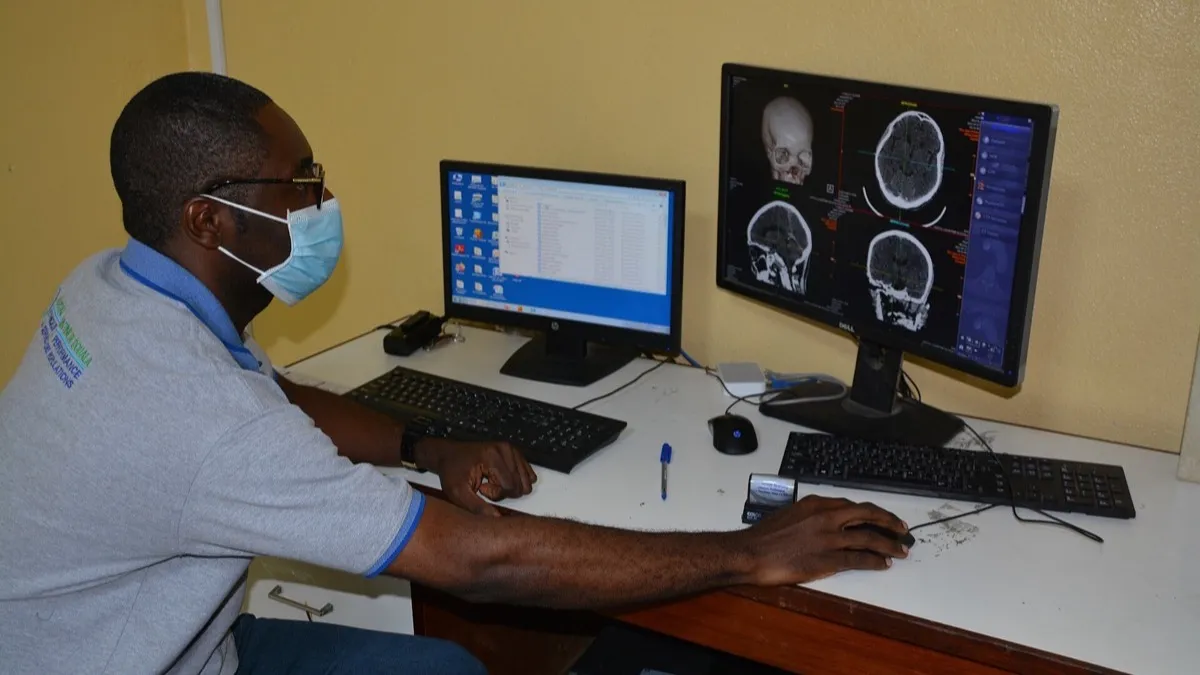
- Cover image: Happi Raphael, CC BY-SA 4.0, via Wikimedia Commons
Edited by Rodrigo Cornejo. How we select and verify: who writes these notes.