What happened
- On October 23, 2026, Nature Medicine published results from the phase 1/2 START-001 trial of invikafusp alfa, a bispecific antibody that selectively activates two T cell subsets, Vβ6 and Vβ10.
- Participants had antigen-rich solid tumours that were mostly resistant to immune checkpoint inhibitors.
- With a March 12, 2025 cutoff, phase 1 escalated doses in 34 patients, from 0.01 to 0.16 mg per kilo, without reaching the maximum tolerated dose. The initial phase 2 enrolled 18 patients.
Why it matters
- Cold tumours, with few immune cells, rarely respond to current immunotherapy. The trial reports confirmed partial responses in microsatellite-stable colorectal cancer and PD-L1-negative lung cancer.
- The drug expanded Vβ6 and Vβ10 T cells in blood and inside the tumour in a dose-dependent way, peaking at the optimal doses.
- The frequent side effect was cytokine release syndrome, mostly grades 1 and 2. There were no treatment-related deaths.
The number
14.8%. Objective response rate, 4 of 27 patients, at the optimal biological doses of 0.08 and 0.12 mg per kilo. Below 0.08 there were no responses.
Context
Two patients had reversible dose-limiting toxicities, one at 0.08 and one at 0.16 mg per kilo. Increases in interferon gamma and soluble CD25 followed the same pattern as T cell expansion. The authors include Marengo Therapeutics, which develops the drug, together with the US National Cancer Institute and the University of Pennsylvania. With 27 patients at the optimal doses, the response rate carries wide uncertainty. The link between patient biology and clinical course is also studied in Alzheimer-like changes in ALS.
What’s next
- Phase 2 of the trial continues at the doses chosen from safety, pharmacokinetic and activity data.
- A comparative trial is still needed to know whether responses in cold tumours hold up against other treatments.
Bottom line
Activating only a fraction of T cells was enough to shrink some resistant tumours. Immune responses measured in trials appear in other settings, such as smell after covid in vaccinated people. Tailor-made protein design advances with Pinal, which starts from a sentence, and parasite biology with the protein that lets Toxoplasma reproduce.
Sources
- Nature Medicine — Bispecific dual T cell agonist invikafusp alfa in solid tumors: the phase 1/2 START-001 trial (October 23, 2026)
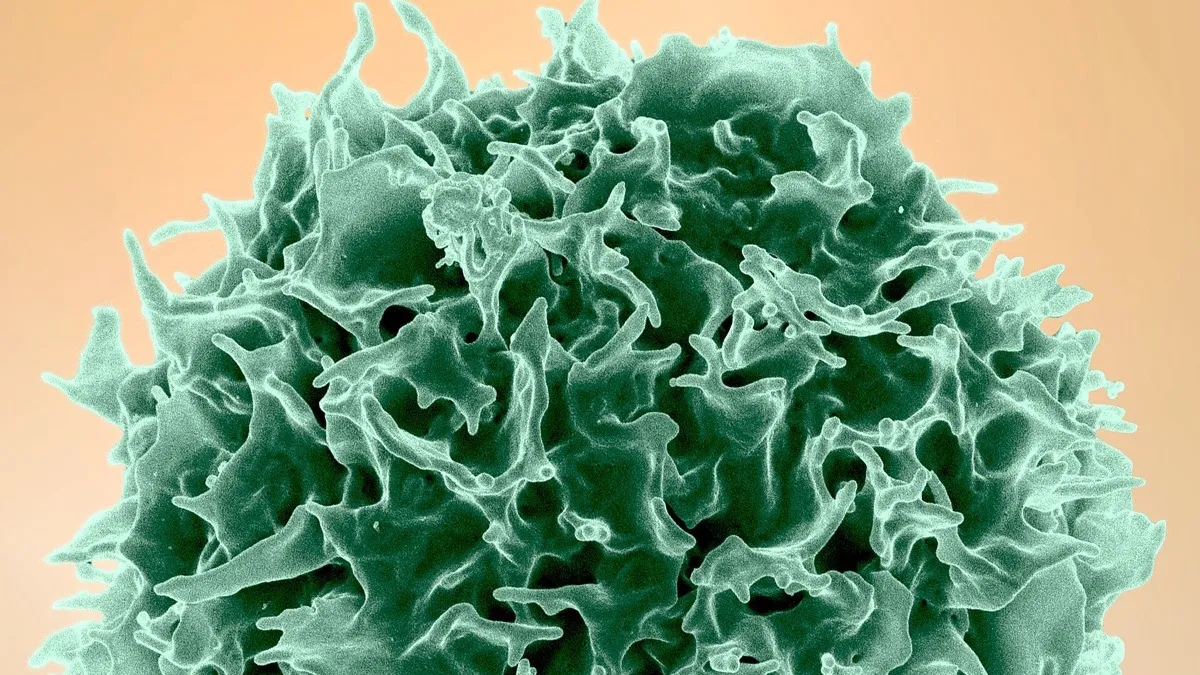
- Cover image: NIAID, CC BY 2.0, via Wikimedia Commons
Edited by Rodrigo Cornejo. How we select and verify: who writes these notes.