What happened
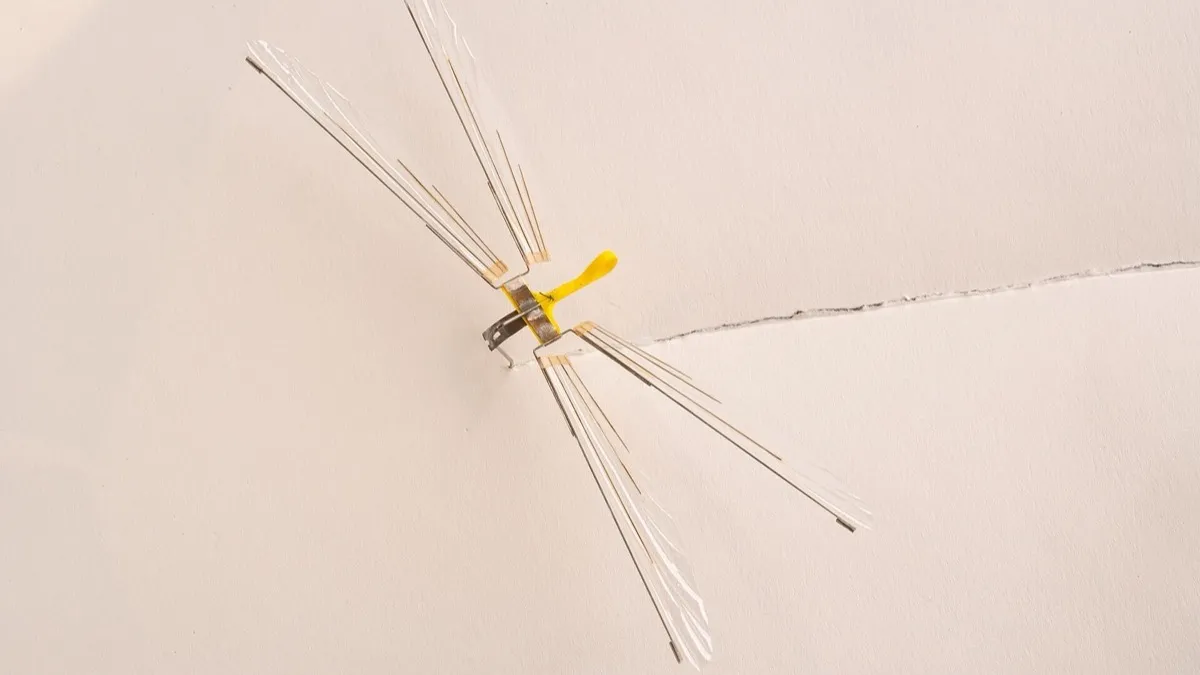
- On October 22, 2026, Nature Communications published the sustained, untethered flight of a sub-gram flapping-wing micro aerial vehicle.
- It was developed by a team at the National University of Defense Technology in Changsha (China), with funding from the country’s National Natural Science Foundation.
- The vehicle weighs 389 mg and has a 6.8 cm wingspan. With a 173 mg circuit and a 350 mg battery, the whole system weighs 984 mg.
- It reached more than 10 meters in altitude and more than 240 seconds of continuous flight at low power, with altitude control and resilience to disturbances.
Why it matters
- Until now robots this size flew tethered to a power source, because the battery and electronics weigh more than the wings lift. This design crosses that barrier by a margin: its maximum lift is 1.88 times its own weight.
- The application the paper cites is search and rescue. The consequence is twofold: it can enter rubble, and a vehicle this size raises regulatory questions that have no answer today.
- For robotics centers in Chile, the practical point is the weight budget: 984 mg includes battery and circuit, and that is the yardstick for any group that wants to replicate it.
The number
984 mg. Total weight of the micro drone with battery and control circuit, which takes off with a maximum lift of 1,850 mg.
Context
Flapping-wing micro vehicles imitate insect flight and are limited by power and payload. The drive circuit’s efficiency, 45% according to the paper, was reached by modulating the waveform, and stability comes from the mechanics of the design itself.
What’s next
- The abstract mentions no sensor payload or onboard communication; the work describes flight and stability.
- No timelines announced for rescue applications.
Bottom line
Small-scale robotics coexists with the industrial kind: Amazon will build its own robots in Indiana, and NVIDIA puts agents inside the robot to turn them into reusable skills.
Sources
- Nature Communications — An untethered sub-gram flapping-wing flight system achieves sustained self-stabilizing and altitude-controlled flight (published October 22, 2026)
- Cover image: CIA, Public domain, via Wikimedia Commons
Edited by Rodrigo Cornejo. How we select and verify: who writes these notes.