What happened
- Five authors, among them Yue Zhang and Jilei Sun, published on 5 November 2026 on arXiv PCBRouteAgent, a multimodal agent that routes printed circuit boards.
- Routing a board requires coordinating board-level connectivity decisions with geometric execution under strict design rules. Recent agents can handle native routing tools, but doing it well on complex boards remains hard.
- The system is inspired by how engineers combine a global strategy with local execution. A global planner uses board images and electrical and geometric information to set the connection topology, routing order, corridors and layer transitions.
- A detailed executor carries those guides to KiCad’s native routing engine and performs bounded local recovery.
Why it matters
- Routing boards is a long task in electronic design, and automating it reliably would be useful for small teams.
- The design separates the what from the how: the planner decides the strategy and the executor carries it out with a tool that already exists, instead of drawing traces blindly.
- Failures are not lost: they are returned as structured feedback so only the affected guides are revised and already accepted routes are preserved.
The number
100%, 94.9%, 100% and 40%. Those are the clean-pass rates it achieved on the four PCBWorld-Bench test splits, called D2, D3-A, D3-B and D3-C, across a total of 247 synthetic and real boards.
Context
On the three real-world subsets, PCBRouteAgent outperformed the best evaluated baseline by 13.9, 36 and 10 percentage points in clean-pass rate, according to the paper’s abstract.
The 40% figure on D3-C marks the current limit: on the hardest set, the agent leaves more than half of the boards unresolved. The abstract does not describe what makes that set so complex or how many boards it holds, so comparisons between sets should be read with caution.
It is also a preprint without peer review, with results obtained by the authors themselves on a benchmark they mention. An independent evaluation with boards from other teams would give a fuller picture.
At Mamífero we follow how agents enter technical tasks. We reported that ThinkingBox rewards the agent for the database it leaves behind and that GitHub Copilot adds projects with several agents and app control. Also that models predict which jobs an agent will finish only if they know its limits and that Bosch will split its chips into a separate division.
What’s next
- An independent evaluation on boards from other teams and tools is still missing.
- The 40% result on D3-C shows where the remaining work lies.
- The authors do not say in the abstract whether they will release the code.
Bottom line
An agent that plans like an engineer and executes with the usual tool solves nearly all of the easy cases and fewer than half of the hard ones. The gap between those two numbers is what matters.
Sources
- Zhang, Y., Sun, J., Jing, L., Wei, Y., Yang, R., “PCBRouteAgent: How Close Are LLM Agents to Becoming PCB Routing Engineers?”, arXiv, 5 November 2026, 2611.08175. Preprint without peer review; this note is based on the abstract.
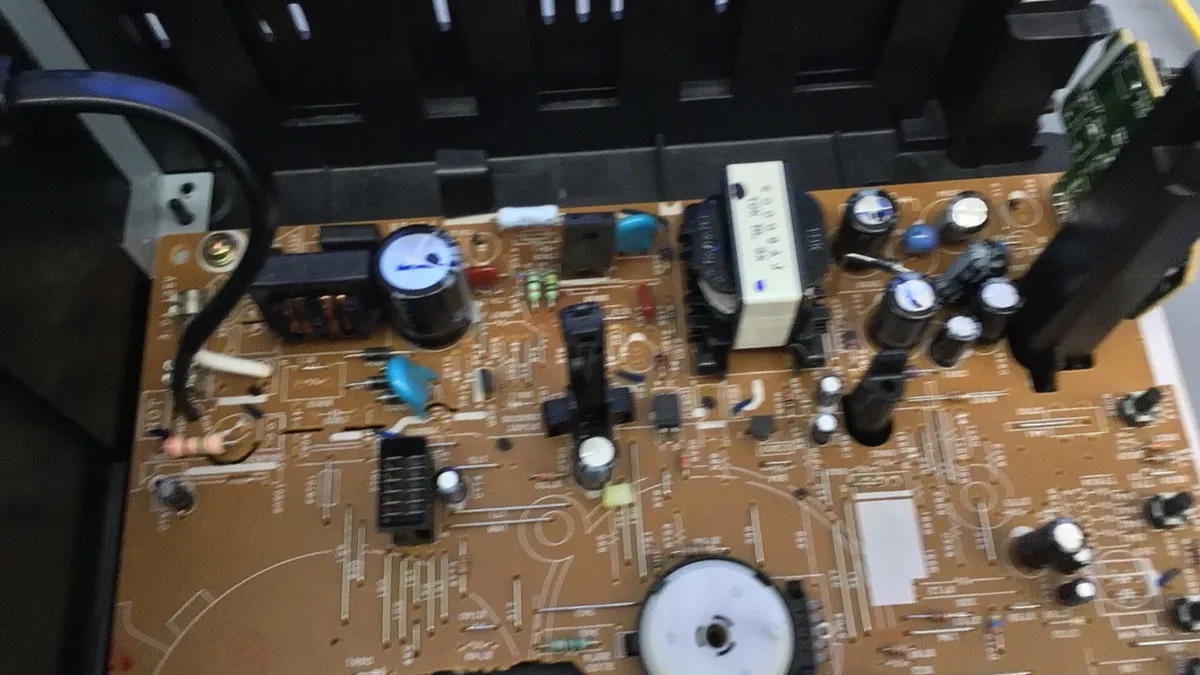
- Cover image: DiscoA340, CC0, via Wikimedia Commons
Edited by Rodrigo Cornejo. How we select and verify: who writes these notes.