What happened
- On October 21, 2026, Physical Review Letters published “One-Positron Quantum Cyclotron,” the work of Gerald Gabrielse’s group at Northwestern University (US).
- The authors kept a single positron, the antimatter counterpart of the electron, suspended indefinitely in the magnetic field of a Penning trap.
- According to the Nature report the same day, the positron was cooled to its lowest possible energy and held for months.
- The paper describes the device. It does not yet report a measurement of the positron’s magnetic moment.
Why it matters
- The standard model predicts the Big Bang produced as much antimatter as matter. The universe is almost entirely matter, so any measurable difference between the two points to physics the theory leaves out.
- The authors propose comparing the positron’s magnetic moment with the electron’s, both measured with a quantum cyclotron. According to the abstract, that would test CPT symmetry, a principle of quantum field theory, in the lepton sector.
- For those who fund basic science in the region, the takeaway is scale: the result comes from a laboratory setup, not an accelerator. The underlying question can be pursued with small equipment and years of patience.
The number
10,000 times. The extra precision with which the magnetic moment of electrons and positrons can be measured, compared with proton–antiproton comparisons, according to Nature.
Context
Since the 1960s physicists have compared particles with their antiparticles. They have seen a slight preference for matter in the behavior of a few of them, far from explaining the makeup of the universe. Detailed proton–antiproton comparisons have shown no differences.
What’s next
- No date for the first measurement of the positron’s magnetic moment; the abstract presents it as an open possibility.
- It will then have to be compared with the electron’s to find out whether there is a difference.
Bottom line
A day earlier, another paper attacked the same asymmetry by a different route: a heavy, long-lived neutrino as the reason matter won. And on another quantum frontier, a speed limit for reaching equilibrium showed how much is left to measure.
Sources
- Physical Review Letters — One-Positron Quantum Cyclotron (published October 21, 2026)
- Nature — Elizabeth Gibney’s report on the single positron in a trap (October 21, 2026)
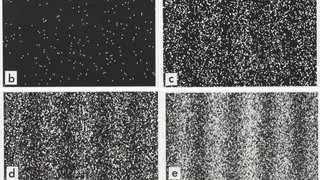
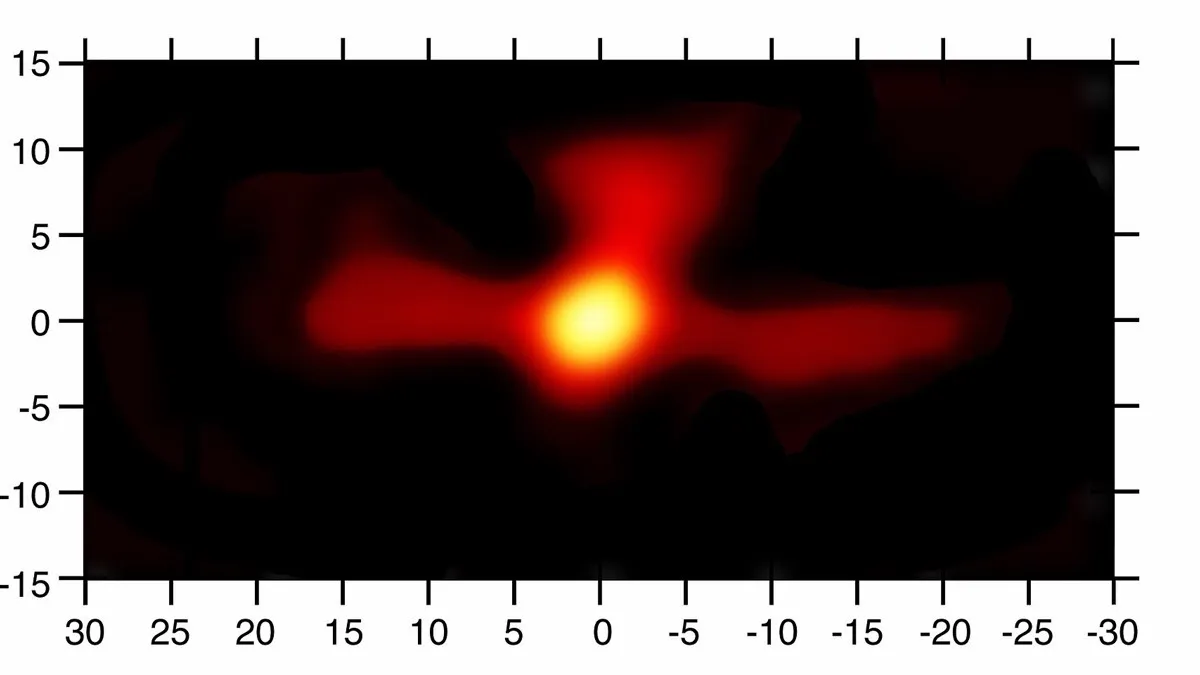
- Cover image: D. D. Dixon (University of California, Riverside) and W. R. Purcell (Northwestern University), Public domain, via Wikimedia Commons
Edited by Rodrigo Cornejo. How we select and verify: who writes these notes.