What happened
- On October 23, 2026, Nature Astronomy published a study by 26 authors from Chinese institutions and Stockholm University, using data from a mid-infrared solar telescope.
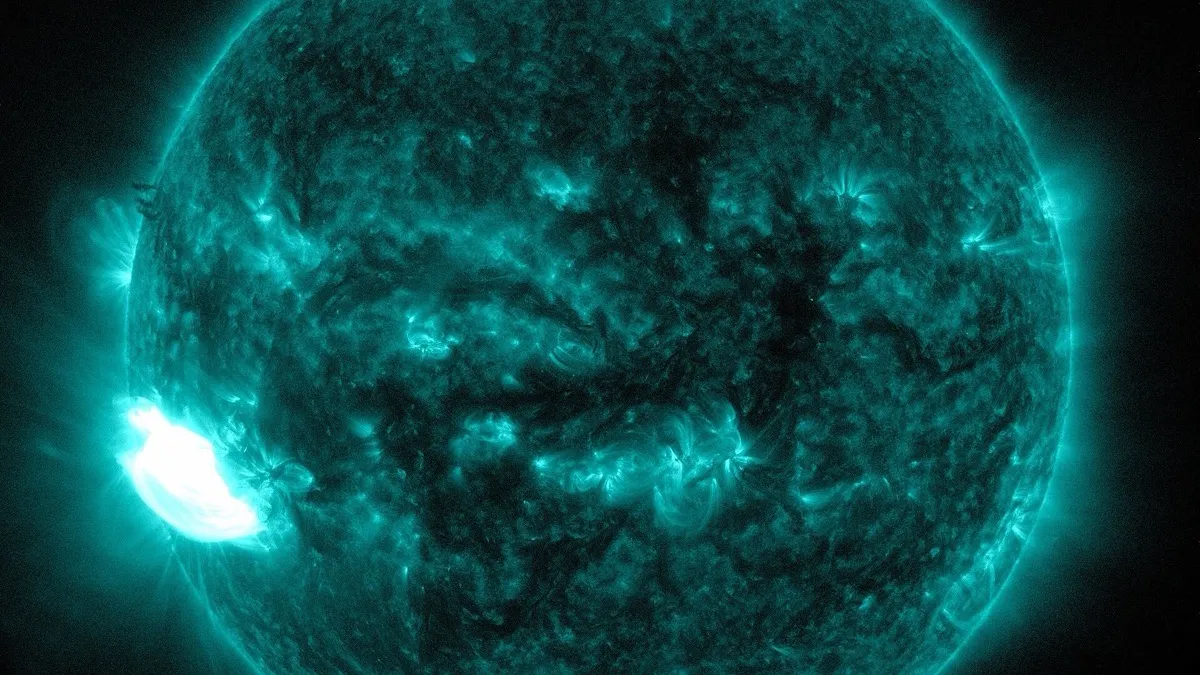
- They tracked the neutral magnesium line at 12.32 micrometres during an X1.5-class flare. Because the line is highly sensitive to the Zeeman effect, its splitting gives the magnetic field strength directly.
- They observed an apparent weakening of the field beneath the flare ribbons during the impulsive phase.
- Radiative-hydrodynamic simulations and atmospheric inversions confirmed that the height at which the line forms rises during the flare.
Why it matters
- Flares release magnetic energy, but how the field changes during them is poorly understood, according to the authors. Measuring it directly is the basis for explaining how that energy builds up and is released.
- The authors are cautious: the change may come from the line forming higher up or from a redistribution of the field. They rule out neither.
- For those studying space weather, the mid-infrared adds a tool to measure the field directly during a flare.
The number
12.32 micrometres. Wavelength of the magnesium line used as a magnetic field gauge.
Context
The magnetic field is one of the fundamental variables in solar physics, and flares are violent, rapid releases of magnetic energy in the Sun’s atmosphere. The study shows that the mid-infrared can follow the field’s evolution during one of them.
What’s next
- No deadlines announced.
- The authors report no new observing campaigns.
Bottom line
The 2025 solar storm exceeded radiation thresholds for high-altitude flights, and another study estimated that the Sun stripped metres of surface from comet 3I/ATLAS: solar activity is measured by its effects far from the Sun.
Sources
- Nature Astronomy — Apparent magnetic field decay in a solar flare from Zeeman splitting of the Mg I 12.32-µm line (DOI 10.1038/s41550-026-03013-2; October 23, 2026)
- Cover image: NASA Goddard Space Flight Center from Greenbelt, MD, USA, Public domain, via Wikimedia Commons
Edited by Rodrigo Cornejo. How we select and verify: who writes these notes.