What happened
- Tessa Frincke and Darryl Seligman, of Michigan State University, published as an advance article in Monthly Notices of the Royal Astronomical Society, on October 13, 2026, an estimate of how much material 3I/ATLAS lost on approaching the Sun.
- Using only already published gas production rates, they estimate solar heating removed a layer between 1.71 and 5.24 meters, between 0.40% and 1.25% of the initial mass.
- If dust is added, at 1 to 4 times the gas ratio, the erosion would exceed 10 meters.
- The authors present the figures as approximations and lower limits, because the measurements are discontinuous and come from different methods and instruments.
Why it matters
- The number gives a scale: layers of meters, not kilometers. That helps decide what to expect from future observations of the material left exposed.
- The result is a model that uses other people’s data. For astronomy done from Chile, with first-rate observatories, the practical message is that continuously measured rates are worth more than scattered ones.
- The estimated erosion is uniform over the surface. A real comet loses material in patches, so the effective layer may be larger or smaller in particular places.
The number
1.71 to 5.24 meters: thickness of surface lost to gas alone, per the MNRAS paper.
Context
3I/ATLAS is the third interstellar object detected in the Solar System. An earlier study placed a radiation-altered layer at about 15 to 20 meters deep, so only the dust scenarios reach that region. Phys.org, which reported it on October 20, quotes the authors saying it is possible the surface was eroded down to layers of unaltered material, which is not yet established. Like the 2025 solar storm and the design of NASA’s lunar base rovers, it is a reminder of what the Sun does to everything passing nearby.
What’s next
- More measurements of gas and dust production after perihelion.
- No announced timeline for observations that test whether unaltered material remains at the surface.
- The paper is an accepted advance version; the final version is pending.
Bottom line
An estimate built from published data is cheap, fast and needs no telescope of its own. Its value is the question it fixes: how much the Sun took, and what was left in view for whoever keeps looking.
Sources
- MNRAS — Assessment of the Mass Loss and Radius Change of 3I/ATLAS Based on Observed Production Rates (DOI 10.1093/mnras/stag1941) — October 13, 2026
- Phys.org — The sun may have stripped away meters of interstellar comet 3I/ATLAS — October 20, 2026
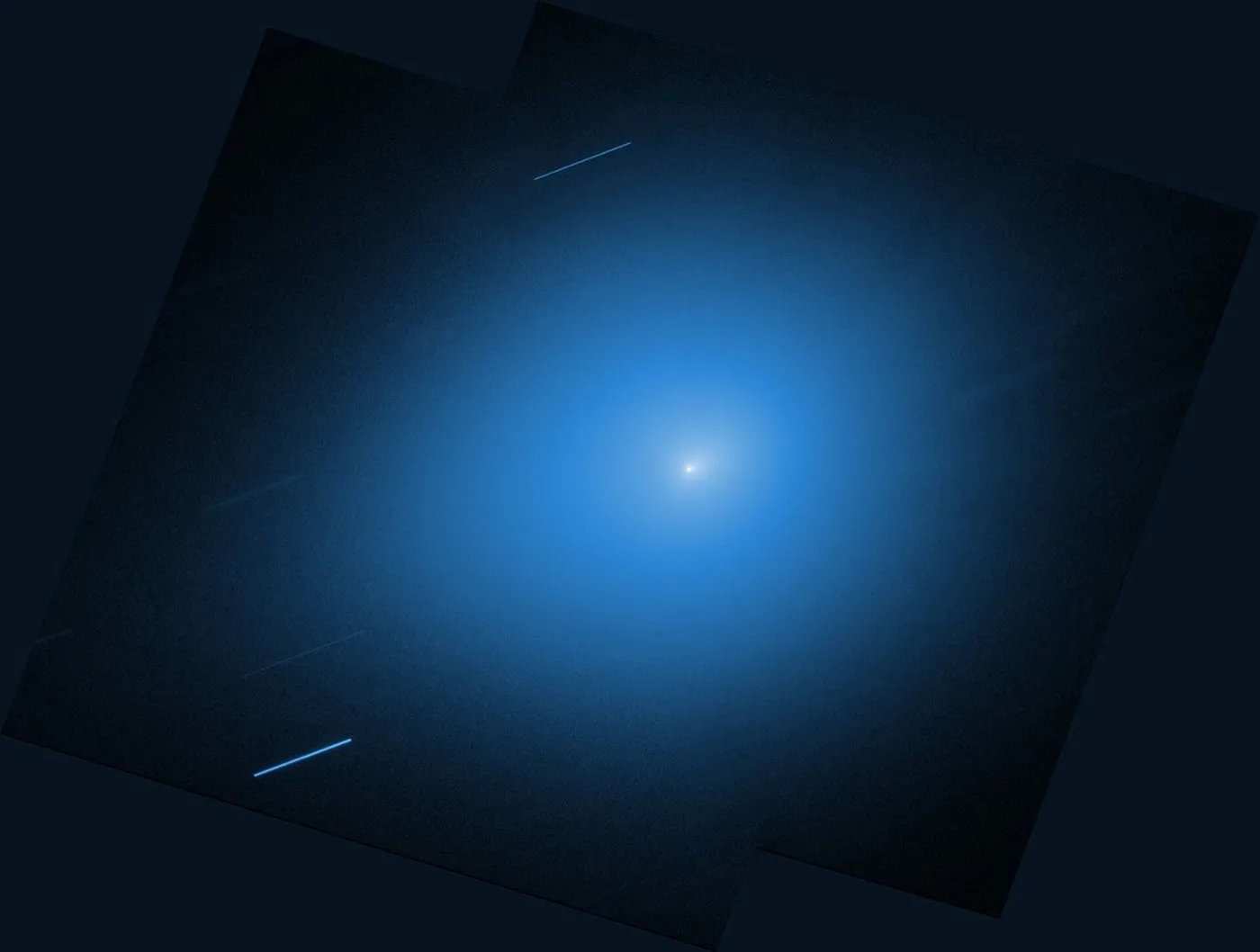
- Image: NASA, ESA, STScI, D. Jewitt (UCLA), M.-T. Hui (Shanghai Astronomical Observatory, Public domain, via Wikimedia Commons
Edited by Rodrigo Cornejo. How we select and verify: who writes these notes.