What happened
- On October 23, 2026, Nature Communications published work by 10 authors from the University of Manchester and Lancaster University.
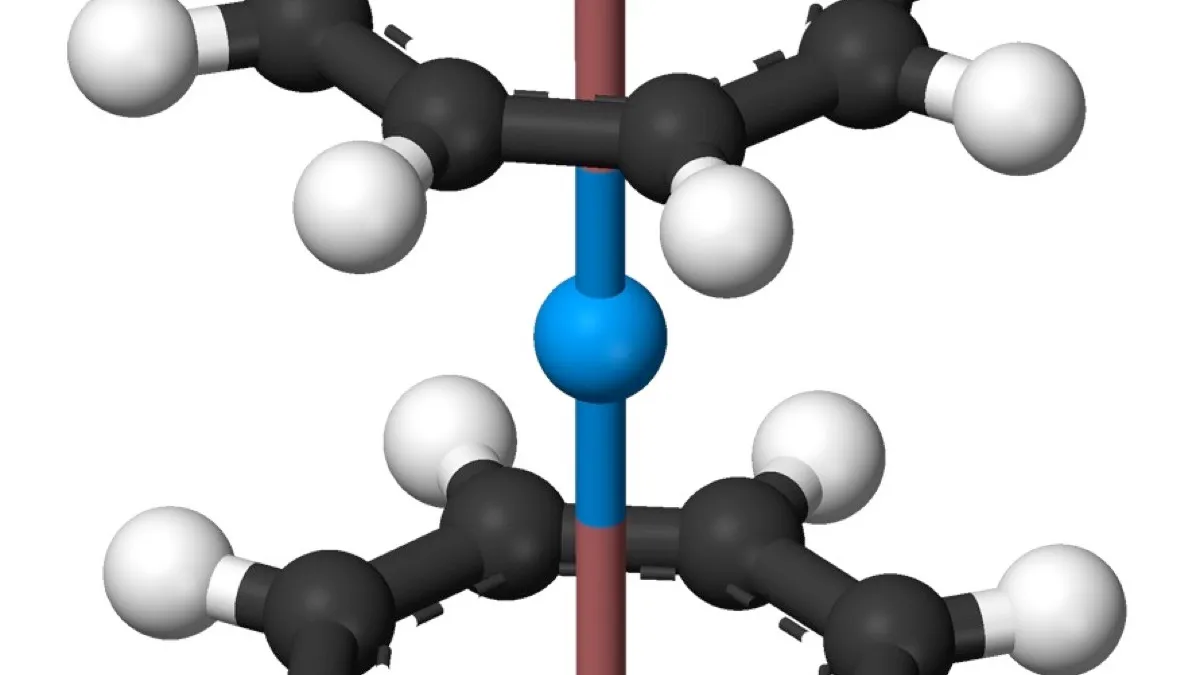
- They isolated the uranocenium cation, the oxidised version of uranocene, a compound with one uranium atom between two eight-carbon rings.
- Uranocene is the actinide equivalent of ferrocene, which oxidises easily. Until now no higher oxidation states of uranocene were known, the authors say.
- Using electron paramagnetic resonance spectroscopy and magnetometry, they showed that this uranium(V) complex has a 5f¹ ground state.
Why it matters
- On oxidation, the uranium–carbon bond barely changes length, and in solution the uranocene/uranocenium pair is almost ideally reversible. Such a system works as a reference for studying f electrons.
- According to the authors, the cause is covalency: uranium’s 5f and 6d orbitals mix more into the bonds and offset the expected contraction. It is a case where an actinide’s covalency governs structure and properties.
- This is basic chemistry, with no immediate application announced. Its value lies in testing theories of bonding in heavy elements.
The number
5f¹. Ground state of uranium(V) in uranocenium: a single electron in the f orbitals.
Context
Ferrocene, an iron atom between two carbon rings, oxidises easily to ferrocenium. Uranocene is its uranium analogue, but its oxidised form had not been isolated. X-ray diffraction confirmed the change in bond length is minimal.
What’s next
- No deadlines announced.
- The authors do not anticipate applications.
Bottom line
Northwestern held a single positron to prepare a symmetry test, and a one-metre titanium single crystal came out of a 3D printer: fine control of matter is advancing at very different scales.
Sources
- Nature Communications — Isolation of uranocenium, the bis-[8]annulene uranium cation (DOI 10.1038/s41467-026-77066-2; October 23, 2026)
- Cover image: Benjah-bmm27, Public domain, via Wikimedia Commons
Edited by Rodrigo Cornejo. How we select and verify: who writes these notes.