What happened
- Xona Space Systems announced on October 22, 2026 a US$250 million Series D at a US$2.45 billion valuation, bringing its total capital to more than US$570 million.
- The round is led by Steve Jurvetson’s Future Ventures, with new and existing investors.
- According to CEO Brian Manning, they launched six Pulsar satellites this week. Four will begin serving users in 2027 and two are the first built entirely in its Burlingame factory.
- Xona says its Pulsar-0 prototype made more than 500 transmissions and achieved positioning accuracy better than two centimeters.
Why it matters
- GPS was designed for another world: today autonomous machines, power grids and telecom networks depend on precise time and position, and a weak signal from 20,000 kilometers away is easy to interfere with.
- Xona’s bet is to drop to low orbit. That is the company’s own reading and it still has to be seen working at scale: there will be no commercial service until 2027.
- For mining, precision farming and power operators in Chile, which today use medium-orbit constellations, an additional source of position and time would be a backup. Compatibility with existing receivers, according to Xona, is achieved without physical changes.
The number
Under 2 centimeters. Positioning accuracy that Xona says it demonstrated with Pulsar-0 in orbit.
Context
Pulsar-0 was last year’s test satellite. On October 7 the company named a new chief operating officer as Pulsar entered scaled production. All accuracy figures come from the company itself.
What’s next
- Service with four of the six satellites in 2027.
- Scaling to global coverage, with no satellite counts or dates.
Bottom line
Low orbit is filling with different uses: Google plans to send AI chips to orbit to escape the power limit on the ground, and Japan launched the MMX probe to Mars to bring back samples from Phobos.
Sources
- Xona Space Systems — What Comes After GPS: Our $250M Series D (published October 22, 2026)
- SpaceNews — Navigation startup Xona raises $250 million as it begins satellite deployment (October 22, 2026)
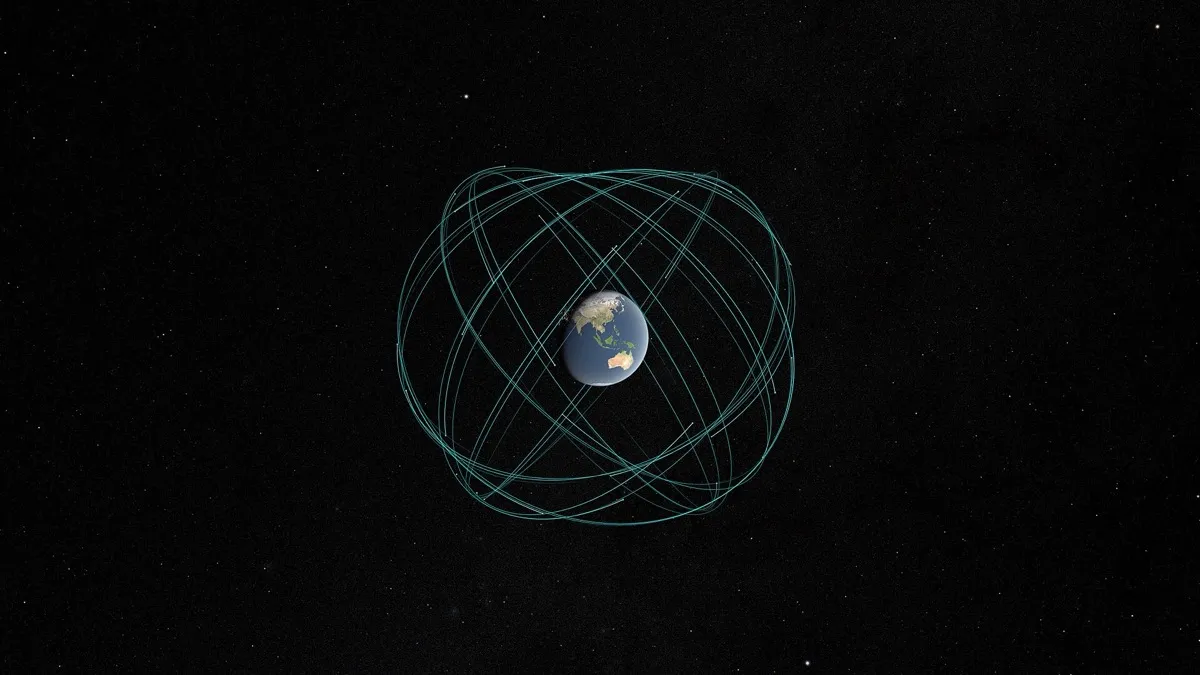
- Cover image: NASA’s Scientific Visualization Studio - Science and Technology Corporation/Kel Elkins, Public domain, via Wikimedia Commons
Edited by Rodrigo Cornejo. How we select and verify: who writes these notes.