What happened
- A mathematical proof settled a conjecture open since 2008 on when quantum computers can achieve enormous advantages over conventional machines.
- The result proves the Aaronson-Ambainis conjecture, linking a question about mathematical functions to whether big speedups require special structure in the problem.
- The work, posted on GitHub by David Turturean of Physical Superintelligence (PSI), was reported on 6 November 2026 by The Quantum Insider, which presents it as AI-assisted.
- The theorem sets a limit on quantum algorithms outperforming classical ones on unstructured inputs.
Why it matters
If a large quantum speedup needs structure in the problem, the search for useful algorithms should look at problems with symmetry or patterns, not arbitrary data. The result reinforces the theory behind that direction. It is also a concrete case of AI in mathematics: the text does not detail what the model contributed, so “assisted” raises the question of how a proof is checked and credited when a machine collaborates.
The number
2008. The year the conjecture was posed. Settling it took about 18 years and arrived as a GitHub document, not yet a peer-reviewed paper, per the outlet.
Context
A conjecture like this bridges Boolean functions, where the influence of variables is studied, and quantum algorithms, whose cost is counted in queries. The outlet notes the theorem does not decide which applications will deliver useful speedups. Related coverage: A study gathers 24 problems where a quantum computer could outdo a classical one, IBM, Oak Ridge and AMD join quantum and classical computing to correct errors, A quantum gas below 10 picokelvin aboard the Chinese space station, Axiom uses agents to verify the Stacks Project, 7,654 pages of advanced mathematics.
What’s next
- The proof must pass expert review before it is considered accepted.
- If confirmed, researchers can focus on problems with exploitable structure.
- How much reasoning came from the model, and how each step was verified, should be clarified.
Bottom line
A proven bound is worth as much as a new algorithm: it says where not to look. That it came with a machine’s help is a reason to look closely at how proofs are made today.
Sources
- Matt Swayne, “AI-Assisted Proof Settles Longstanding Question About Quantum Speedups”, The Quantum Insider, 6 November 2026. Based on the outlet’s article; the original GitHub document was not reviewed and the proof was not verified.
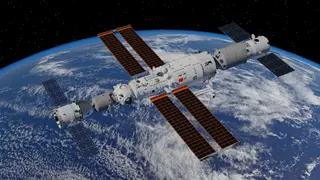
- Cover image: PantheraLeo1359531, CC BY 4.0, via Wikimedia Commons
Edited by Rodrigo Cornejo. How we select and verify: who writes these notes.