What happened
- IBM, the Quantum Science Center at Oak Ridge National Laboratory and AMD presented on 5 November 2026 a co-design platform for researching quantum error correction, according to a press release reproduced by The Quantum Insider.
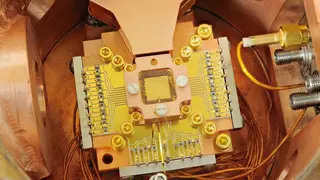
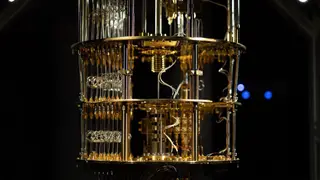
- The first deployment places IBM quantum computers, among them the 120-qubit Nighthawk processor, next to Oak Ridge’s Umbra high-performance system.
- Umbra uses AMD Instinct MI355X GPUs and 5th Gen AMD EPYC CPUs. That classical capacity will go to research on error correction, decoding and software orchestration.
- The three institutions want to compare architectures and workflows with both kinds of machine working together.
Why it matters
- Qubits make errors easily. Correcting them requires measuring and decoding in real time, work that falls on very fast classical computers.
- The question has changed, says IBM’s Jay Gambetta: it is no longer whether correction will work on hardware, but how to accelerate and optimize it for useful systems.
- For a public lab, having the two machines together makes it possible to test at scale ideas that used to stay in simulation.
The number
230 times. That is the approximate increase in hard operations still needed. IBM says it has shown experiments with up to 70 logical qubits and 438 hard operations. The US Department of Energy’s target is 100 logical qubits and 100,000 operations by late 2028.
Context
The 100-logical-qubit target belongs to the so-called Q Competition, part of the Department of Energy’s Quantum Genesis Mission. A logical qubit spreads information across several physical qubits so that errors can be detected and corrected without losing it.
According to the release, Nighthawk’s square lattice connectivity, its speed and real-time pulse control let teams compare what each method requires in qubits, time, samples and classical computing. These are company claims; progress towards the target will have to show up in published results.
We follow this race at Mamífero. We reported that a trapped ion corrected its own errors and passed break-even and that Jülich ran qubit gates in 6.8 nanoseconds. Also that Qblox connected its quantum controller to an NVIDIA DGX Spark and that Telefónica and IQM will install a quantum computer in Madrid.
What’s next
- Researchers will test correction methods and workflows with an eye on the 2028 target.
- IBM presents this as the start of a platform that other participants could join.
- Publishing comparisons between methods will make it possible to measure how far the gap to those 100,000 operations narrows.
Bottom line
Correcting quantum errors has also turned out to be a classical computing problem. That is why this announcement is as much about GPUs as about qubits, and the 2028 deadline puts that bet to the test.
Sources
- The Quantum Insider, “Oak Ridge National Laboratory, IBM And AMD Launch New Co-Design Platform for Quantum Error Correction”, 5 November 2026, link. It reproduces IBM’s press release.
- Cover image: IBM Research, CC BY 2.0, via Wikimedia Commons
Edited by Rodrigo Cornejo. How we select and verify: who writes these notes.