What happened
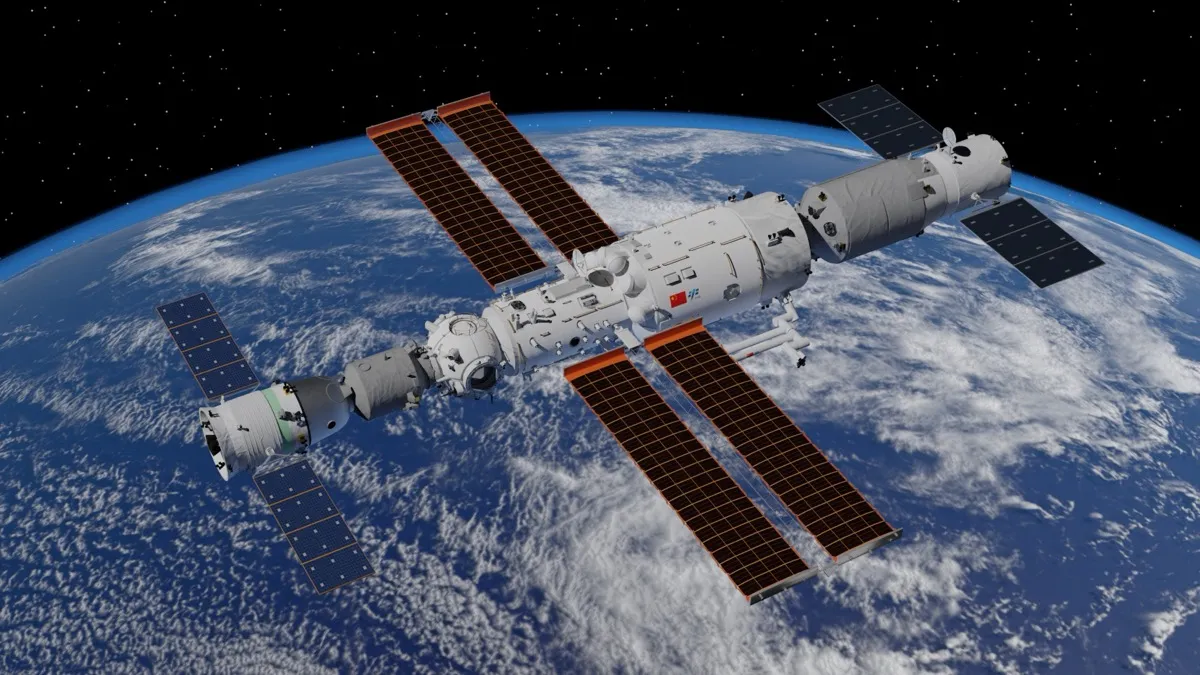
- Twenty-two researchers, with Xiong, Li, Jin and Huang among the authors, published on 5 November 2026 in Science a Bose-Einstein condensate created aboard China’s Tiangong space station.
- The condensate contains 2.0 × 10⁴ atoms and reaches an equivalent temperature of 9.7 picokelvin, with a range of -2.7 to +3.2.
- The free expansion time, during which the cloud of atoms is left to evolve unconfined, reached 7 seconds.
- Unlike earlier records, obtained with magnetic traps on atom chips, this experiment uses an optical dipole trap.
Why it matters
- Ultracold atom platforms enable fundamental physics tests and precision measurements with atom interferometry.
- Microgravity extends the time during which the cloud can be observed, something impossible in a ground laboratory, where the atoms fall.
- The optical trap offers better optical access and can condense both magnetic and non-magnetic atoms, a flexibility the magnetic trap lacks.
The number
9.7 picokelvin. A picokelvin is a trillionth of a degree above absolute zero. The previous record reported in this kind of system was 38 picokelvin, with 2 seconds of free expansion.
Context
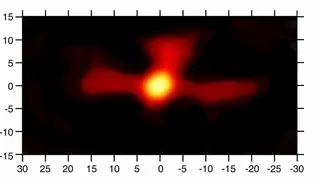
A Bose-Einstein condensate is a state of matter in which thousands of very cold atoms behave as a single quantum entity. Reaching those temperatures means trapping the atoms and removing the most energetic ones, then releasing them to measure how they expand: the slower the expansion, the lower the equivalent temperature.
Optical trap systems had not been used before to prepare degenerate gases under microgravity, according to the paper. The authors suggest this result could stimulate a new generation of experiments in quantum simulation and precision measurement in space.
At Mamífero we follow cold and quantum physics. We reported that Northwestern suspended a single positron and that Columbia trapped electron waves in a metal by interference. Also that a trapped ion corrected its own errors and that Grenoble made a photon source built only from silicon.
What’s next
- The authors envisage quantum simulation and metrology experiments aboard the station.
- A longer expansion would allow more sensitive atom interferometers.
- Whether other space platforms replicate the result with optical traps remains to be seen.
Bottom line
Cooling matter to near absolute zero is hard; holding it still long enough to look at it is harder. In orbit, seven seconds of free fall solve much of the problem.
Sources
- Xiong, Li, Jin, Huang et al., “Quantum gases below 10 picokelvin in space”, Science, 5 November 2026, DOI 10.1126/science.aea5324. This note is based on the paper’s abstract.
- Cover image: Shujianyang, CC BY-SA 4.0, via Wikimedia Commons
Edited by Rodrigo Cornejo. How we select and verify: who writes these notes.