What happened
- On October 23, 2026, Phys.org distributed a theoretical study titled «When black holes admit pair-of-pants topologies», published in Physical Review D by Giacomo Cacciapaglia, Manuel Del Piano, Vania Vellucci and Francesco Sannino.
- The authors ask which laws prevent a black hole from splitting in two and whether any circumstance would allow it.
- For a non-rotating black hole, splitting would reduce total entropy, which thermodynamics disfavors. The calculations show that fast rotation opens a loophole.
- But the two parts must also be able to separate and not fall back onto each other. With that requirement, the window narrows again, except for black holes spinning near the maximum possible rate.
Why it matters
- If it happened, the black hole’s horizon would take a pants-like shape over time, with one section dividing into two «legs». Hence the study’s name.
- In theories with extra dimensions, black-hole-like objects are known that become unstable and break apart, and splitting can be favorable when one part is much smaller.
- Sannino stresses that thermodynamic feasibility does not prove the split happens, and that the probability remains unknown.
The number
No figure. The authors say they cannot yet give a probability that a black hole splits, because it depends on how gravity behaves beyond Einstein.
Context
Sannino expects small primordial black holes to be more prone to splitting than astrophysical ones, which are much larger. As a possible indirect signal, he mentions that gamma-ray telescopes such as Fermi-LAT could look for emissions from tiny fragments that would form during mergers. The paper is listed on Crossref dated October 22, 2026, and there is an arXiv version. This note relies on Phys.org’s account of the university release; the full paper was not read.
What’s next
- The authors are working to quantify the probability according to how gravity behaves beyond general relativity.
- An indirect check would depend on gamma-ray telescope data.
Bottom line
On black holes and their surroundings, a black hole’s disk swells and shades itself earlier than expected. In particle physics and cosmology, a heavy, long-lived neutrino could explain why matter beat antimatter. From the Webb telescope, Webb measures methane in 3I/ATLAS with 13 times more deuterium than comet 67P. And on the limits of thermodynamics, a quantum speed limit for reaching equilibrium was demonstrated.
Sources
- Phys.org — Can a black hole split in two? Rapid rotation may offer a loophole (October 23, 2026; University of Southern Denmark release)
- Study: Cacciapaglia et al., «When black holes admit pair-of-pants topologies», Physical Review D, DOI 10.1103/cx69-t466 (October 22, 2026 per Crossref; the paper text was not read)
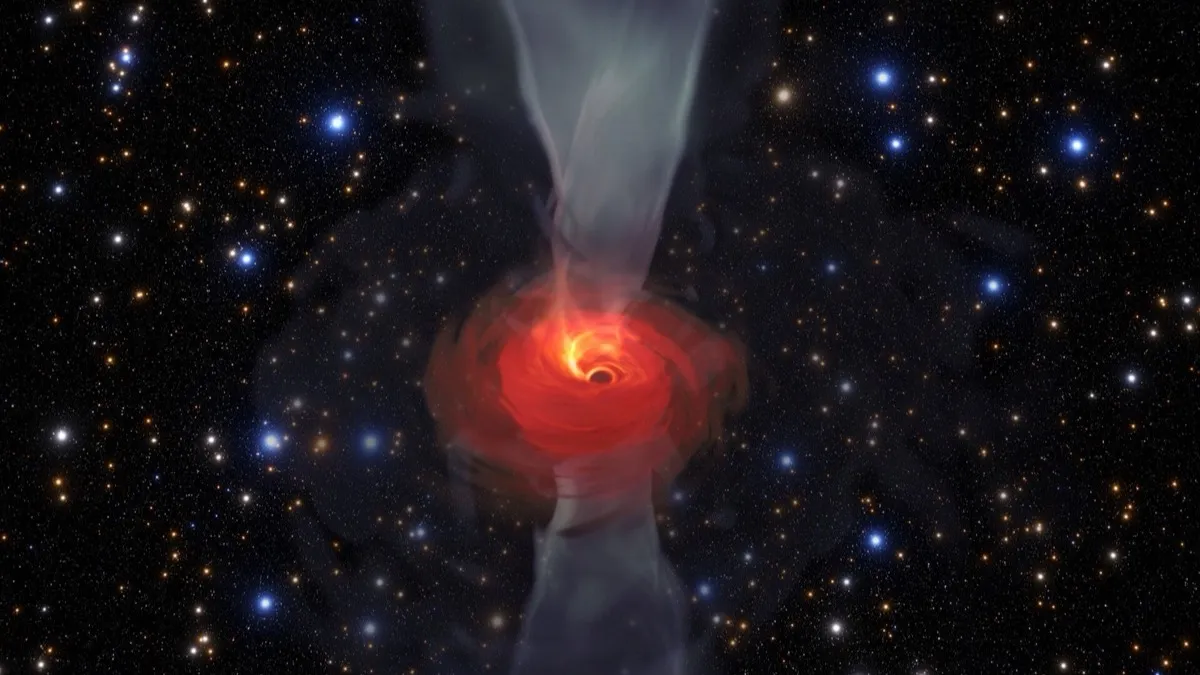
- Cover image: Jordy Davelaar et al./Radboud University/BlackHoleCam, CC BY 4.0, via Wikimedia Commons
Edited by Rodrigo Cornejo. How we select and verify: who writes these notes.