What happened
- On October 22, 2026, Nature Astronomy published multiwavelength observations of a black hole X-ray binary during the decline of an outburst.
- The team, led by astrophysicists Armas Padilla and Muñoz-Darias, with the University of La Laguna among the institutions, tracked the system’s optical and near-infrared spectrum.
- At the peak of the outburst, near 20% of the Eddington limit, the spectrum was cool and dominated by hydrogen and helium recombination lines.
- As luminosity fell, the spectrum turned hot, highly irradiated and nearly featureless.
Why it matters
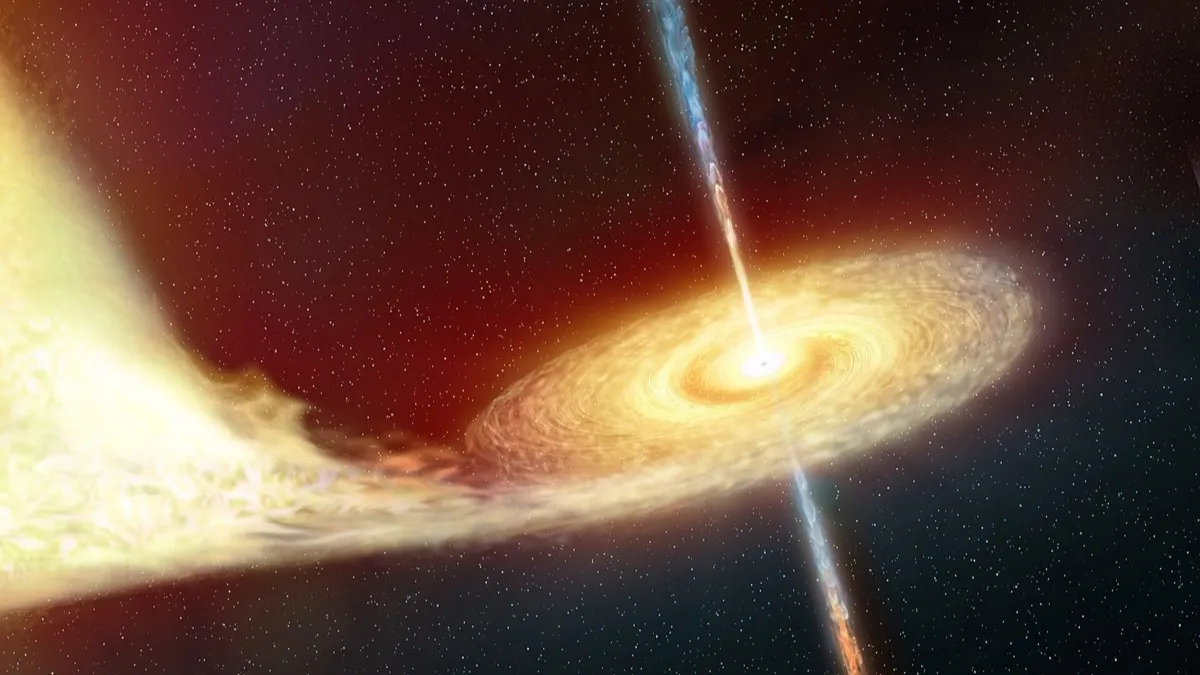
- The authors read the change as the emergence of a thickened inner disk at the peak, which shields the outer regions from the energetic radiation produced near the black hole. X-ray spectra from the same dates support that reading.
- Theory expected the disk to puff up only when approaching the Eddington limit, the maximum luminosity at which radiation does not yet blow away infalling gas.
- If the effect is common, as observations of similar systems suggest, it changes what is inferred from these objects.
The number
20% of the Eddington limit. The system’s luminosity at the outburst peak, when the disk was already casting a shadow over its outer regions.
Context
According to the paper, self-shadowing structures at luminosities well below the limit affect estimates of black hole spin, X-ray polarisation measurements and the physical conditions of the outer disk and its winds. The work includes authors from Oxford, New York University Abu Dhabi, Kyoto and other centres. Astronomy this week also measured methane with 13 times more deuterium in 3I/ATLAS and estimated how much surface the Sun stripped from that comet.
What’s next
- The authors propose revisiting spin and polarisation measurements of other X-ray binaries with this effect in mind.
- New outbursts from similar systems will show whether the disk always thickens at the same threshold.
Bottom line
A change of colour in the light of a distant system forces a rethink of when gas falling into a black hole deforms. In the solar system, the 2025 solar storm exceeded radiation thresholds for flights and Chang’e-6 suggests KREEP is more widespread on the far side of the Moon.
Sources
- Nature Astronomy — A self-shadowing black hole accretion disk at sub-Eddington luminosities (October 22, 2026)
- Cover image: NASA, ESA, Martin Kornmesser (ESA/Hubble), CC BY 4.0, via Wikimedia Commons
Edited by Rodrigo Cornejo. How we select and verify: who writes these notes.