What happened
- Seven researchers, with Berman, Campbell, Hartmann and Heinemann among the authors, published on 5 November 2026 in Nature Communications start-to-end simulations of a compact X-ray laser.
- Today’s X-ray free-electron lasers are large, complex machines, limited by electron beam brightness.
- The proposal uses ultra-bright beams produced by a metre-scale plasma wakefield accelerator, with a plasma photocathode releasing a beam of very low emittance.
- By tuning the beam charge, space-charge forces balance the beam fields against the wakefields, which reduces energy spread and improves stability.
Why it matters
- The so-called water window is a range of soft X-rays especially useful for observing biological material, because water is relatively transparent and carbon is not.
- Today that kind of coherent light comes from very large facilities, with scarce access for most research teams.
- The authors argue their approach would help widen access to coherent, high-power soft X-ray radiation.
The number
One metre scale. Both the plasma wakefield accelerator and the undulator, the device that makes electrons wiggle so they emit light, are posed at metre dimensions, against the hundreds of metres of current facilities.
Context
Beam stability is decisive for extracting, transporting and focusing it inside the undulator. According to the simulations, the resulting beams produce coherent, femtosecond-scale, wavelength-tunable photon pulses at strong gain.
The regime described would reliably generate multi-gigawatt-class pulses across the water window. Tuning comes from varying the witness beam charge, and the scheme holds up against variations in plasma wakefield strength and jitter in the laser that drives the photocathode. The nature of the work deserves emphasis: these are start-to-end simulations, not a built device.
At Mamífero we follow accelerator and light physics. We reported that Smith-Purcell radiation concealed a chirality and that AIST counts photons by the magnetic flux quanta they leave. Also that Grenoble made a photon source built only from silicon and that Shanghai tested a flat optic for EUV lithography.
What’s next
- The next step is to demonstrate the scheme experimentally, as it exists in simulation for now.
- If it works, mid-sized laboratories could reach coherent soft X-rays without a giant facility.
- The water window opens imaging applications in hydrated biological samples.
Bottom line
The brightest X-ray sources take up kilometres. This work describes how one might fit in a room, provided the plasma behaves as the simulations predict.
Sources
- Berman, Campbell, Hartmann, Heinemann et al., “Strong-gain water-window X-ray laser driven by plasma photocathode wakefield acceleration”, Nature Communications, 5 November 2026, DOI 10.1038/s41467-026-78880-4. This note is based on the paper’s abstract.
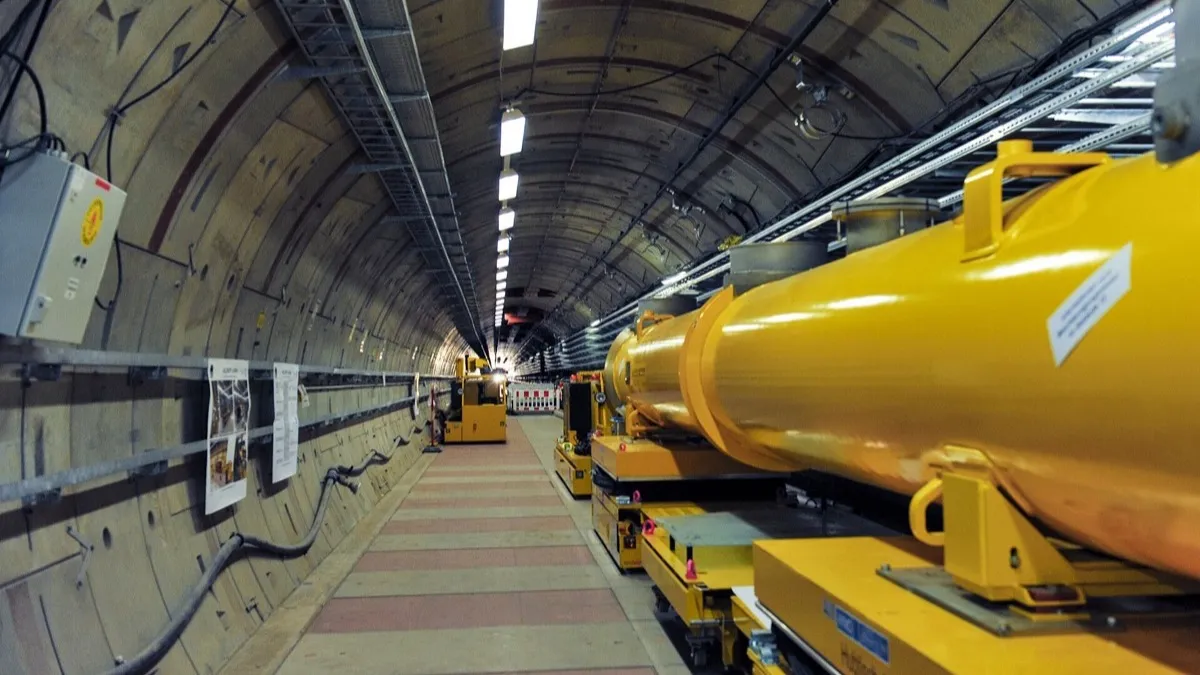
- Cover image: Simon Bierwald from Dortmund, Germany, CC BY 2.0, via Wikimedia Commons
Edited by Rodrigo Cornejo. How we select and verify: who writes these notes.