What happened
- On October 23, 2026, Phys.org distributed a study from the Singapore University of Technology and Design (SUTD) and China, published in Nature Communications, on the Smith-Purcell effect.
- In 1953 it was shown that an electron beam skimming past a grating emits light whose color depends on the electron’s speed and the grating’s spacing.
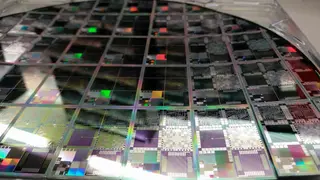
- The new work found that this radiation is inherently chiral, meaning it has «handedness». The authors observed it with silicon gratings inside a scanning electron microscope.
- To reveal it they broke the symmetry in two ways: rotating the grating relative to the beam or moving the beam from the center toward an edge.
Why it matters
- The chirality went unnoticed because of symmetry. Left- and right-handed light are spread symmetrically in space, and measurements along the symmetry plane cancel them.
- Because it does not rely on a delicate resonance, the effect is broadband: the light could be tuned from about 450 to 900 nanometers with little change in chirality.
- Wu sees chiral light sources as the application closest to use, with extreme ultraviolet light, used in lithography, an attractive target.
The number
0.87. Chirality measured with a 100-nanometer grating, more than double what had been reported for Smith-Purcell.
Context
On the scale used, 1 is light of a single handedness and 0 is no net handedness. The value rose with the twist angle to 0.726 at 30 degrees, and reversing the twist flipped the handedness. Shrinking the grating pitch from 120 to 100 nanometers reached 0.87. Simulations of shifting the beam predict up to 0.98. The authors warn that some materials glow under electron bombardment and can swamp the signal, and that reaching X-rays would require even smaller structures or more energetic electrons.
What’s next
- The authors see applying the idea to chiral sources as the next step, with extreme ultraviolet light as a goal.
- For X-rays with controlled chirality, new quantum physics at those scales would have to be understood.
Bottom line
Chirality and electron control appear in other work: WS₂ layers with the same twist and no central defect respond to polarized light and Columbia traps electron waves in a metal by interference. On lithography light, Shanghai tested a flat optic for EUV lithography. And in particles, Northwestern suspends a lone positron and prepares a symmetry test.
Sources
- Phys.org — Plain silicon reveals a hidden electron effect (October 23, 2026; SUTD release)
- Study: «Observation of inherent chiral Smith–Purcell effect via symmetry breaking», Nature Communications, DOI 10.1038/s41467-026-78729-w (October 22, 2026 per Crossref; the paper text was not read)
- Cover image: Wabbot9, CC BY-SA 4.0, via Wikimedia Commons
Edited by Rodrigo Cornejo. How we select and verify: who writes these notes.