What happened
A team linked to Cornell detected vocalizations of bowhead whales using a fiber optic cable in Alaska, according to an institutional publication from November 10, 2026. The work expands a listening technique that had already recorded blue whales and fin whales.
Researcher Léa Bouffaut uses distributed acoustic sensing, DAS. A machine sends laser pulses down the fiber and measures tiny changes caused by vibrations. Thus, infrastructure laid for telecommunications can also function as a sensor network on the seabed.
Why it matters
The difference with a microphone is the length of the recording area. A cable allows disturbances to be observed along many points along its path, rather than relying solely on a sensor placed in one position. This offers potentially useful information about the presence and movements of animals.
The challenge is to demonstrate which vocalizations can be distinguished and under what conditions. The intense and very low frequency signals of some whales had already served as proof. Bowhead whales emit calls of higher frequency and lower intensity, so detecting them expands the tested range. It does not prove, by itself, that any species can be followed with any cable.
The number
Between about 150 and 300 hertz. This is the approximate range that Cornell mentions for bowhead and North Atlantic right whale calls, which are more difficult to record than signals below 100 hertz already detected using this technology.
Context
Bouffaut worked during the spring of 2026 near Utqiaġvik with local organizations and with a Quintillion cable. The statement describes weeks of analyzing large volumes of data before identifying the vocalizations.
The publication also presents a review in Methods in Ecology and Evolution on the status of DAS for monitoring marine mammals. The date of the announcement should not be confused with the season in which the observations were made.
On related topics, Mamífero has also published carbon transport by marine snow, soil respiration and nitrogen deposition, Aerosols and radiation budget in East Asia and resilience measurements in changing systems.
What’s next
The researcher proposes moving from demonstrations to operational tools through collaboration with those who manage the infrastructure and those responsible for conservation. To do this, it will be necessary to know which sections are useful and how their records compare with reference observations.
The method complements underwater microphones, according to Cornell. Not all cables or all acoustic conditions offer the same information. The ability to access data from the ground and cover long distances is a design advantage, but the quality of detection must be checked for each use. Estimating populations requires more than recognizing that a vocalization was present.
Bottom line
Underwater fiber can provide a way to listen to the ocean using existing infrastructure. The detection of bowhead whales expands the available tests. Turning that signal into useful monitoring requires calibration, access to cables, and careful interpretation of what you’re actually hearing.
Sources
- Cornell Chronicle, Kathi Borgmann, communication on acoustic detection with optical fiber, November 10, 2026. The source does not indicate publication time.
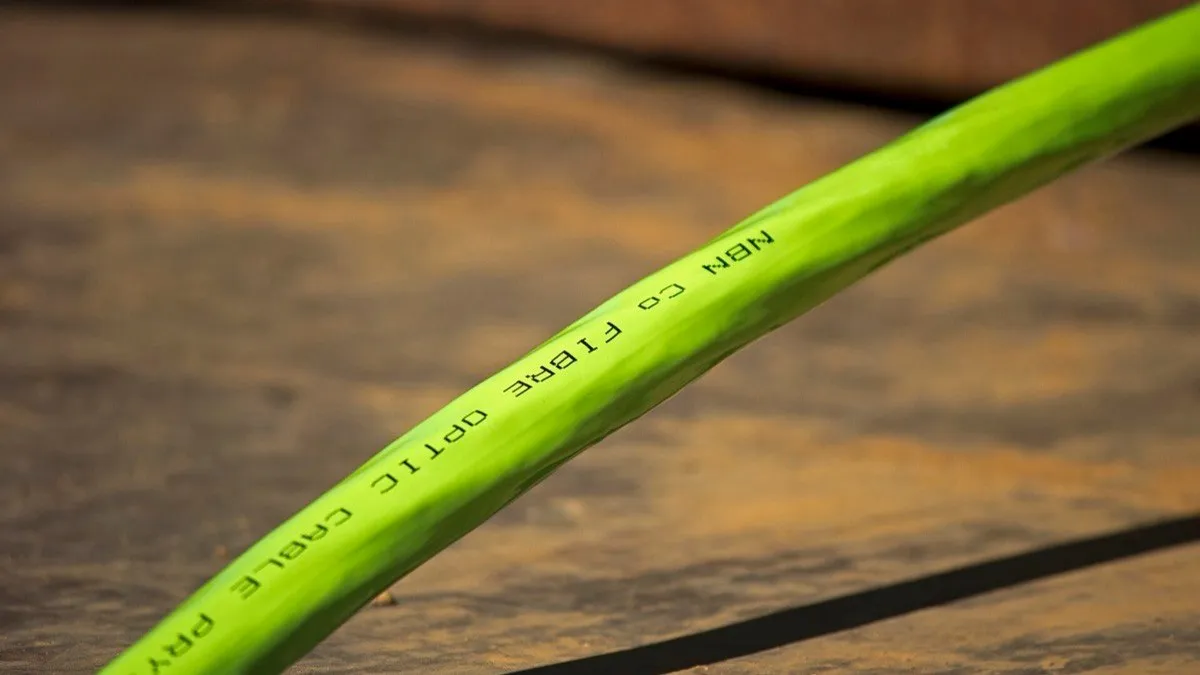
- Cover image: Bidgee, CC BY-SA 3.0 au, via Wikimedia Commons. Cropped and resized to 1200 × 675 pixels. Reference photograph; it does not document the announced event.
Edited by Rodrigo Cornejo. How we select and verify: who writes these notes.