What happened
- A group led by Kyungtae Kim, June-Young M. Lee and Hyeongseop Kim published on November 7, 2026 in Nature Communications a scheme to manipulate Majorana bound states with a “Josephson trijunction.”
- A trijunction is the point where three Josephson junctions meet on a topological insulator in a perpendicular magnetic field.
- According to the study, that geometry offers two dynamics: a source/sink one, where pairs of Majorana states are created or annihilated, and a path one, where one of them moves between a junction and the center.
- The work is theoretical and calculation-based: the authors illustrate the scheme with a double-trijunction setup. This summary is based on the paper’s abstract.
Why it matters
Majorana bound states are zero-energy localized states in topological superconductors that obey non-Abelian statistics when exchanged. Building topological qubits requires moving them at will: generating, displacing and fusing them so they can be braided.
The proposal offers a way to achieve those operations with a fixed structure, which according to the authors needs no dynamical control of the setup. That simplicity is what makes it relevant for topological quantum computing designs.
The number
Two dynamics in one structure. At a source/sink boundary, two Majorana states are generated in pairs at the center and one leaves toward a junction; the reverse also occurs. At a path boundary, one moves from a junction to the center or vice versa, with no other involved.
Context
The authors show how, by combining those two dynamics, Majorana states can be fused and braided in a network of trijunctions. With the double-trijunction example, they argue non-Abelian state evolutions can be manipulated without dynamical control of the setup and detected by Josephson emission spectroscopy.
It is important to distinguish the scope: the paper proposes and calculates, it does not demonstrate a topological qubit in a device. Majorana states in the lab are a debated subject, and this study does not settle that discussion. The full text was also not reviewed, only the abstract.
At Mamífero we have followed advances in quantum control and superconductivity. We reported that Jülich ran qubit gates in 6.8 nanoseconds, that Quantinuum reached 5 errors per million operations on a logical qubit, that vibrations in a superconductor were mapped layer by layer and that AIST counted photons through magnetic flux quanta in a superconductor.
What’s next
- An experimental group would have to build the trijunction and look for the spectroscopy signals the study proposes.
- It remains to be checked whether the scheme withstands the noise and defects of real materials.
- If verified, it would give a route to operate topological qubits without dynamical control of the structure.
Bottom line
The study delivers not a device but a blueprint: where to join three junctions so Majorana states are created, moved and brought together. Its value will be known when someone builds it and measures what it predicts.
Sources
- Kim, K., Lee, J.-Y. M., Kim, H. et al., “Topological Josephson trijunctions as a Majorana source and path”, Nature Communications, November 7, 2026, DOI 10.1038/s41467-026-79077-5, link. The note is based on the paper’s abstract.
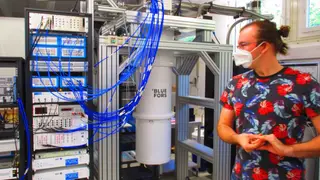
- Cover image: OJB Quantum, CC BY 4.0, via Wikimedia Commons
Edited by Rodrigo Cornejo. How we select and verify: who writes these notes.