What happened
- A team of 21 researchers published on 3 November 2026 in Nature Communications a mouse study on low-digestible carbohydrates and the bacterium Salmonella enterica serovar Typhimurium, a common foodborne pathogen.
- Low-digestible carbohydrates, such as fibres and sugars the gut does not fully absorb, are generally considered good for the microbiota.
- The authors show that acute overconsumption of some of them, particularly low-digestible sugars such as arabinose, lactulose and the polyols used as sugar substitutes, weakens the gut’s resistance to colonisation by Salmonella.
- In infected mice, that excess raised pathogen loads in faeces, encouraged its spread to the rest of the body and caused colitis.
Why it matters
- It shows that a dietary component considered good for the microbiota can, in excess, work in a pathogen’s favour.
- Polyols are used as sugar substitutes in many foods, so the question of quantities has practical interest, although the study was done in mice.
- The effect is not just that the bacterium grows more: the change in the gut also makes it more virulent.
The number
3. That is the number of low-digestible sugar examples the study names: arabinose, lactulose and polyols.
Context
The authors analysed the case of arabinose in detail. Its rapid fermentation acidifies the gut environment, disturbs the microbiota, changes short-chain fatty acid levels and increases amino acid availability, which can sustain the pathogen’s growth.
The disturbance also affects virulence. It widens the tissues Salmonella can occupy, for example spreading into the small intestine, and selects for more invasive bacteria. Unlike what happens when the microbiota is disrupted by antibiotics, in this case colonisation requires two of the bacterium’s type III secretion systems, SPI-1 and SPI-2. That links virulence with the pathogen’s ability to thrive.
At Mamífero we follow pathogens and their mechanisms. We reported that without the DDP protein the Toxoplasma parasite cannot reproduce and that a clade of enterovirus D68 tracks cases of acute flaccid myelitis. Also that a French patient was the first known human case of Shamonda virus and that macaques that lived through a viral outbreak avoid contaminated food more.
What’s next
- It remains to be seen whether the effect occurs in people and at what levels of intake.
- The study describes acute overconsumption; the effect of usual amounts is not established.
- The link between fermentation, acidity and virulence raises questions about other gut pathogens.
Bottom line
The fibre and sugars we do not absorb usually feed the bacteria that protect us. This mouse study shows that in excess they can do the opposite: acidify the gut and leave Salmonella with more room and more weapons.
Sources
- Nguyen, B., Wotzka, S., Maier, L. et al., “Overconsumption of low-digestible sugars can increase susceptibility to Salmonella Typhimurium infection”, Nature Communications, 3 November 2026, DOI 10.1038/s41467-026-78218-0. This note is based on the paper’s abstract.
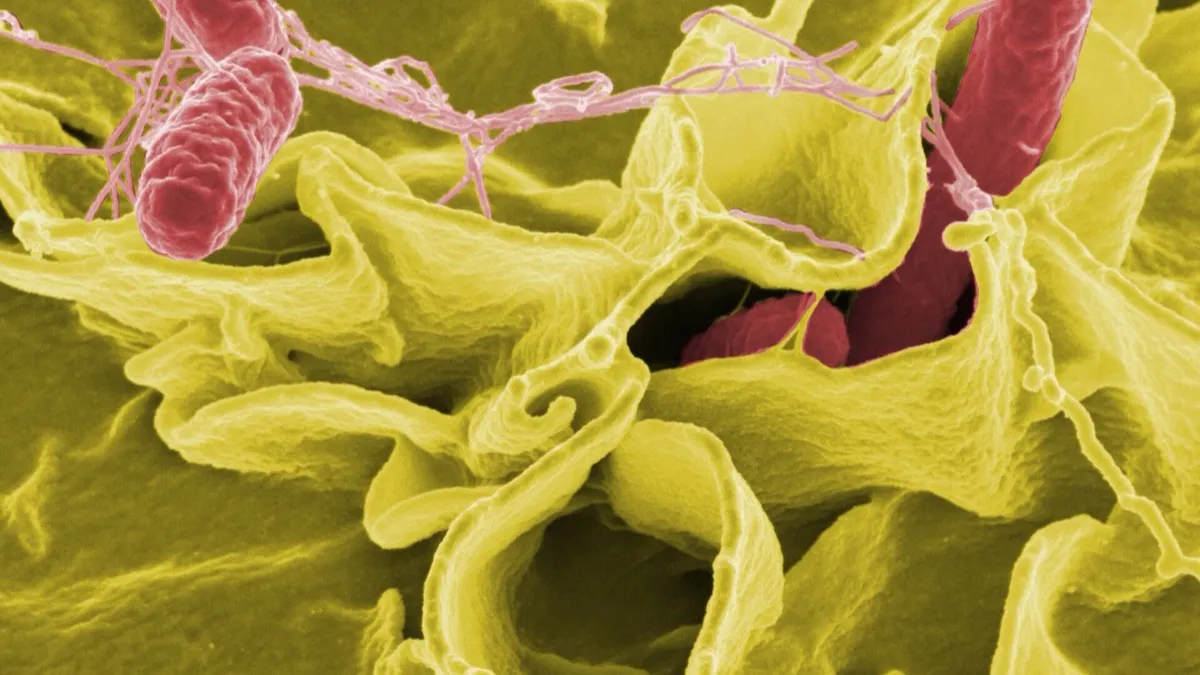
- Cover image: NIAID, Rocky Mountain Laboratories, public domain, via Wikimedia Commons
Edited by Rodrigo Cornejo. How we select and verify: who writes these notes.