What happened
- On October 22, 2026, Nature published work by 13 authors from the University of Copenhagen, the Weizmann Institute, the University of Augsburg, IIT Madras and Huazhong University of Science and Technology.
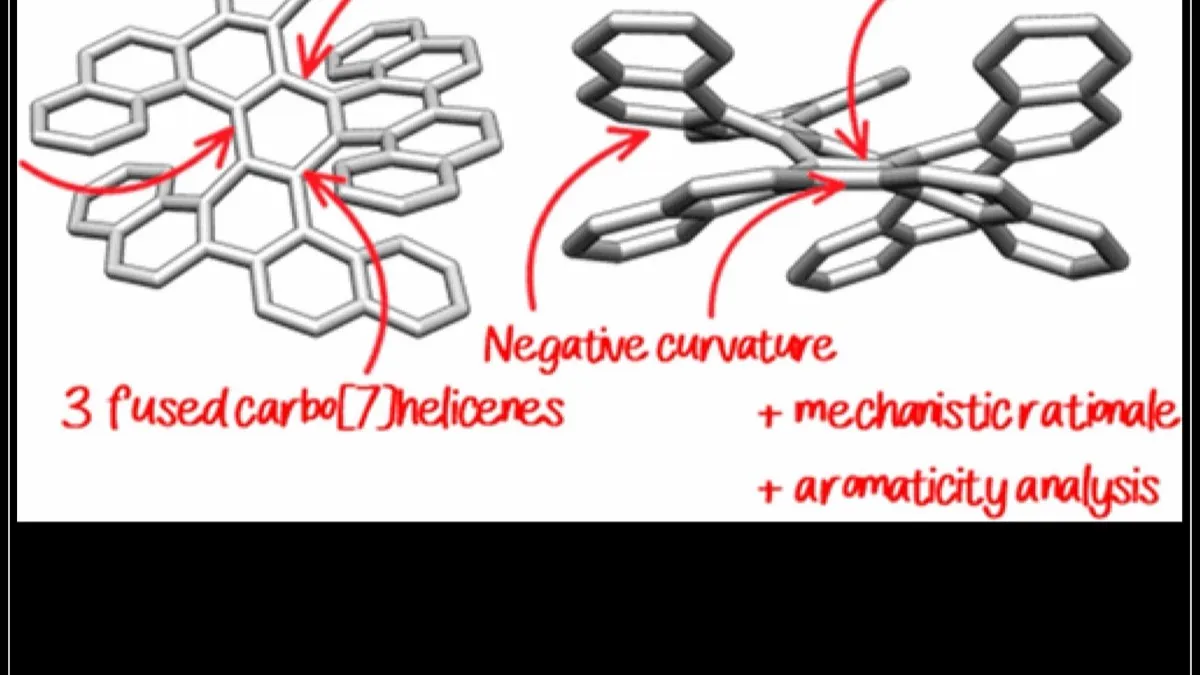
- They suspended a helicene molecule between two electrode tips. An applied voltage drives cyclic motion with 100% directional preference, which reverses when the polarity is flipped.
- Above a voltage threshold, the current through the rotating molecule rises significantly. Where that rise begins can be tuned by stretching or compressing the helix.
- Calculations attribute both effects to rotation driven by current-induced forces, with a transition from stepwise to continuous rotation.
Why it matters
- A rotor that responds to current and also modulates it combines two functions in one piece: motor and switch.
- The authors present it as a prototype for a new class of torque-driven molecular machines with full unidirectionality.
- It is an experiment with one molecule between two tips, not a device ready to manufacture. Its value is in showing the mechanism.
The number
100%. Directional preference of the rotation, reversible with voltage polarity.
Context
The Archimedes screw has pumped water for more than two millennia, and its helical shape appears in chiral molecules. It had been proposed that current could generate torque in them; the authors say such effects were absent in earlier helical junctions.
What’s next
- No deadlines announced.
- The calculations predict a transition to continuous rotation above a threshold voltage, which other groups can test.
Bottom line
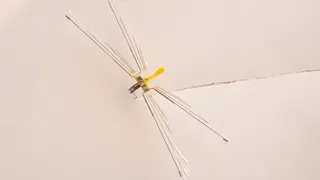
A microdrone under one gram flew for more than four minutes without a tether, another tiny machine. And Columbia trapped electron waves in a metal through interference, also at the scale of a few atoms.
Sources
- Nature — Current-Driven Molecular Machine with Rotation-Enhanced Conductance (DOI 10.1038/s41586-026-11312-x; October 22, 2026)
- Cover image: Denis Hagebaum-Reignier / Yannick Carissan / Yoann Coquerel / Institut des Sciences Moléculaires de Marseille / Aix-Marseille University / Institut de chimie / National Center for Scientific Research, Public domain, via Wikimedia Commons
Edited by Rodrigo Cornejo. How we select and verify: who writes these notes.