What happened
- Six researchers, with Wang, Qu and others among the authors, published on 5 November 2026 in Nature Communications an origami-inspired modular architecture that computes mechanically, without electronics.
- Mechanical computing is envisioned as a pathway toward processing in the structure and material themselves, with potential for intelligent metamaterials and robots in extreme environments. Until now, architectures were tied to a binary paradigm.
- The design encodes logical mappings into the structure’s own kinematic response, with inputs and outputs decoupled.
- The multi-stable states of two Kresling origami configurations serve as physical carriers of the signals, and torsional transitions among those states allow switching.
Why it matters
- A structure that computes on its own could be built into soft robots or materials that must work where electronics fail, such as extreme environments.
- Ternary logic, with three values instead of two, can represent more information per signal than binary, and this work implements it in a mechanical system.
- Comparisons between binary and ternary systems show the challenges and opportunities of multi-valued logic.
The number
Seven logic gates. The team demonstrated seven common gates and also modular half-adders and full-adders, in binary and ternary versions, from logic operations to more advanced arithmetic.
Context
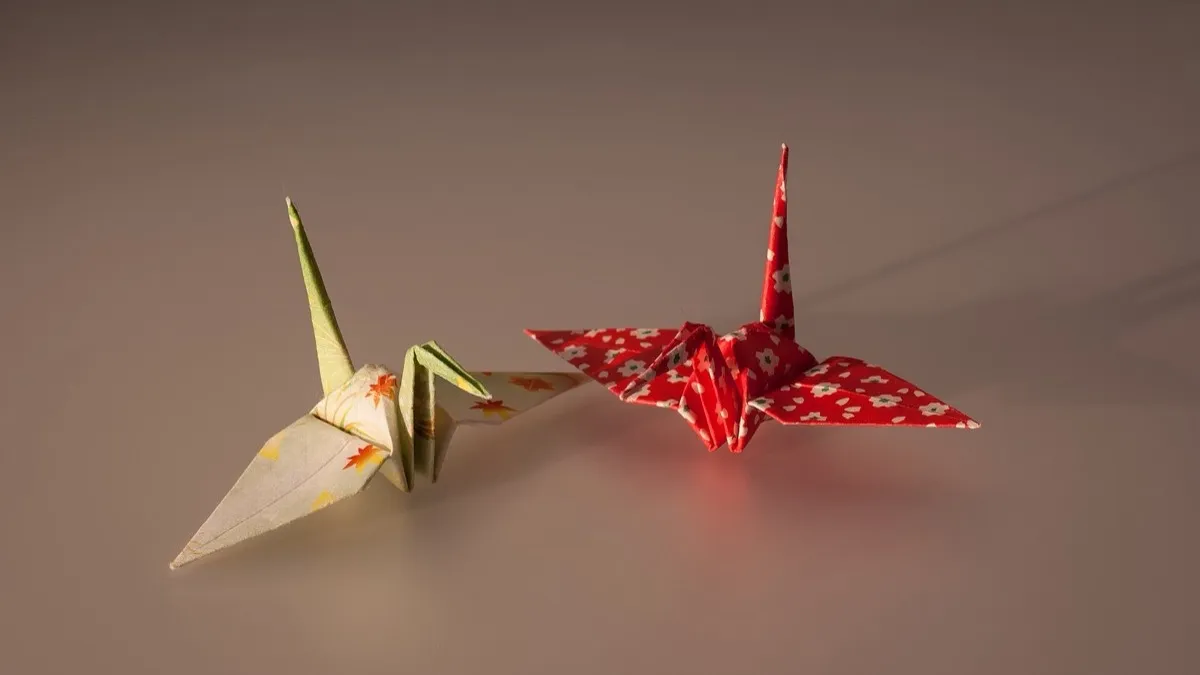
Kresling origami is a cylindrical foldable pattern that can remain stable in more than one configuration and folds with a twist. Each stable configuration represents a value, and the twist that takes it from one to another switches the signal.
The physical platform and its response-programming strategy are, according to the authors, a simplified and generalized paradigm that would support migration to higher-level mechanical computing mechanisms.
An important nuance: a mechanical computer of this kind is slow and low in density compared with a chip, and does not compete with electronics in speed. Its interest lies in the structure’s autonomy and in working without electrical power for computation, something the abstract frames as potential and not as a demonstrated application.
At Mamífero we follow structures that sense and move. We reported that Chongqing created a battery-free thimble that transmits the finger’s stroke and that a sub-gram microdrone flew untethered for over four minutes. Also that a sleeve with tactile pixel fibres shows video and that PolyU presented a negative-curvature alloy that withstands cryogenic temperatures.
What’s next
- The authors see the platform as a base for more advanced mechanical computing mechanisms.
- Integrating these units into robots or metamaterials would be the step towards an application.
- The speed, durability and size of the circuits that can be built remain to be measured.
Bottom line
That a set of folded paper adds numbers is a useful curiosity. What is valuable is that it does so with three states, and with the shape itself as memory.
Sources
- Wang, Wang, Qu, Wang et al., “Toward Ternary Computing Enabled by Origami-Inspired Modular Architectures”, Nature Communications, 5 November 2026, DOI 10.1038/s41467-026-79187-0. This note is based on the paper’s abstract.
- Cover image: Laitche, Public domain, via Wikimedia Commons
Edited by Rodrigo Cornejo. How we select and verify: who writes these notes.