What happened
- Nineteen researchers, with Yuan, Xing, Zhang and Li among the authors, published on 6 November 2026 in Nature Communications green perovskite LEDs with a lifetime of 1,350 hours at an initial luminance of 1,000 nits.
- That figure, T50, is the time it takes for brightness to fall to half. According to the paper, in most cases the experimentally measured half-life of visible perovskite LEDs stayed below 1,000 hours, in contrast to the much longer extrapolated lifetimes.
- The devices reach a maximum energy-conversion efficiency of 28.0% and a peak external quantum efficiency of 24.5%.
- The authors also built a flexible active-matrix display prototype with these LEDs.
Why it matters
- Perovskite LEDs offer high colour purity and efficiency, but their stability under display conditions was the obstacle to reaching products.
- The gap between measured and projected lifetimes matters: a long projection with no direct measurement leaves doubts about real performance.
- Reaching 1,000 hours at 1,000 nits, measured, is a reference milestone for displays, hence the title of the work.
The number
2.1 volts. That is the voltage at which the device operates near 1,000 nits, below the material’s bandgap energy. In that range ion migration, which degrades these LEDs, is suppressed.
Context
The advance is due to a fluorinated self-assembled molecular layer, inserted between the metal oxide and the polymer layer that carries holes. That layer gives charge injection a nearly Ohmic behaviour and makes it possible to lower the operating voltage.
The authors observed that the total number of photons the device emits over its T50 lifetime increases sharply when the operating voltage drops below the bandgap. That leads to the conclusion that a low-voltage architecture is key to reaching the 1,350-hour stability.
These are laboratory results in a single colour, green. Between a stable device and a commercial display, the other colours, large-scale manufacturing and lifetime under real use remain to be solved, something the abstract does not address.
At Mamífero we follow optical materials and devices. We reported that quantum-dot photodiodes match InGaAs ones in the infrared and that a sleeve with tactile pixel fibres shows video. Also that Wuhan grows lead sulphide infrared sensors in water and that HexaTech launches a 100 mm aluminium nitride substrate.
What’s next
- The result still has to be extended to the other colours needed for a full display.
- Large-scale manufacturing and stability under real use are pending steps.
- The flexible active-matrix prototype points towards displays for wearable devices.
Bottom line
The key was not a new material, but a layer a few molecules thick that lets the LED switch on at lower voltage. Sometimes lifetime is won at an interface.
Sources
- Yuan, Xing, Zhang, Li et al., “Addressing the 1000-h/1000-nit stability challenge in perovskite LEDs”, Nature Communications, 6 November 2026, DOI 10.1038/s41467-026-79298-8. This note is based on the paper’s abstract.
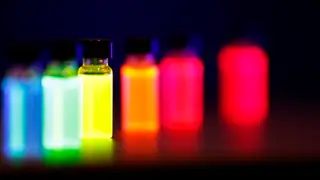
- Cover image: Mister rf, CC BY-SA 4.0, via Wikimedia Commons
Edited by Rodrigo Cornejo. How we select and verify: who writes these notes.