What happened
- Researchers at the Regensburg Center for Ultrafast Nanoscopy (RUN) experimentally demonstrated a fundamental limitation: an electron’s location and its behavior over time cannot both be determined with arbitrary precision.
- They call it the “space-time limit”.
- The work is an international collaboration including the groups of Jascha Repp, Rupert Huber, Franz Giessibl and Klaus Richter in Regensburg, and Angel Rubio’s team at the Max Planck Institute in Hamburg.
- ScienceDaily circulated it on 7 November 2026.
Why it matters
Heisenberg’s uncertainty principle limits what can be known at once about properties such as a particle’s position and momentum, not because of instrument flaws but because of the laws of nature. For position and time the principle imposes no such restriction. This new limit sets a practical frontier for those wanting to watch electrons move in materials and devices with fine detail in space and time, key for ultrafast electronics and quantum technologies.
The number
100,000 times faster. The speed that, per ScienceDaily’s headline, electronics could reach by understanding this limit, against current devices.
Context
Understanding how chemical reactions occur, how light interacts with materials and how electrons travel through devices is essential for clean energy, quantum computing and high-performance electronics. Ultrafast microscopy seeks to measure these processes in space and time at once, but the new limit fixes how much sharpness can be asked of both. The text read does not detail the experimental technique or the exact limit value, so the “100,000 times” figure is the outlet’s projection, not a measured result. Related coverage: An electron crosses a silicon-germanium T-junction with 100% fidelity, Vibrations of the crystal are mapped layer by layer in a superconductor below its unit cell, A quantum gas below 10 picokelvin aboard the Chinese space station, Origami structures compute with three states and achieve mechanical gates and adders.
Measuring an electron in a material requires lighting it with pulses of light or other particles. The shorter the pulse, the better time is resolved, but the worse energy and, per this work, position are defined. It is a trade-off like a photograph: a very short exposure freezes motion but leaves the image with less information. The Regensburg experiment turns that intuition into a relation measured on real electrons.
What’s next
- Other labs can look for the limit in different materials.
- Designers of ultrafast instruments will have to weigh the frontier when choosing resolution.
- Theorists will need to pin down the mathematical relation behind the limit.
Bottom line
Every new instrument finds nature caps what can be seen. Knowing the cap helps design better, even if it limits the dream of seeing everything.
Sources
- ScienceDaily, “A hidden limit of space and time could unlock electronics 100,000 times faster”, 7 November 2026, on work from the Regensburg Center for Ultrafast Nanoscopy and the Max Planck Institute. The scientific paper was not read.
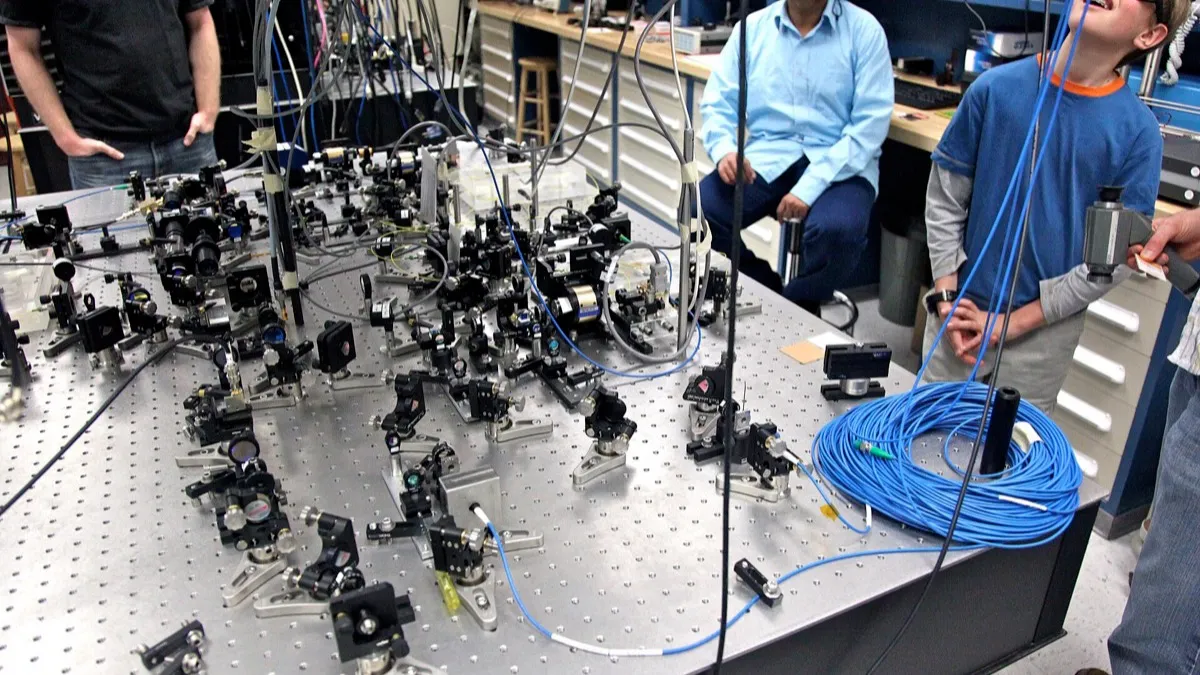
- Cover image: Steve Jurvetson from Menlo Park, USA, CC BY 2.0, via Wikimedia Commons
Edited by Rodrigo Cornejo. How we select and verify: who writes these notes.