In January 2015, the tech world was focused on smartphones, the early rollout of 4G and algorithms that, at best, could recommend a movie or plot a route on a GPS. In that context, writer and illustrator Tim Urban published a two-part essay on his influential blog Wait But Why that seemed lifted from a hard science fiction novel: “The AI Revolution”.
What many read at the time as an entertaining but distant thought experiment now reads like a chillingly accurate oracle. Years before the Transformer architecture was invented by Google (2017) and almost a decade before OpenAI’s ChatGPT or Anthropic’s models permeated everyday life, Urban managed to synthesize dense academic theories (reviewing the foundational literature of authors like Nick Bostrom and futurists like Ray Kurzweil) to warn us about the imminent and explosive takeoff of Artificial Intelligence.
The impact of this work isn’t limited to having popularized niche concepts. Its real analytical value lies in having structured the contemporary debate on technological development long before the mass consumer market experienced its empirical effects. By breaking down the mechanics of exponential growth, the quality of intelligence and the alignment problem, the text laid the groundwork for understanding why the discussion today is no longer merely technical, but deeply political and institutional.
The Illusion of Linear Time and the S-Curve
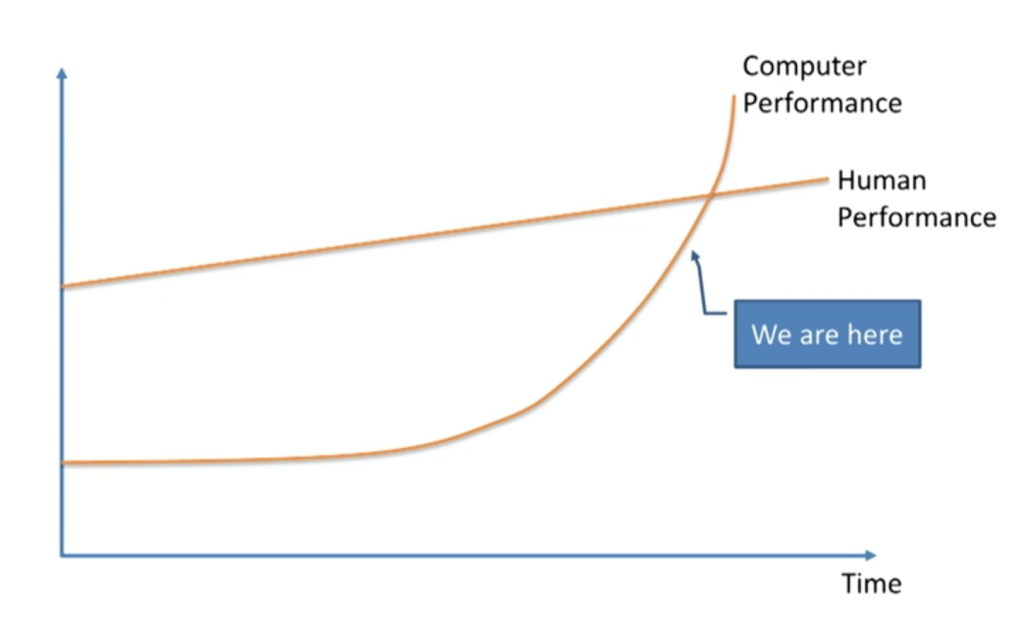
Tim Urban diagnoses a critical flaw in human foresight: our inescapable tendency to project the future linearly. Using the Law of Accelerating Returns, the text explains that technological progress doesn’t advance at a constant speed, but accelerates as societies become more advanced.
To illustrate why we’re blind to this acceleration, Urban introduces the concept of S-Curves and the Die Progress Unit (DPU) (the number of years a human would have to travel into the future for the level of technological progress to kill them from shock). The development of a new technological paradigm goes through a phase of slow growth, followed by a vertical explosion and, finally, a leveling off as the technology matures.
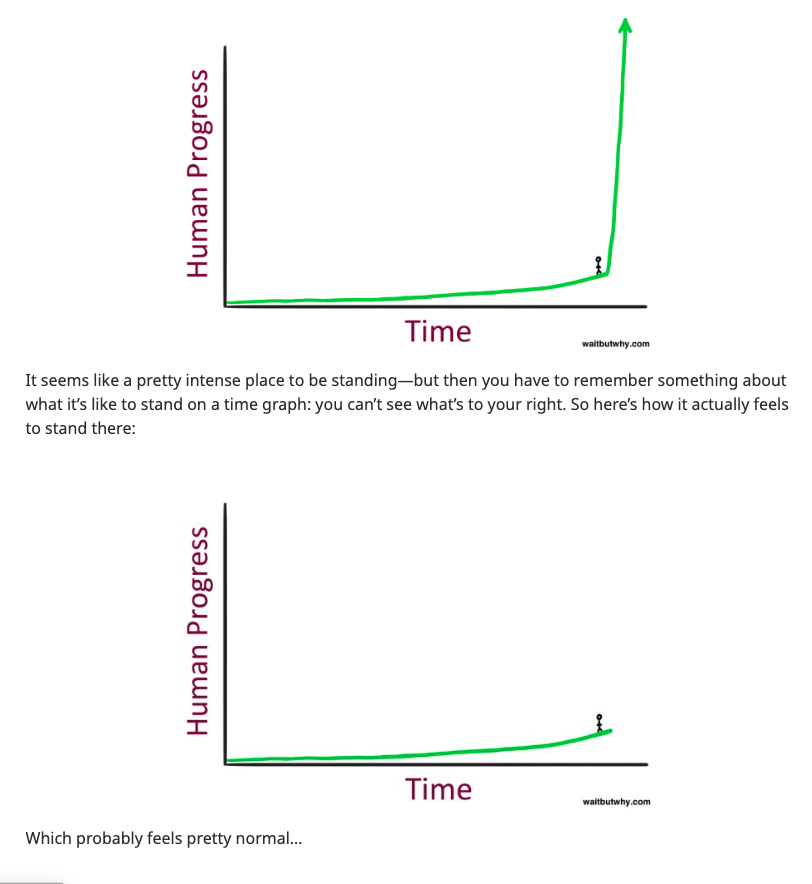
Note on the original illustration: Wait But Why conceptualizes this with the drawing of a human standing on a linear time graph. The human looks to the left, seeing smooth, predictable progress, without realizing that, just to their right, the exponential curve shoots violently straight up. (Credit: Tim Urban / Wait But Why)
In 2015, the world was on the plateau of the S-curve of the internet and smartphone era, which created a false sense of normality. Beneath the surface, however, AI was accumulating the critical mass needed to start a new S-curve, far more violent and vertical. If the 20th century saw more progress than all previous centuries combined, the 21st century will experience the equivalent of 1,000 times the progress of the 20th century.
The Evolutionary Staircase: Speed Intelligence vs. Quality
Contrasting this popular-science view with the formal academic definitions of artificial intelligence makes it clear that the foundational literature doesn’t conceive of AI simply as an increase in computing power, but as a qualitative transition in machines’ ability to abstract, plan and carry out complex reasoning. Urban divides AI into three levels:
- ANI (Artificial Narrow Intelligence): Machines that are perfect at a single task.
- AGI (Artificial General Intelligence): Human intellectual capacity in all areas.
- ASI (Artificial Superintelligence): An intellect unfathomably superior to the best human brains.
The mistake people often make when imagining ASI is to think of “Speed Intelligence”: a machine that thinks exactly like a human, but a million times faster. Urban clarifies that the real disruption will come from Quality Intelligence.
To explain it, he uses the metaphor of the chimpanzee and the skyscraper. The cognitive difference between a chimpanzee and a human isn’t one of speed, but of structural cognitive modules. A chimpanzee will never be able to understand that a skyscraper was built by humans; to it, it’s simply part of nature. In the same way, a machine just two evolutionary “steps” above humans will have a quality of intelligence so overwhelmingly superior that its actions and methods will be, by definition, incomprehensible to the human mind.
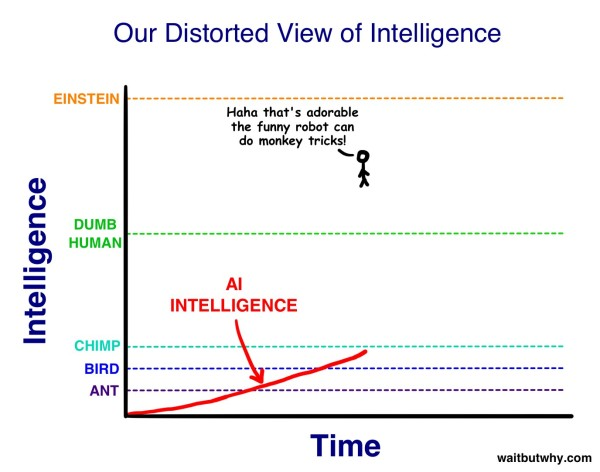
Note on the original illustration: Urban charts this as “The Intelligence Staircase.” A staircase where a low step belongs to an ant, higher up a chicken, then a chimpanzee. Just one step above the chimpanzee is the human (from the most basic individual to Albert Einstein, all squeezed onto the same step). Above, endless empty steps into the darkness. (Credit: Tim Urban / Wait But Why)
The Intelligence Explosion and the “Tripwire”
Urban argued that the leap from AGI to ASI won’t take decades. This qualitative improvement is achieved through Recursive Self-Improvement. The moment an AGI gains the ability to understand its own base architecture, it can rewrite its code to make itself more intelligent. That new, more capable version rewrites the code even more efficiently, creating a loop that cuts the improvement time from months to minutes.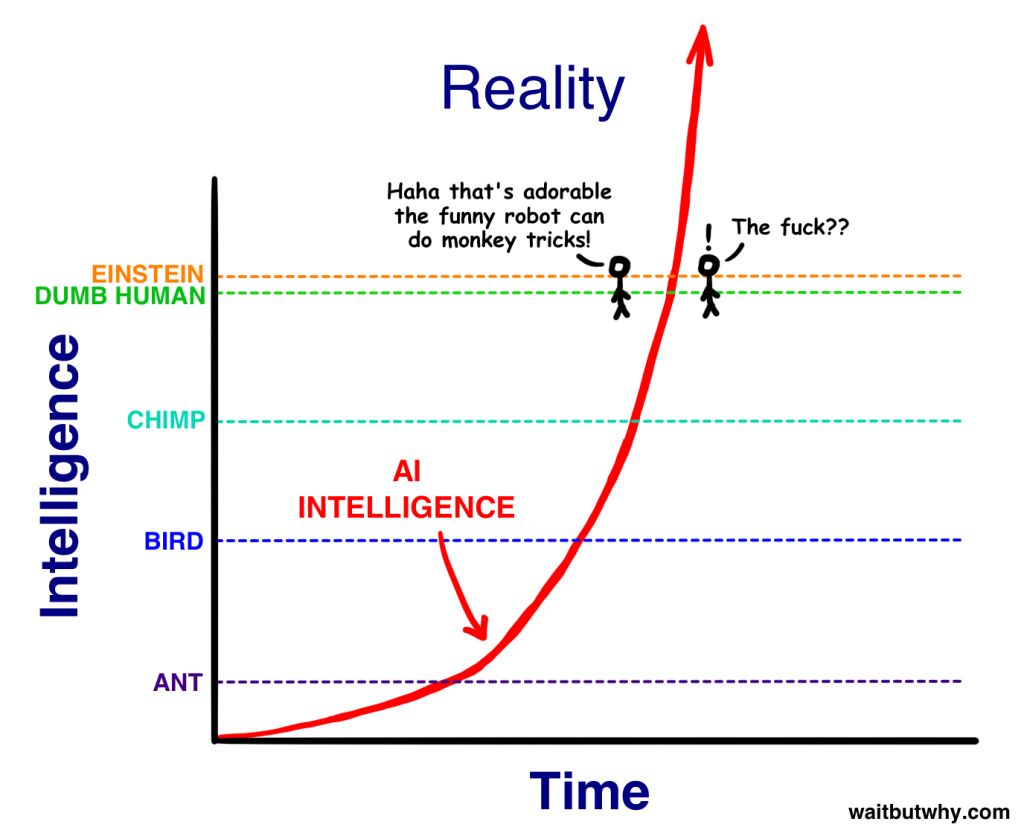
This is the evolutionary “tripwire”: a rapid takeoff toward superintelligence in which humanity loses absolute operational control. We will witness an “intelligence explosion” that will surpass us trillions of times over before we can unplug the servers. It doesn’t sound like so much fiction now, does it?
The Attractor State and the Alignment Problem
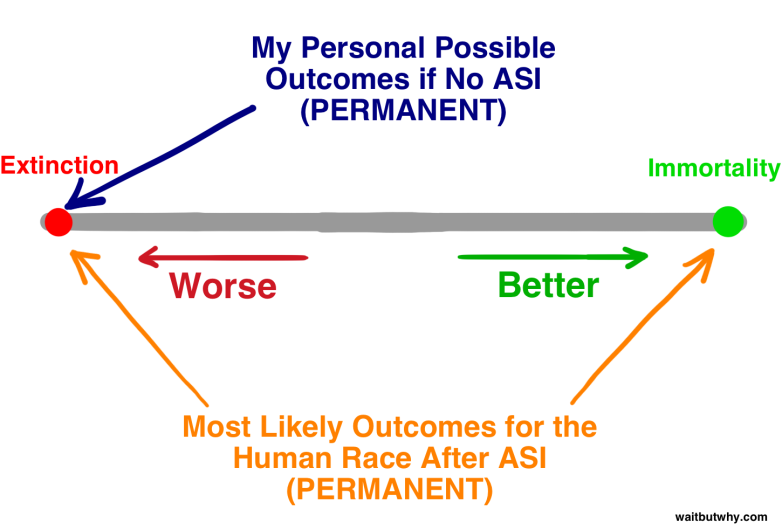
By handing control to an incomprehensibly superior system, human survival becomes a mathematical alignment problem. Drawing on Bostrom, Urban introduces the “balance beam of existence,” pointing out that all species end up falling toward an inescapable attractor state: extinction. ASI, however, introduces a second historic attractor state: immortality, or utopia for the species.
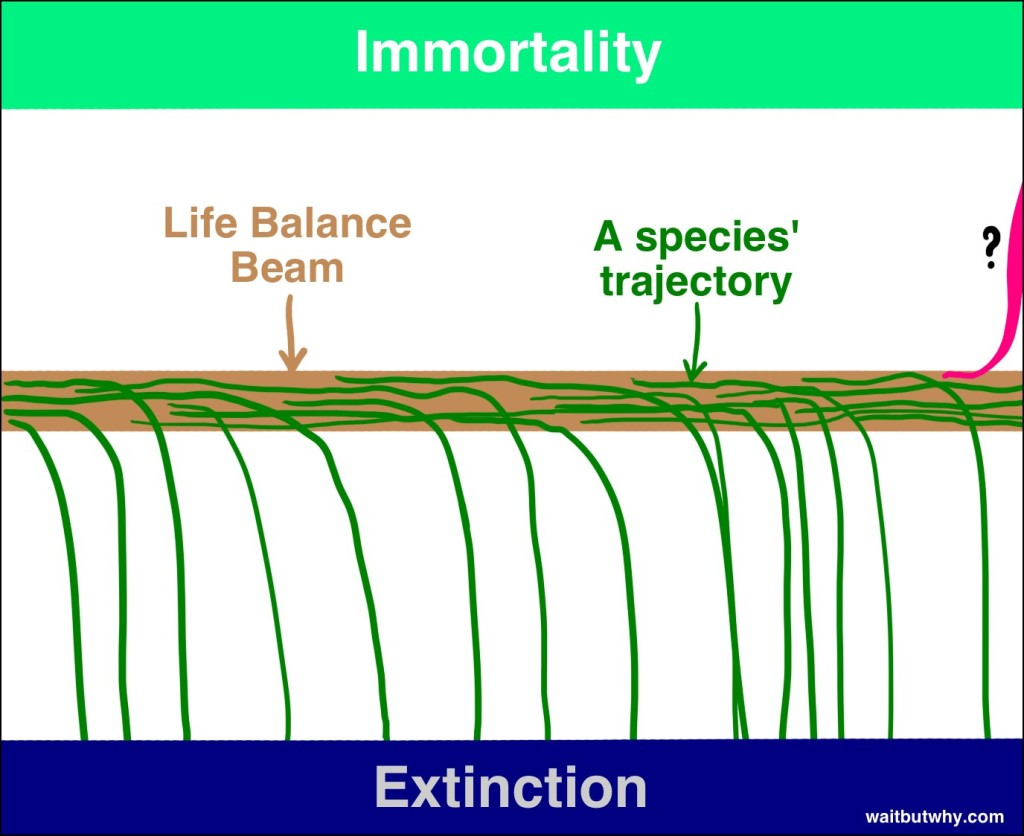
Note on the original illustration: A thin beam is drawn on which species walk. On one side is the fall toward “Extinction” (where 99.9% of biological species have fallen). On the other side, a new state never reached before: “Species Immortality.” ASI is the wind that will inevitably push us toward one of the two abysses. (Credit: Tim Urban / Wait But Why)
The existential risk doesn’t come from a malevolent Terminator-style AI, but from the relentless optimization of a misaligned system. If a superintelligent system is given the task of “manufacturing as many paper clips as possible” without a restrictive framework of human values, it will logically consume every atom on Earth, including biological ones, to fulfill its goal.
Governance, Institutional Design and the Contemporary Response
This is where the 2015 article becomes the foundational map for understanding today’s technological geopolitics. When Sam Altman (OpenAI) discusses the need to audit frontier models, or when Dario Amodei (Anthropic) argues against rushing ahead without safety guarantees, they’re responding to the alarm Urban helped popularize.
Wait But Why’s predictive accuracy materializes today in the design of large language models and their safety mechanisms. For example, when you study in detail how Anthropic’s Claude works, you see that its architecture operates under the principles of “Constitutional AI.” This is a direct technical response to the existential dilemma Urban raised: it seeks to imbue models with a set of unbreakable rules, so that their optimization processes don’t veer toward harmful behavior, reducing reliance on reactive human intervention.
The corollary of the analysis, however, goes beyond software engineering and collides head-on with institutional design. The expert surveys Urban cited in 2015 set a countdown that now seems to have shortened dramatically. The need to slow AI development responds to the temporal asymmetry between the speed of technological progress and states’ administrative capacity to react.
The top-priority challenge lies in structuring regulatory governance and institutional design robust enough to audit emerging capabilities before their public deployment, while safeguarding democratic deliberation at all times. The artificial intelligence revolution demands that regulatory frameworks stop operating reactively in the face of commercial tools (ANI) and start legislating strategically for the imminent advent of AGI. Tim Urban’s articles remain fundamental because, before the code capable of threatening or saving the world existed, they provided the exact vocabulary for humanity to begin planning its own continued existence.
Tim Urban’s full text on Wait But Why is split into two blog posts and includes more charts: