What happened
The dissolved organic matter that participates in the formation of deep waters in the Weddell Sea retains its molecular properties during this process, according to an article published on November 10, 2026 in Nature Communications. The discovery helps clarify how carbon enters an ocean reservoir that can keep it out of the atmosphere for centuries.
The authors studied the extractable fraction using solid phase. That delimitation matters: the results are not equivalent to exhaustively characterizing every organic compound in the ocean or all the processes that transport carbon to the bottom.
Why it matters
Antarctic bottom waters decrease in volume with climate change, and this modification can affect abyssal carbon storage. To evaluate its consequences, it is necessary to know both how much carbon is transported and what characteristics it has.
The work separates those two questions. That a molecular signature is preserved during deep water formation does not prove that the amount transported remains constant. This distinction avoids interpreting chemical stability as circulation stability. The evidence offers a reference to study future changes in a process that connects the continental shelf and the deep ocean, without resolving by itself the entire climate balance of that region.
The number
0.155 ± 0.03 petagrams of carbon per year. This is the estimate of transfer from Weddell to the Antarctic bottom water. The figure is equivalent to about 155 ± 30 million tons of carbon, a unit conversion of the reported value.
Context
About half of the Antarctic bottom water is formed in Weddell, according to the study. Platform processes alter little the signature of the exported organic fraction, possibly because long residence times favor its remineralization to inorganic carbon.
The dominant composition is established before dense shelf water mixes with warmer off-shelf waters. The result follows that physical and chemical sequence.
On related topics, Mamífero has also published carbon transport by marine snow, soil respiration and nitrogen deposition, Aerosols and radiation budget in East Asia and resilience measurements in changing systems.
What’s next
The authors expect that the molecular composition will be preserved even with the weakening of bottom water formation. It is an expectation about material characteristics, different from a guarantee about water volume or total carbon flux.
To study oceanic climate change it will be necessary to follow both magnitudes and check how they respond to new circulation conditions. The measurement provides a basis for that comparison. Also remember that a fraction obtained through an extraction procedure must remain identified when comparing data from different campaigns. Changing methods or reservoirs could prevent direct comparisons even if the same general expression for organic carbon is used.
Bottom line
The study better defines the signature of the carbon that Weddell sends at depth. Its molecular stability provides information about the formation process. The amount that continues to reach the bottom will also depend on circulation, which is precisely one of the variables exposed to climate change.
Sources
- Nature Communications, DOI 10.1038/s41467-026-79040-4; verified publication date in the journal, November 10, 2026. Summary and text of the article consulted. The magazine does not indicate publication time.
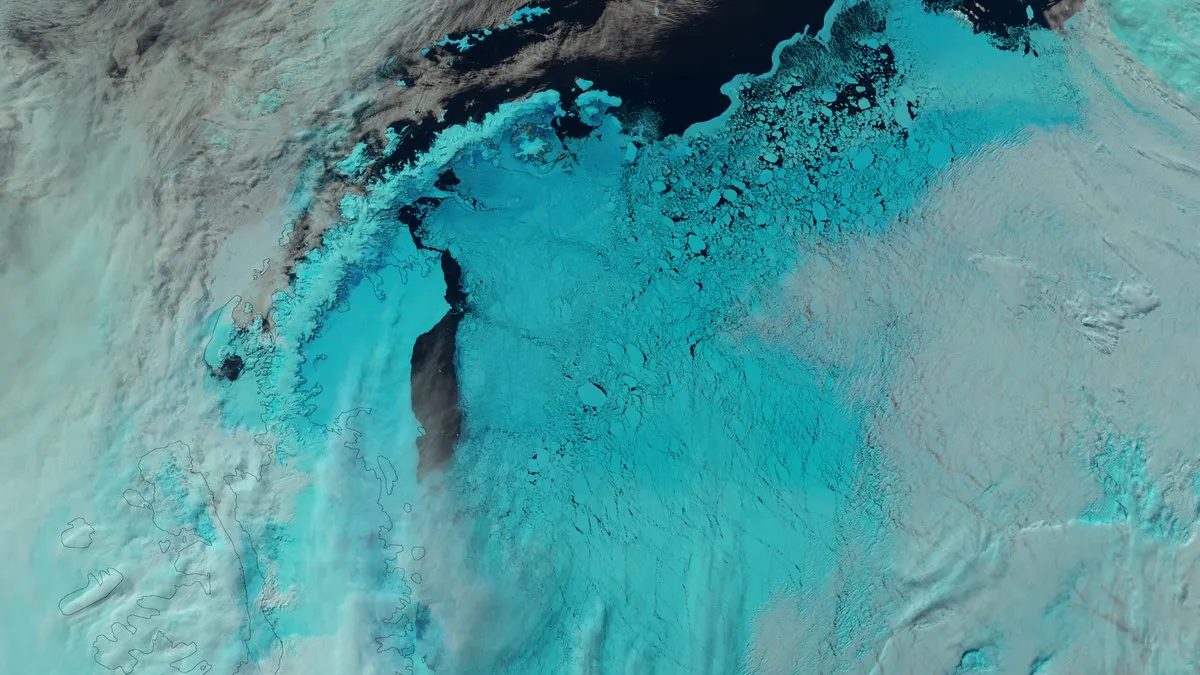
- Cover image: JPSS imagery: CSU/CIRA & NOAA/NESDIS, Public domain, via Wikimedia Commons. Cropped and resized to 1200 × 675 pixels. Reference photograph; it does not document the announced event.
Edited by Rodrigo Cornejo. How we select and verify: who writes these notes.