What happened
- The terms under which the big providers treat what you type into their chatbots are not the same, and free or personal accounts are often under different rules than business ones.
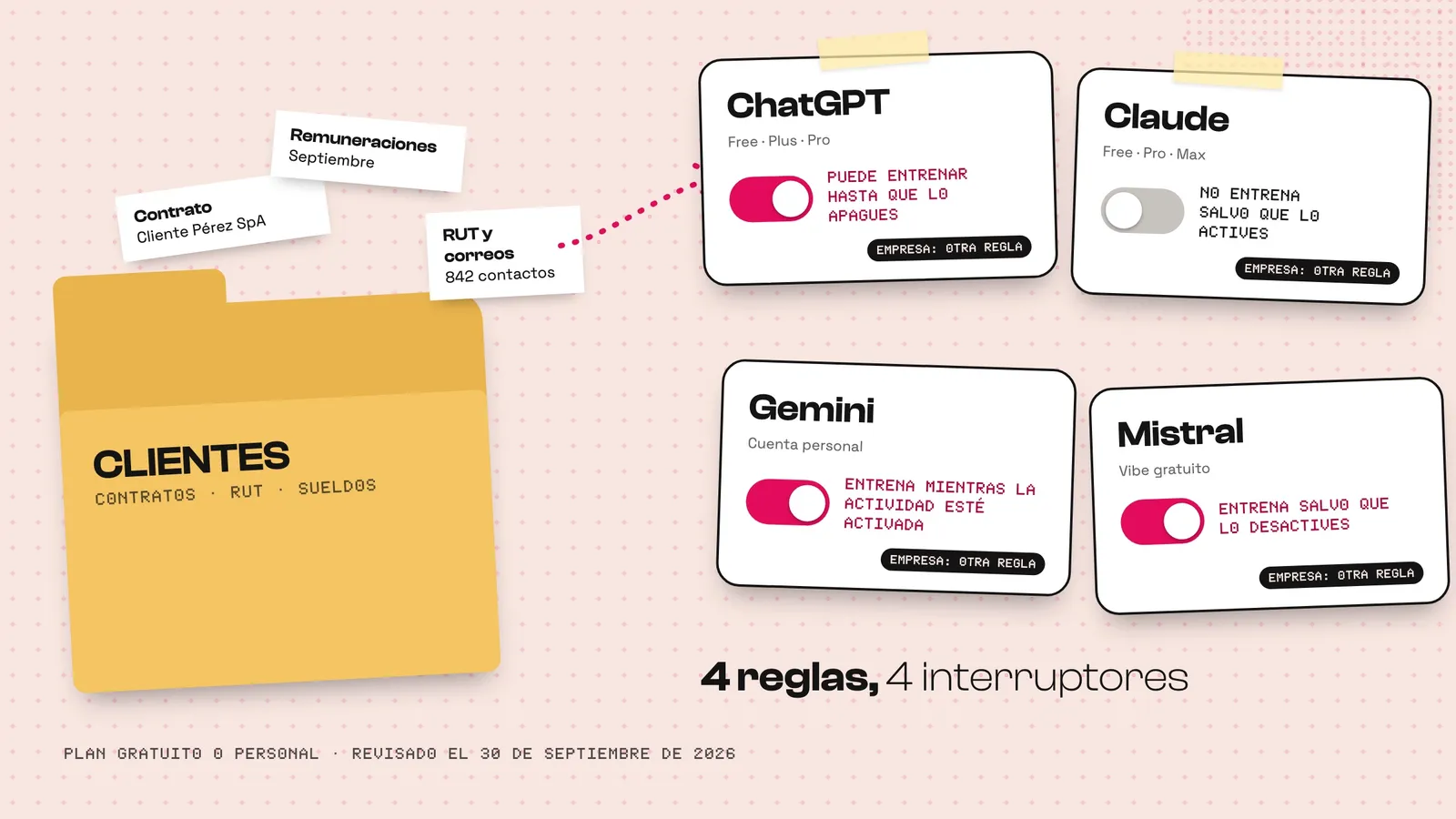
- ChatGPT. On Free, Plus and Pro, OpenAI may use your content to train models. You switch it off under Settings, Data controls, “Improve the model for everyone.” On Business, Enterprise, Edu and the API it is not used by default.
- Claude. On Free, Pro and Max, Anthropic does not train on your chats unless you turn on the model-improvement option under Privacy. Incognito chats are not used even if it is on. Commercial products, such as Claude for Work, the API and Enterprise, follow a separate policy. The page was updated on March 16, 2026.
- Gemini. While Gemini Apps activity is on, Google uses chats to train its models. Those reviewed by people are kept for up to three years, even if you delete your activity. Work or school accounts may have different terms.
- Mistral. On the free Vibe plan it trains unless you turn it off, as we reported in this note. Pro, Team, Enterprise, Studio and the paid API are excluded by default.
| Provider | Free or personal plan | Business plan | Where to switch it off |
|---|---|---|---|
| ChatGPT | May train on your chats | Business, Enterprise, Edu and API: not by default | Data controls |
| Claude | No, unless you turn it on | Separate commercial policy | Privacy |
| Gemini | Trains while activity is on | May differ on Workspace accounts | Gemini Apps activity |
| Mistral | Yes, unless you turn it off | Pro, Team and Enterprise: not by default | Admin panel, Vibe |
Why it matters
- A small business’s risk is rarely in the provider it signed with: it is in the personal account someone on the team uses to summarize a contract, a payroll spreadsheet or a client list. That material enters under the free plan’s terms, not the company’s.
- Four providers mean four toggles in four places. An internal policy that says “turn off training” is not enough if nobody knows where it is in each tool.
- Responsibility for the third-party data a file contains stays with whoever uploads it, not with the model provider. With the data protection law on its way, that point gets more delicate, as we explained in The law coming for you is not the one you’re watching and in the consequences of postponing it.
- A one-page policy is enough to start:
- Use company accounts, not personal ones, for anything that touches clients.
- Do not paste client national ID numbers, emails or phone numbers, contracts, payroll or credentials into a free chatbot.
- Check each tool’s training toggle and note who checked it and when.
The number
4 providers, 4 rules, 4 different places to switch training off.
Context
The terms change often, and the ones that count are those in force the day the tool is used. This comparison comes from each provider’s official pages, reviewed on September 30, 2026. Business plans do not by themselves deliver legal compliance: they only change the starting point of the contract.
What’s next
- None of the providers announced changes to these terms.
- The review is worth repeating whenever the company changes plan or tool.
Bottom line
What a team types into a chatbot is company data from the moment it is typed. The useful question for a small business is in which account, and who switched the toggle off.
This note describes terms of service published by providers and is not legal advice.
Sources
- OpenAI, How your data is used to improve model performance
- Anthropic, Is my data used for model training?
- Google, Gemini Apps Activity
- Mistral, Privacy and data controls
Written by Mamífero. Edited by Rodrigo Cornejo. See how we select and verify every note.