What happened
Teams at Fermilab, CERN and the Sanford Underground Research Facility began installing the steel structures of two cryostats from the DUNE experiment, according to a statement reproduced by The Quantum Insider on November 10, 2026. The vessels will house liquid argon to detect neutrinos underground in South Dakota.
The installation occurs almost a mile deep. Thousands of beams had to be moved from the surface to the assembly area. The announcement corresponds to works and infrastructure integration; the detectors and the long-distance beam still need to complete subsequent stages.
Why it matters
DUNE will combine facilities separated by 1,300 kilometers. A detector close to the source at Fermilab will measure the beam before travel; The distant detectors will allow us to study what happens to the neutrinos during the journey. For this they need a cryogenic environment that remains stable.
Cryostats are a material part of that challenge. It is not enough to excavate a space: they must hold enormous quantities of liquid at very low temperatures and allow the installation of instruments. The beginning of assembly shows that a planning and transportation phase becomes physical structures, although it does not mean that the experiment is ready to collect all the planned data.
The number
Approximately 17,000 tons of liquid argon per cryostat. This is the capacity indicated for each of the two containers. The steel provided for its structures totals more than 6,200 tons, according to the reproduced statement.
Context
CERN participates in design, planning, logistics and installation, in cooperation with a steel structural contractor. The DUNE collaboration brings together more than 1,500 researchers, according to the same source.
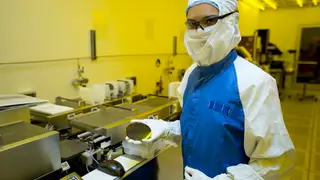
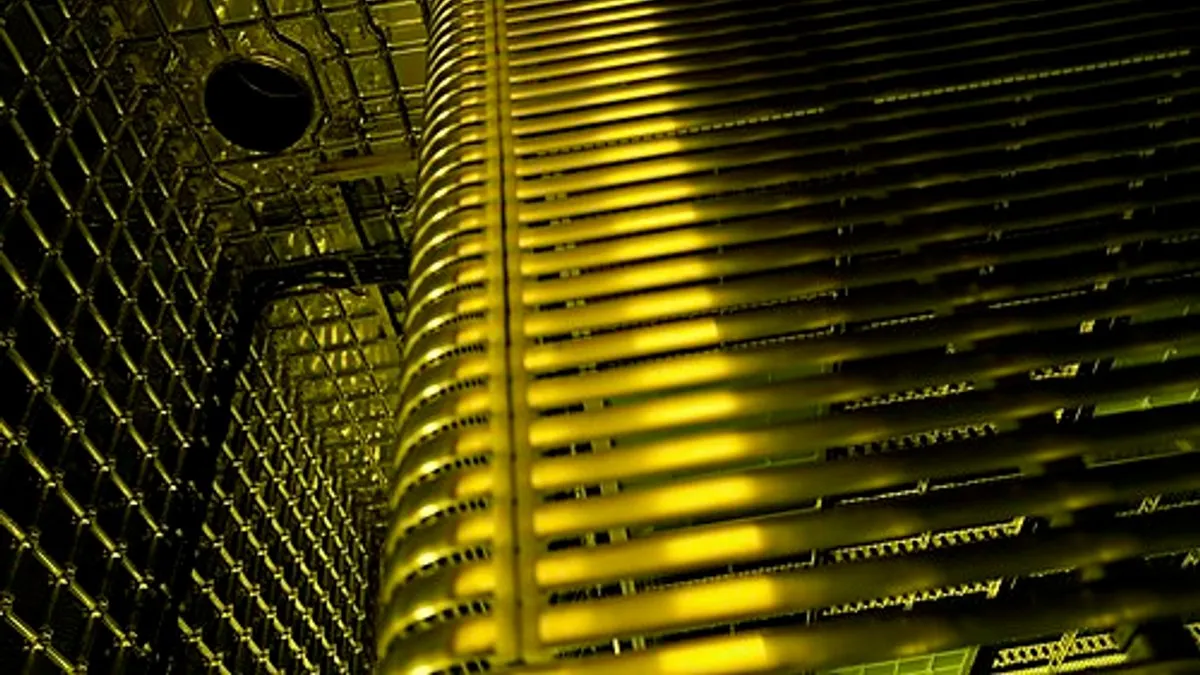
ProtoDUNE’s experience was used to develop and test technologies that will be used in the distant modules. The photograph in this note corresponds to that prototype environment, not the current state of the underground assembly in South Dakota.
On related topics, Mamífero has also published a source of single photons from silicon, Toshiba’s quantum networking development, electrical noise measurements in a cuprate and a review on quantum effects in proteins.
What’s next
The communicated calendar places the completion of the underground infrastructure in 2029, the installation of detectors in 2030 and the beginning of the long-distance beam in 2031. These are planned dates and should be read as milestones of a project in development.
The assembly will allow specific problems of scale to be followed: installation sequence, transportation of parts and coordination between teams working underground. Next will come cryogenic integration and instrumentation. None of these stages can be considered completed from the beginning of the structures. Project monitoring needs to distinguish the progress of the works from the availability of the scientific instrument.
Bottom line
DUNE begins to build the vessels that will make its distant measurements possible. The news is an infrastructure milestone, with capacities and deadlines defined in the statement. The results on neutrinos will come when that facility, its detectors and the beam can work together.
Sources
- The Quantum Insider, identified reproduction of the statement of Fermilab and CERN, November 10, 2026. The full reproduction of the statement, dated November 10, was consulted. A publication time for the original could not be confirmed.
- Cover image: Markbenecke, CC BY-SA 4.0, via Wikimedia Commons. Cropped and resized to 1200 × 675 pixels. Reference photograph; it does not document the announced event.
Edited by Rodrigo Cornejo. How we select and verify: who writes these notes.