What happened
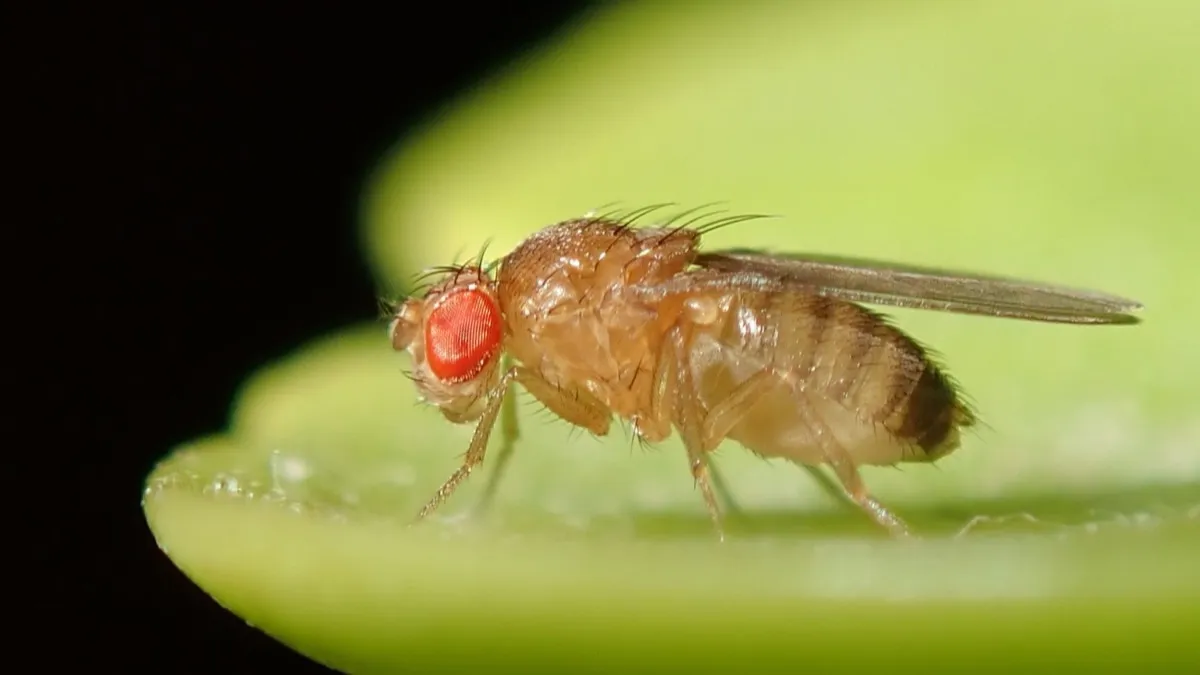
- A team from the University of Washington and the Allen Institute for Brain Science in Seattle published on 28 October 2026 in Nature the identification of a three-neuron circuit that generates the leg rhythm of a walking fruit fly.
- The researchers built dynamic simulations of the connectomes, the complete maps of neural connections, of the Drosophila ventral nerve cord, the fly’s equivalent of the spinal cord.
- A computational screen of neurons descending from the brain picked out DNg100, a known command neuron for walking, as the strongest driver of rhythmic leg activity.
- Pruning the simulated network left a minimal circuit of one inhibitory and two excitatory neurons, necessary and sufficient to produce motor rhythm in all six legs.
Why it matters
- Walking relies on central pattern generators: circuits that produce a rhythm without receiving a rhythmic input. The structure of such a circuit for walking was not known in any animal.
- The result held across four different connectome datasets, which lowers the chance that it is an artefact of a single map.
- The simulations predicted that another descending pathway, DNb08, also drives rhythmic leg movements. The team confirmed it with optogenetics, activating those neurons with light in behaving flies.
The number
3 neurons. One inhibitory and two excitatory neurons make up the minimal circuit that sets the rhythm in all six legs.
Context
Fruit fly connectomes have been completed in recent years and allow hypotheses about circuits to be tested before going into the lab. Mamífero reported how a map of 166,691 neurons from a fly ended up playing video games online. This work uses those maps for a basic biology question.
The link between genes, circuits and behaviour is a recurring theme: an ancient retrovirus switched off a brain gene in chimpanzees, more cells with two X chromosomes soften Turner syndrome in the brain and, in humans, the arrival of electricity cut sleep in Qom communities.
What’s next
- The identified circuit is “putative”: simulations point to it and one experiment confirmed a prediction, but the activity of the three neurons has yet to be recorded directly during walking.
- The authors suggest the same circuit may drive other rhythmic leg movements, such as grooming.
- If vertebrates have a similar organisation, the finding will guide the search for walking circuits in the spinal cord.
Bottom line
Walking looks automatic, and in part it is: three neurons are enough to set the rhythm in the fly. The work also shows a method. With a complete map of the nervous system, researchers can simulate first and experiment afterwards, with sharper questions.
Sources
- Pugliese, S. M., Chou, G. M., Abe, E. T. T. et al., “Connectome simulations identify a central pattern generator for fly walking”, Nature, 28 October 2026, DOI 10.1038/s41586-026-11195-y
- Cover image: Alexis, CC BY 4.0, via Wikimedia Commons
Edited by Rodrigo Cornejo. How we select and verify: who writes these notes.