What happened
- The Korea Institute of Machinery and Materials (KIMM) opened the “AI Humanoid Data Factory” on 3 November 2026, a centre that collects data from humanoid robots as they perform real tasks in order to train AI models.
- The facility was built by the research group on self-growing humanoids led by Dr Chan Hun Park, together with the Electronics and Telecommunications Research Institute (ETRI).
- It is Korea’s first centre dedicated to producing data for bipedal humanoids. It can record everything from arm and leg movements to full-body tasks.
- It currently runs 12 robots. People operate them remotely while their movements and task information are recorded.
Why it matters
- The models that control robots need large amounts of data from physical tasks, and that data cannot be downloaded from the internet like text.
- With this centre, Korea can produce and accumulate its own humanoid task data. KIMM expects this to reduce dependence on foreign data and models.
- The cycle is iterative: data trains a model, the model is tested on physical robots and what those tests generate is fed back into training.
The number
12. That is the number of humanoid robots the data factory starts with. KIMM plans to gradually expand both the number of robots and the range of tasks.
Context
At the opening ceremony, several robots showed how data is collected from everyday tasks, such as taking items out of a fridge, handling laundry and tidying a sofa, and from industrial tasks, such as operating buttons and levers inside a vehicle. KAIROS, a Korean-developed humanoid, was also shown doing precise object manipulation and imitating full-body movements. The goal is to train models that understand human instructions and their surroundings and can be applied to different platforms, including the K-Humanoid standard platform.
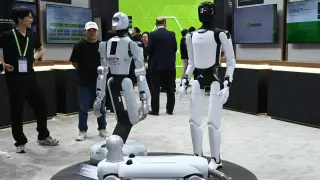
Robotics and its data are a topic Mamífero follows. We reported that NVIDIA puts agents inside the robot and turns them into reusable skills and that Alphabet released its robotics base under an Apache licence. Also that Reliable Robotics raised US$115 million and reached a US$1 billion valuation and that a microdrone weighing under a gram flew untethered for more than four minutes.
What’s next
- KIMM will add robots and tasks to data collection.
- The trained models will be tested on physical robots and on the K-Humanoid platform.
- The stated goal is for robots to carry out tasks autonomously from human instructions.
Bottom line
Korea is betting that the humanoid race is won with its own data from physical tasks. Its factory starts with 12 robots run by people; the value lies in what gets recorded from every movement.
Sources
- Korea Institute of Machinery and Materials, “Korea opens its first AI humanoid data factory”, release on EurekAlert, 3 November 2026, eurekalert.org
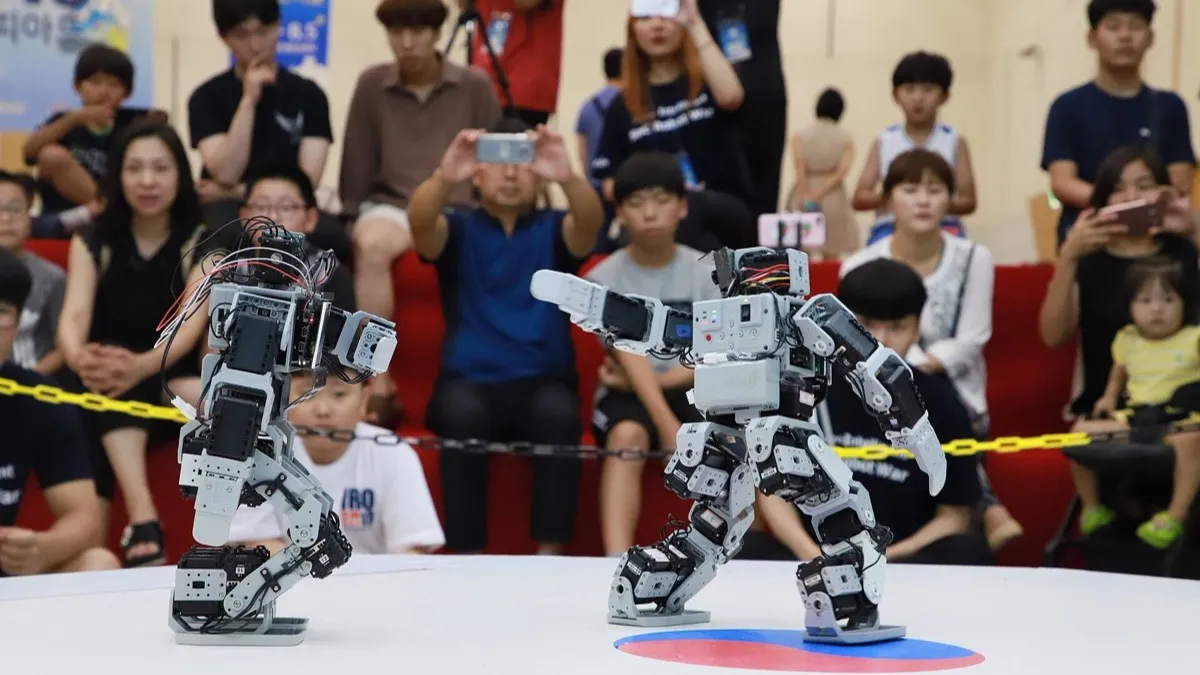
- Cover image: Alexey82kr, CC BY-SA 4.0, via Wikimedia Commons
Edited by Rodrigo Cornejo. How we select and verify: who writes these notes.