What happened
- Fifteen researchers, with Snodgrass, Li, Mambakkam and Medina-Muñoz among the authors, published on 4 November 2026 in PNAS an analysis of the relationship between maize genetic diversity and human linguistic diversity in its centre of origin.
- They used publicly available genotyping and passport data from about 2,000 traditional maize varieties, more than 500 whole genomes of people from Mexico and indigenous linguistic maps.
- Maize neither survives nor disperses without farmers, which makes it a useful case for measuring the human effect on a species’ diversity.
- The main result: maize shows very little overall structure, which the authors read as a sign of how effectively indigenous farmers moved and mixed its populations.
Why it matters
- It is a way of measuring, with data, the role of indigenous communities in conserving and circulating a crop that feeds much of the world.
- For seed banks, loosely structured diversity means varieties do not group cleanly by region or by people.
- The work separates two things that are often conflated: what geography explains and what culture explains.
The number
About 2,000 varieties. That is the number of traditional maizes analyzed, alongside more than 500 human genomes from Mexico, a combination that allows both diversities to be compared on the same map.
Context
The principal components of maize diversity do show correlations with human genetic diversity. However, when modelling the relationship linearly, the authors find little additional effect of human population structure beyond shared geography: if two communities are close, their maizes resemble each other, with no need to invoke cultural identity.
Locally, by contrast, differences in maize do appear patterned by language, although at larger spatial scales the genome-wide effect is weak. Despite that faint global signal, language-based association analyses, FST outliers and selection scans identified genome regions linked to specific languages.
At Mamífero we follow crop biology. We reported that more than 400 designed enzymes degrade plastic and that an excess of poorly digestible sugars eases Salmonella infection. Also that nitrogen falling on grasslands destabilizes their production and that Cerrado soils hold carbon that markets ignore.
What’s next
- The genome regions associated with specific languages remain as leads for selection studies.
- The method can be applied to other crops that equally depend on farmers to disperse.
- What this diffuse structure implies for conserving local varieties has yet to be seen.
Bottom line
Mesoamerican maize looks more like a network than a mosaic of compartments. Behind that mixing lie centuries of farmers exchanging seed across language boundaries.
Sources
- Snodgrass, Li, Mambakkam, Medina-Muñoz et al., “Maize genetic diversity is largely unstructured by human ethnolinguistic diversity in its center of origin”, PNAS, 4 November 2026, DOI 10.1073/pnas.2603915123. This note is based on the paper’s abstract.
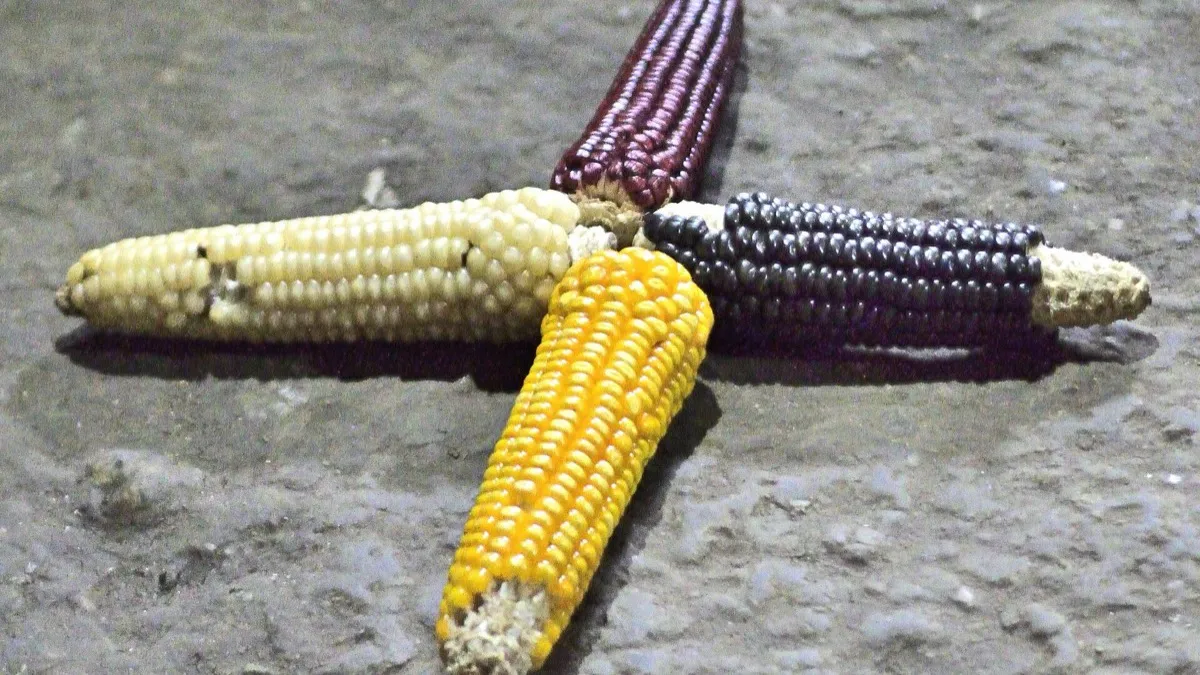
- Cover image: Ricardo Plantard, CC BY-SA 4.0, via Wikimedia Commons
Edited by Rodrigo Cornejo. How we select and verify: who writes these notes.