What happened
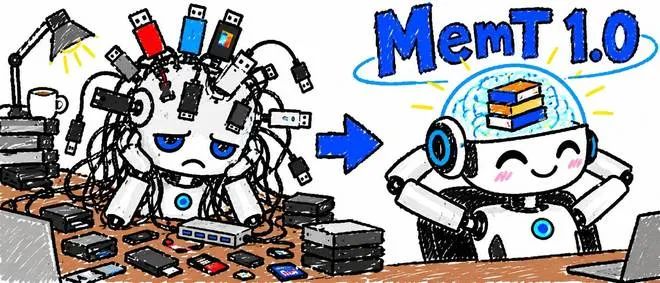
- A paper published on October 20, 2026 presents MemT-1.0, a model family that builds memory into its architecture. The paper is listed as arXiv 2610.26825.
- There are two sizes: Nano, with 36 billion parameters (3 billion active) and dynamic memory of 10 million, and Flash, with 288 billion (17 billion active) and dynamic memory of 336 million.
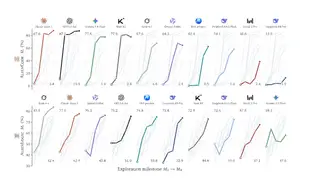
- On 11 memory benchmarks, Flash averages 50.6 points and Nano 47.0. The authors rank them first and second among parametric memory methods, those that store history in the model’s weights.
- With 128,000 tokens of history, Nano cuts per-trajectory storage about 66 times and speeds up inference 1.86 times, compared with a full KV cache.
Why it matters
- An agent that works for days with a company accumulates history. Storing it as text and rereading it at every step consumes tokens, which is what gets billed. The proposal attacks that cost at the source.
- The paper’s text admits a limit worth reading: textual memory systems still score higher on long-history tests, such as LongMemEval-S and BEAM-1M. The advantage is efficiency, not accuracy.
- For an SME evaluating an assistant with memory, the useful question is what is lost by compressing. A history stored in weights cannot be read, audited or deleted as easily as a text file, which matters if personal data is involved.
The number
66 times. Reduction in per-trajectory storage of the Nano model versus a full KV cache, with 128,000 tokens of history.
Context
Agent memory had already been showing cracks. A training-free method raised the reward of agents that lose their reasoning as context grows, and LongHarness measured how much each long-context harness costs. MemT tries to solve the same problem by changing the model, not the setup around it.
What’s next
- The text does not say whether the weights and code will be released, or under what license.
- No dates announced. An outside replication of the 11 benchmarks will decide how much of the figure survives.
Bottom line
Agent memory continues to be solved on two fronts: more finely tuned harnesses outside, or models that remember inside. MemT bets on the second, and leaves text systems as the reference in the long tests.
Sources
Edited by Rodrigo Cornejo. How we select and verify: who writes these notes.